
Better Hip Mobility Starts With Moving Like Your Glutes Actually Work
2026-10-7
Most hip mobility routines look the same: a lunge stretch, a pigeon pose, maybe a 90/90 transition. They’re not useless, but they share a blind spot. They tend to train the hip one plane at a time, often while the body is supported, still, and disconnected from everything else.
Your glutes don’t work that way. They extend the hip, rotate it, and control it side to side, often within a single step. Hip mobility that holds up in real life has to be trained the same way, through all planes of motion, with the kinetic chain and core stability involved from the start. That’s the thinking behind four drills we use in Myofascial Integrated Movement.
Why All Three Planes Matter for the Glutes
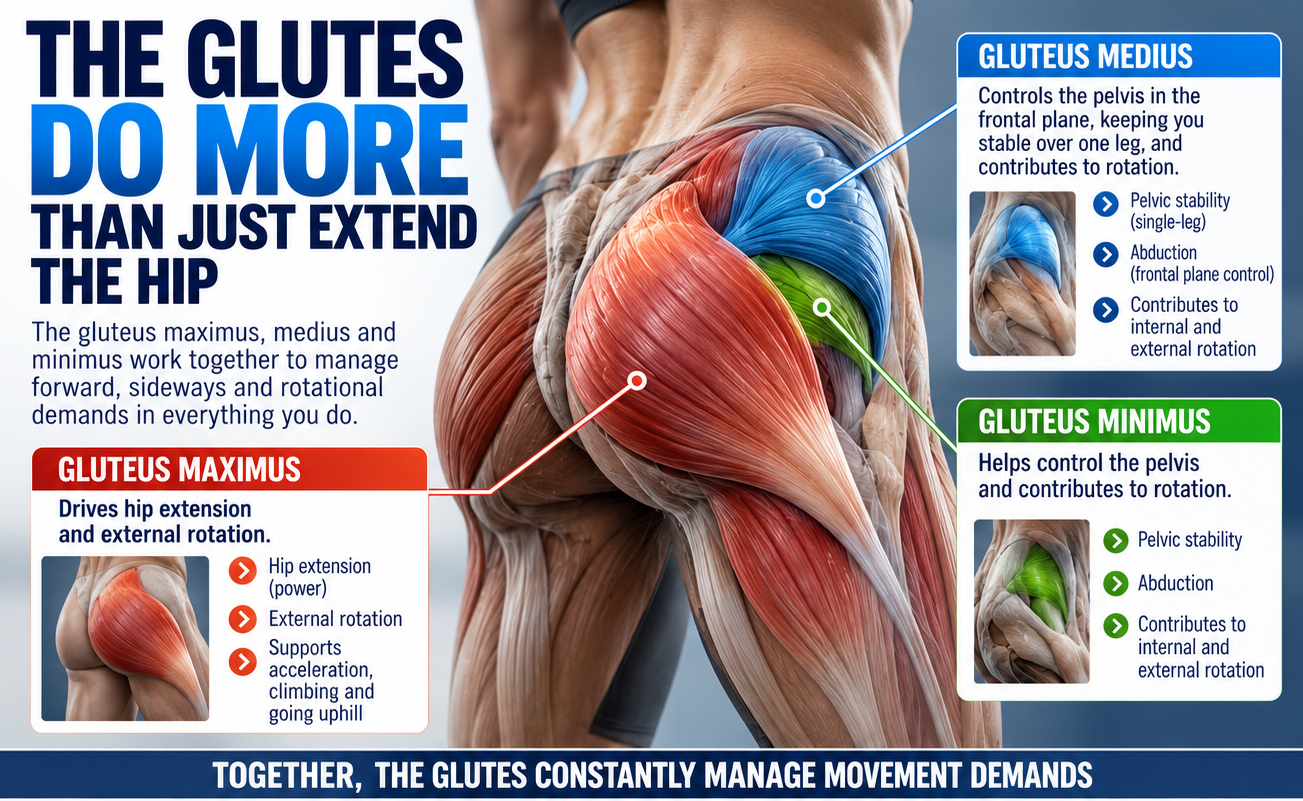
The glutes aren’t one muscle doing one job. The gluteus maximus drives hip extension and external rotation. The gluteus medius and minimus control the pelvis in the frontal plane, keeping you stable over one leg, and contribute to rotation too. Together they constantly manage forward, sideways, and rotational demands during walking, running, and changing direction.
Train hip mobility only in the sagittal plane and you’re preparing only part of what the glutes do. Usable mobility means controlling the hip through its range in every direction while the rest of the body works around it.
Yang Style Forward Walking With a Medicine Ball
Slow, deliberate forward walking sounds almost too simple, but holding a medicine ball changes the task. The load shifts your center of mass, so each step requires a controlled weight transfer over the stance leg, with the hip extending, rotating, and stabilizing in sequence. At that pace there’s no momentum to hide behind, so you feel exactly where the hip is and isn’t moving well.
The ball also gives the upper body something to organize around, encouraging the trunk and pelvis to coordinate through the step. That’s the kinetic chain doing its job.
Lateral Medicine Ball Walking With Silk Reeling
Frontal-plane movement is where many hips are undertrained. Lateral walking asks the gluteus medius and the hip’s adductors to control the pelvis as weight shifts side to side. Adding silk reeling, the spiraling, rotational movement pattern , layers rotation on top of that lateral shift.
Now the hip is moving and stabilizing in two planes at once, while the medicine ball connects the arms, trunk, and legs through a continuous, spiraling pattern. It’s far closer to how the hip works when you cut, sidestep, or catch yourself than a standard banded side step.
Parting Hands With Forward Step and Return Using Mobility Balls
Parting hands is a classic tai chi movement, and pairing it with a forward step and return pattern using our Mobility Balls turns it into a rich hip and trunk drill. As the hands part, one leg steps forward into a staggered stance, asking the lead hip to flex, accept weight, and stabilize while the trailing hip extends and controls the return. Stepping back out reverses the demand, so the hips work through flexion, extension, and rotation within a single repetition rather than one isolated motion.
The Mobility Balls add sensory feedback through the hands as the step and reach happen together, giving the nervous system a clearer picture of position and control. That matters because mobility isn’t just range, it’s the brain trusting the hip to move there, and it’s more willing to do that while the body is actively stepping rather than standing still.
Bow Side Stance Silk Reeling Cable Press
This one brings strength and mobility together. From a bow stance, a staggered position with weight loaded into the front leg, the cable press forces the core to resist rotation and lateral pull while silk reeling spirals force through the hips and trunk.
The result is hip mobility under real load and tension. The glutes are working to stabilize and drive the movement, the core is managing the cable’s resistance, and the whole system is coordinating to transfer force from the ground, through the hips, and out through the press. That’s the kinetic chain working as one unit instead of a stack of separate parts.
Find out SO much more in our Myofascial Integrated Movement online certification and save 30% for a limited time with code “mim30” HERE
Why This Approach Holds Up
None of these drills isolate the hip. Each asks it to move through multiple planes while the core stabilizes the trunk and the rest of the chain participates. That has practical advantages over static, supported stretching:
It trains mobility in positions that look like real movement, so the range carries over instead of staying theoretical.
It builds strength and control at the end of available range, where people tend to feel unstable or restricted.
It lets the nervous system practice new range under coordination and load, which often makes mobility gains stick.
Traditional hip stretching still has value. But if you want mobility that shows up when you walk, turn, step sideways, or push against resistance, train it the way the glutes function: in every plane, connected to the whole body, and supported by a core that knows how to stabilize.
Your hips were never meant to move alone. Train them like they don’t have to.
Featured in





© 2026 Ultimate Sandbag Training. Site by Jennifer Web Design.