Enjoyed Thanksgiving? You Don’t Need to Feel Guilty About It!

Thanksgiving should be a time to enjoy family, friends, traditions, and yes, FOOD! Yet every year, we see the same messages throughout the fitness industry.
How to burn off your Thanksgiving dinner. How many calories are in your favorite holiday foods. How to avoid gaining weight. Why you need to get back on track immediately.
It’s almost as though enjoying a holiday meal is something we should feel guilty about.
But here’s something I’ve learned after more than three decades of coaching people: the guilt we attach to eating and exercise can become a bigger obstacle to long-term success than the occasional indulgence itself.
And there’s some fascinating research explaining why.
The Surprising Science of Guilt and Eating
One of my favorite studies on this topic was published in the journal Appetite in 2014.
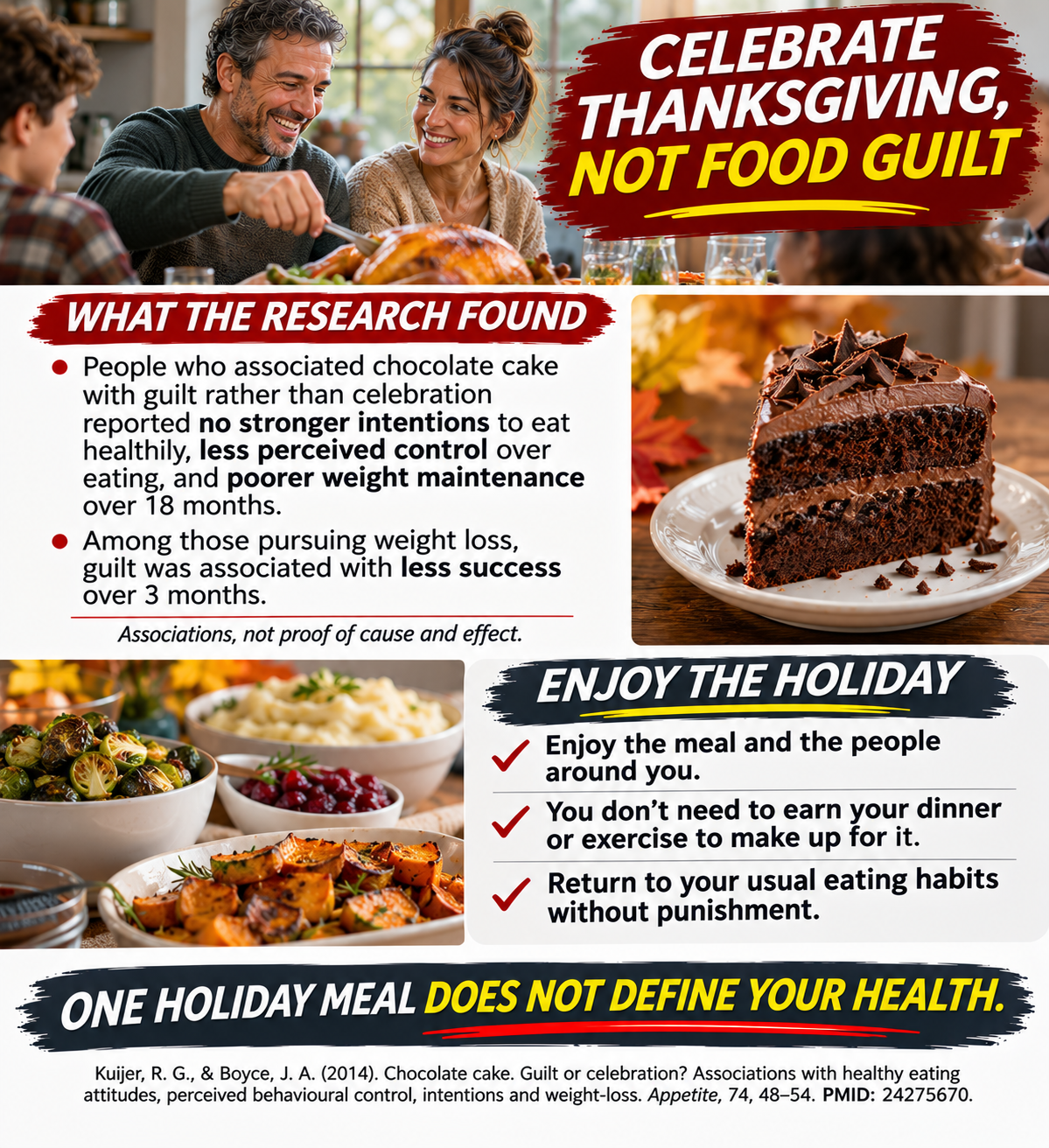
Researchers Kuijer and Boyce examined how people associated eating chocolate cake with either guilt or celebration.
Interestingly, people who associated chocolate cake with guilt didn’t demonstrate stronger intentions to eat healthfully. Instead, they reported feeling LESS control over their eating and were less successful with weight management over time.
The studychallenges the popular belief that feeling bad about eating something enjoyable helps us make healthier choices.
Think about how often we experience this.
You enjoy Thanksgiving dinner, have another serving of stuffing, and finish with a piece of pumpkin pie.
The next morning, instead of remembering a wonderful evening, you tell yourself you’ve ruined your progress.
Suddenly, one enjoyable meal becomes evidence that you lack discipline.
But did you actually fail at anything?
Why Beating Yourself Up Can Backfire
Psychologists have studied something sometimes called the what-the-hell effect, where people who believe they’ve broken their dietary rules may abandon restraint and continue eating beyond what they intended.
In a 2007 experiment, researchers Adams and Leary examined whether self-compassion could change this response.
Participants who received a brief self-compassion intervention experienced less distress, and highly restrictive eaters showed less subsequent eating after consuming a food they considered unhealthy.
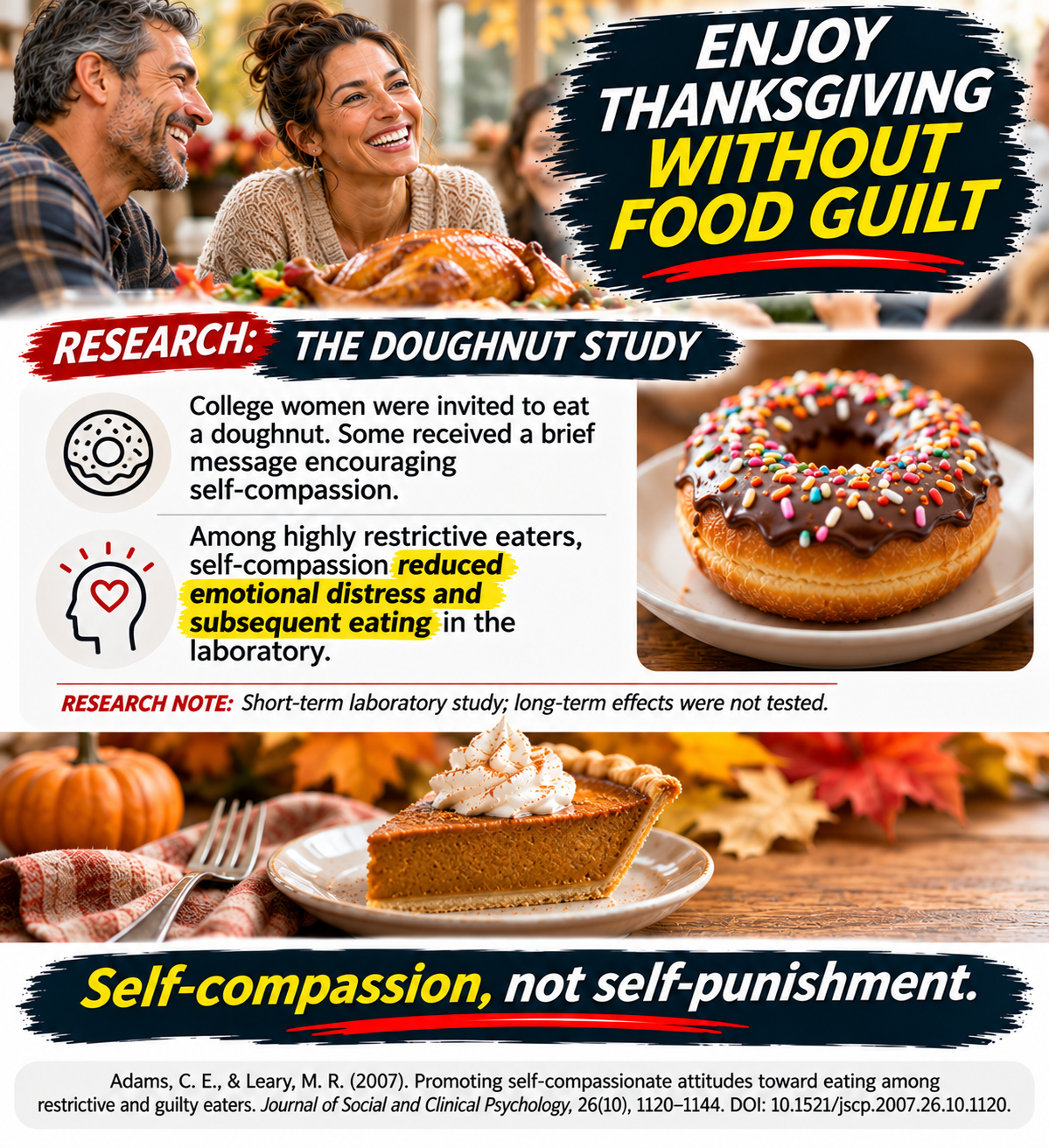
In other words, treating yourself with understanding rather than criticism may help interrupt the cycle of guilt and overeating.
This doesn’t mean self-compassion automatically improves everyone’s eating habits. But it suggests that shame and harsh self-judgment aren’t necessary ingredients for behavior change.
You can recognize that you ate more than usual without deciding you’ve done something wrong. You can enjoy dessert without believing you need to earn it through exercise. And you can return to your normal eating habits without punishment.
Consistency Matters More Than a Perfect Day
One of the biggest misconceptions about health is that success depends on getting every decision right. But our health behaviors develop over weeks, months, and years, not from one Thanksgiving dinner.
A 2024 systematic review and meta-analysis examining health-related habit formation found that developing habits often takes months, with considerable variation between individuals.
Importantly, repetition, personal choice, and consistent routines influenced habit development.
More recently, a 2026 systematic review and meta-analysis involving over 6,000 participants found that consistency in exercise routines was associated with physical activity habits and behavior.
The lesson isn’t that we must follow rigid schedules.
It’s that repeatedly returning to supportive behaviors matters more than expecting ourselves to perform them perfectly.
One holiday meal doesn’t erase months of nutritious eating.
One missed workout doesn’t eliminate the strength you’ve developed.
And one weekend of enjoying yourself doesn’t mean you need to start over.
View this post on Instagram
The Same Lesson Applies to Exercise
This is where the research becomes especially interesting.
A 2024 longitudinal study following 654 adults found that greater self-compassion predicted later physical activity, partly through improved confidence in overcoming exercise barriers.
Think about what that means.
People who approach their struggles with greater understanding may feel more capable of navigating obstacles rather than viewing them as personal failures.
That’s incredibly relevant during the holidays.
Maybe you missed your usual workout because you were traveling. Perhaps your schedule changed, you slept later, or you simply wanted to spend time with family.
None of those situations requires punishment.
You don’t need an exhausting workout to compensate for Thanksgiving dinner.
You don’t need to skip meals the next day.
You don’t even need a special holiday recovery plan.
You can simply return to the habits that were supporting you before the holiday.
View this post on Instagram
Enjoying Food Is Part of a Healthy Life
Nutrition isn’t just about calories, protein, vitamins, and minerals.
Food is also connected to culture, relationships, memories, and enjoyment.
A sustainable approach to nutrition should make room for those experiences rather than treating them as obstacles to overcome.
Of course, nutritional needs vary, and some people must consider specific medical conditions or dietary restrictions.
But for most people, enjoying Thanksgiving foods doesn’t require guilt or a dramatic change in their normal routine.
If you ate more than usual, that’s okay.
If you enjoyed a second dessert, that’s okay too.
Your next meal can simply be another opportunity to eat in a way that supports your health.
The Most Important Thing to Remember
The real goal of fitness and nutrition isn’t to become someone who never misses a workout or never eats something simply because it tastes wonderful.
It’s to develop habits flexible enough to support your health while allowing you to enjoy your life.
That’s why we emphasize consistency, adaptability, and self-compassion in our DVRT approach.
You don’t need to be perfect to make meaningful progress.
You don’t need guilt to motivate healthier choices.
And you certainly don’t need to spend the day after Thanksgiving trying to undo the day before.
Enjoy the holiday. Appreciate the people around you. Eat foods you love. Then return to the habits that help you feel your best.
Because a healthy relationship with fitness and nutrition should make your life better, not give you more reasons to feel bad about yourself.
We have great strategies in our person oriented programs HERE and workout programs HERE with 35% off. Also save BIG only a couple of more days with code “holiday” HERE
View this post on Instagram