Fascia: What’s Actually True, What’s Marketing, and Why It Matters for Strength Training

Somewhere along the way, fascia went from “that stringy white stuff on a chicken breast” to the internet’s favorite explanation for literally everything. Tight hips? Fascia. Mystery shoulder pain? Fascia. Can’t touch your toes? You guessed it, fascia. If social media is to be believed, this tissue is secretly running your entire body while your brain just takes credit.
It’s time to sort out what the research actually supports, what’s marketing hype, and why training fascia intelligently, genuinely matters for strength, resilience, and performance.
First, What Fascia Actually Is
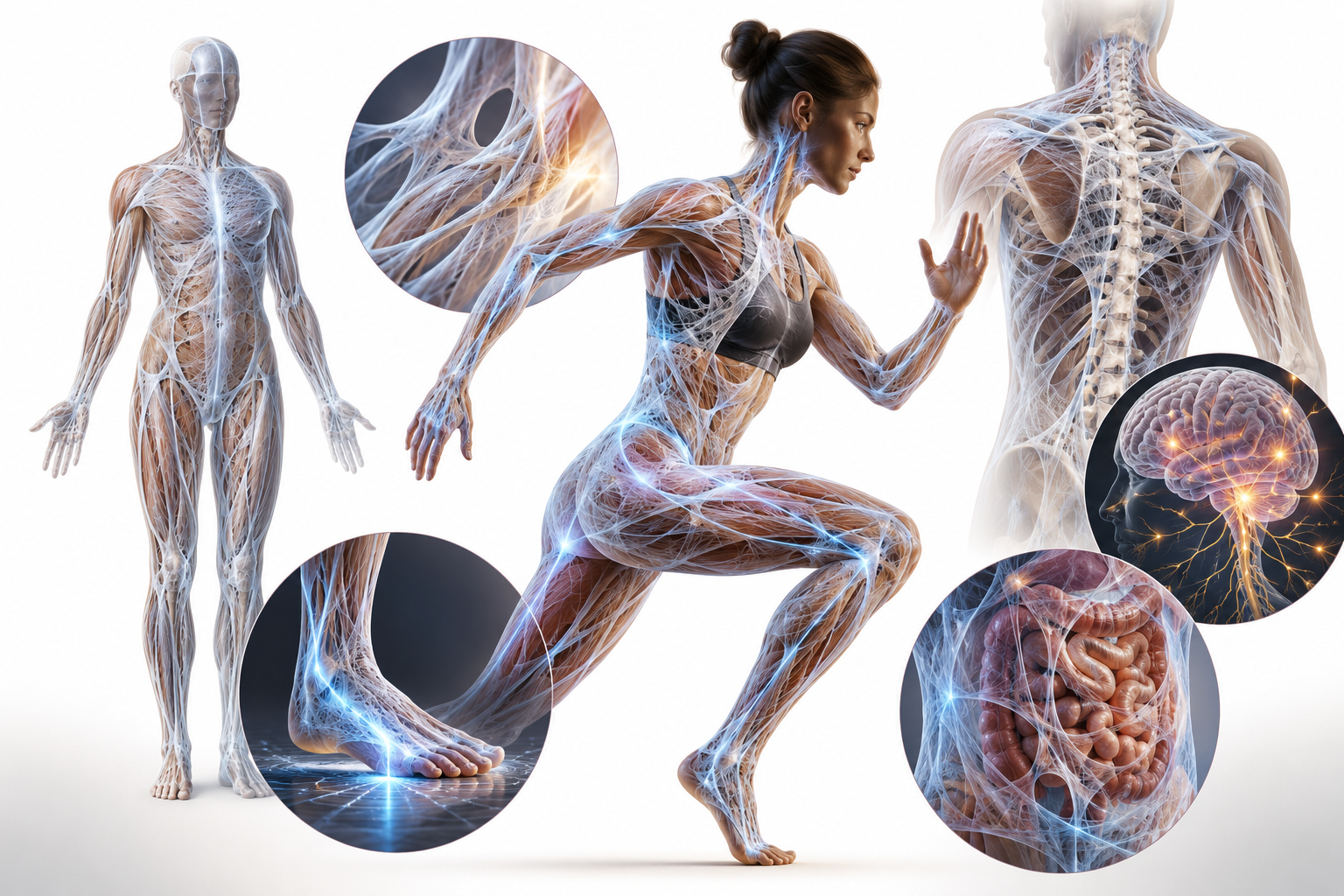
Fascia is connective tissue, roughly 70% water, with the rest made up mostly of collagen and elastin fibers, wrapping around and connecting muscles, organs, and bones into one continuous network. It’s a real, biologically active tissue involved in movement, force transmission, and proprioception. What it isn’t is some mystical master controller silently pulling the strings behind every ache you’ve ever had. That job still belongs to your brain and nervous system.
What Is Foam Rolling Actually Doing?
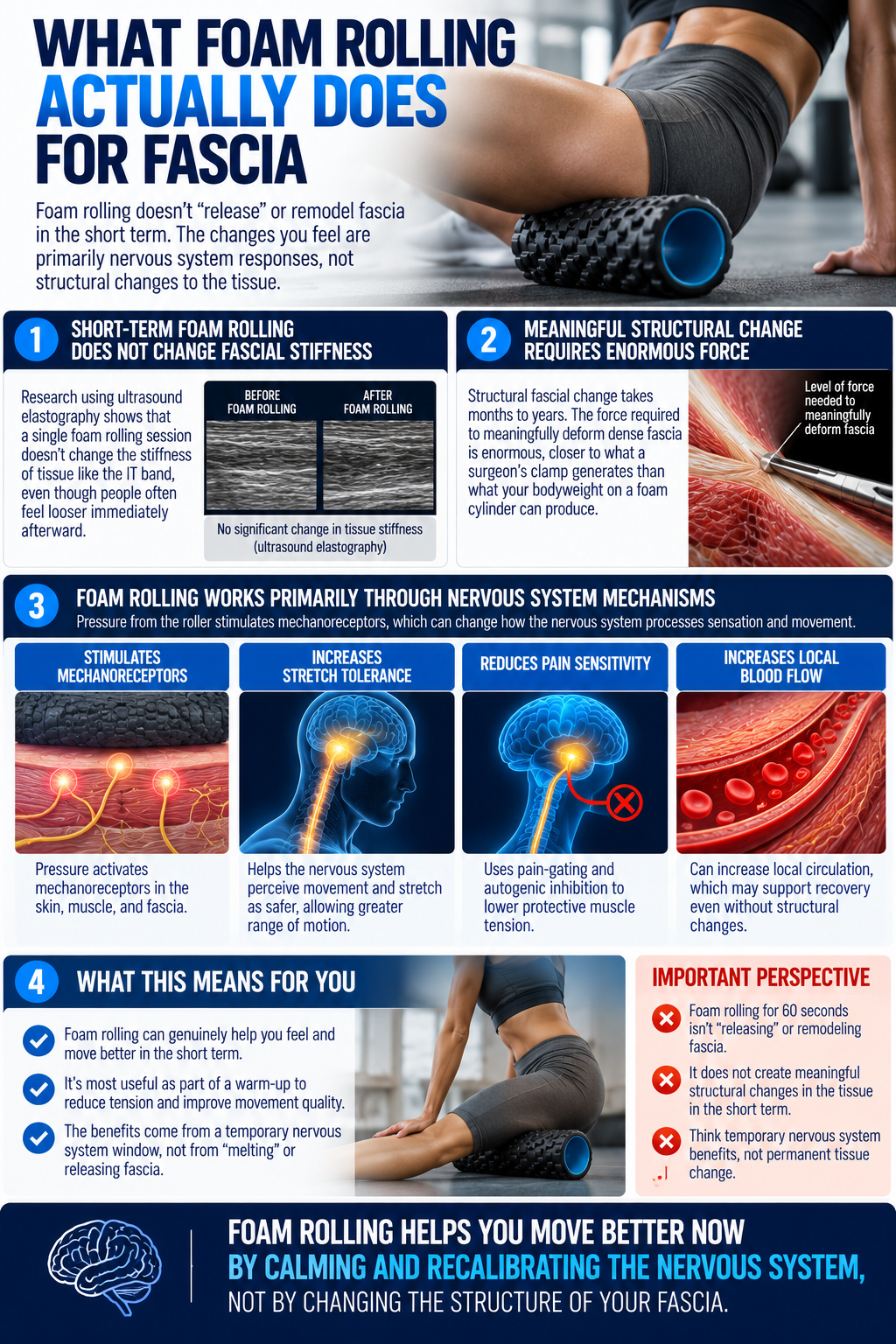
Structural fascial change takes months to years, foam rolling for 60 seconds before our workout obviously isn’t “releasing” or remodeling anything. The force required to meaningfully deform dense fascia is enormous, closer to what a surgeon’s clamp generates than what your bodyweight on a foam cylinder can produce. Research using ultrasound elastography backs this up directly: a single foam rolling session doesn’t change the stiffness of tissue like the IT band at all, even though people often feel looser immediately afterward.
So what explains the real range-of-motion and tension changes people experience? The evidence increasingly points to the nervous system rather than the tissue itself. Pressure from the roller stimulates mechanoreceptors in the skin, muscle, and fascia, which appears to increase stretch tolerance, reduce pain sensitivity, and temporarily lower protective muscle tension, a process closer to autogenic inhibition and pain gating than mechanical release. Foam rolling also increases local blood flow, which can support recovery even without any structural change occurring. None of that makes foam rolling useless, it can genuinely help you feel and move better short-term, especially as part of a warm-up. It just means the honest explanation is “temporary nervous system window,” not “melting fascia.”
You Can’t Isolate Fascia (Or a “Fascial Chain”)
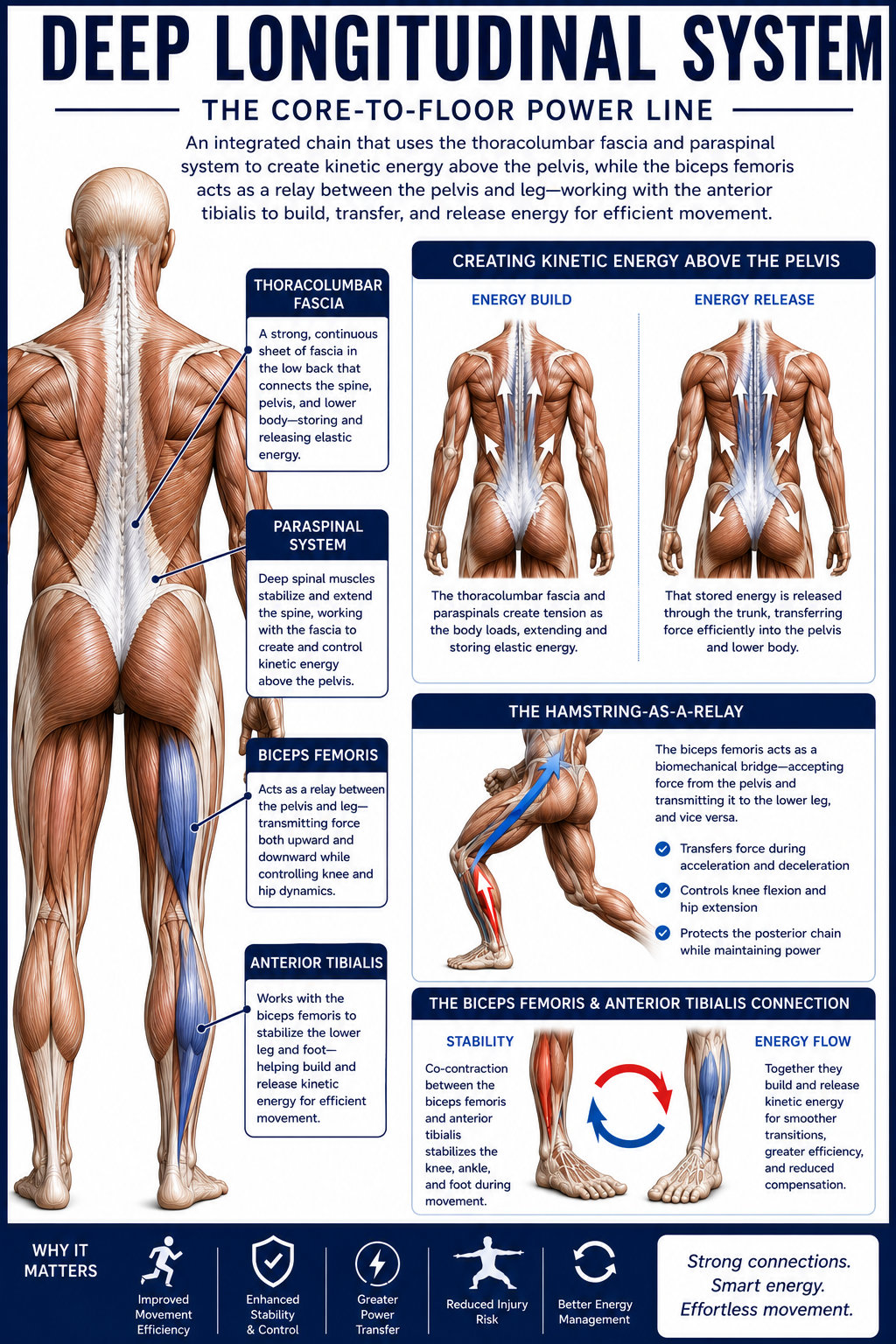
Here’s another claim worth examining: that you can target one specific muscle, or one specific “fascial chain,” and train it independently of everything around it. Anatomically, this doesn’t hold up. Fascia isn’t a separate system layered on top of muscle, it’s continuous with it, wrapping, dividing, and blending into muscle tissue at a microscopic level. There’s no clean line where “muscle” stops and “fascia” begins, which means any exercise that loads a muscle is simultaneously loading its surrounding fascia. You can emphasize a region, but you can’t isolate the connective tissue from the contractile tissue it’s woven into.
Trauma Doesn’t “Live” in Your Fascia
You’ve probably heard some version of this one too: unresolved trauma gets physically stored in your fascia, independent of your brain, waiting to be released through bodywork or movement. It’s an emotionally compelling idea, and it shows up constantly in wellness spaces. It’s also not supported by the evidence. A detailed review of the proposed mechanisms behind “fascial unwinding” found that while fascia can contract and relax at a cellular level, the claim that tissue independently stores and releases memory, separate from the nervous system, has no scientific research backing it. The sensation of a specific touch or body position triggering an emotional response doesn’t mean that memory was physically stored in that tissue, it means the nervous system associated that input with something, which is a very different mechanism.
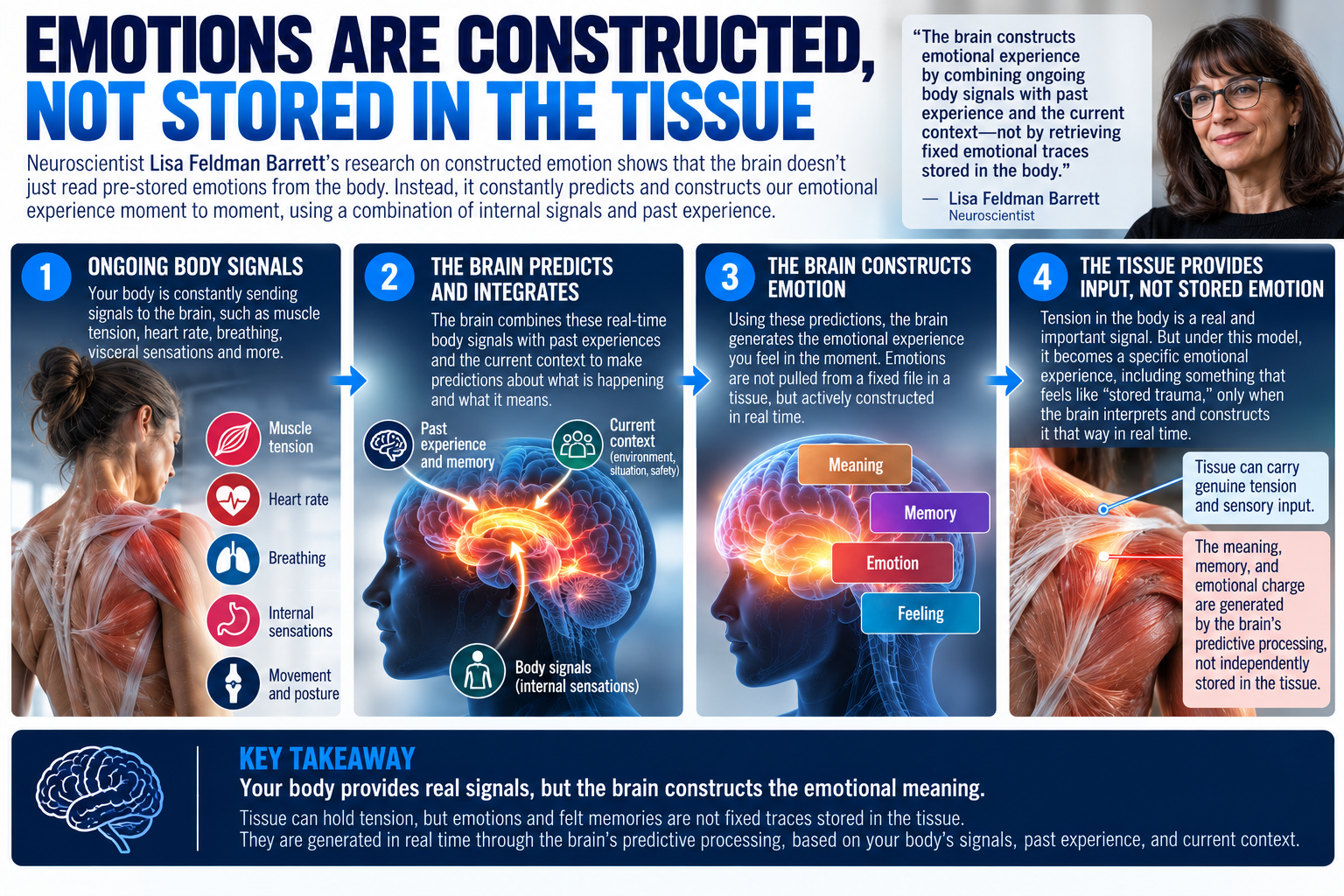
Neuroscientist Lisa Feldman Barrett’s research on constructed emotion adds useful context here, even though she isn’t writing about fascia specifically. Her work argues that emotions, and the feelings we associate with memory, aren’t stored as fixed traces sitting in a particular body part, waiting to be triggered. Instead, the brain is constantly predicting and constructing experience moment to moment, combining ongoing internal signals like muscle tension, heart rate, and breathing with past experience to generate what we perceive as an emotion or a felt memory. Tension in the body is a real signal, but under this model, it only becomes a specific emotional experience, including something that feels like “stored trauma,” when the brain actively interprets and constructs it that way in real time. That reframes the claim entirely: the tissue can carry genuine tension and sensory input, but the meaning, the memory, and the emotional charge are being generated by the brain’s predictive processing, not independently filed away inside the tissue itself.
This matters practically. If the belief is that tissue itself is holding onto trauma, the implied fix is finding the right technique to physically release it. But if the nervous system is actually constructing the experience, which both the fascial unwinding research and Barrett’s work point toward, then approaches that work with the nervous system, like breath, movement, and gradually building a sense of safety in the body, make a lot more sense than searching for the one spot where trauma is supposedly trapped.
What the Research Actually Supports
Strip away the hype and you’re left with something genuinely useful. Fascia plays a real role in transmitting force throughout the body, not just within individual muscles. Research on fascial continuity shows that proper motor coordination and efficient force transfer depend on the integrity of this connective tissue network, which is a big part of why movement can feel so efficient when everything is working together, and so inefficient when it isn’t.
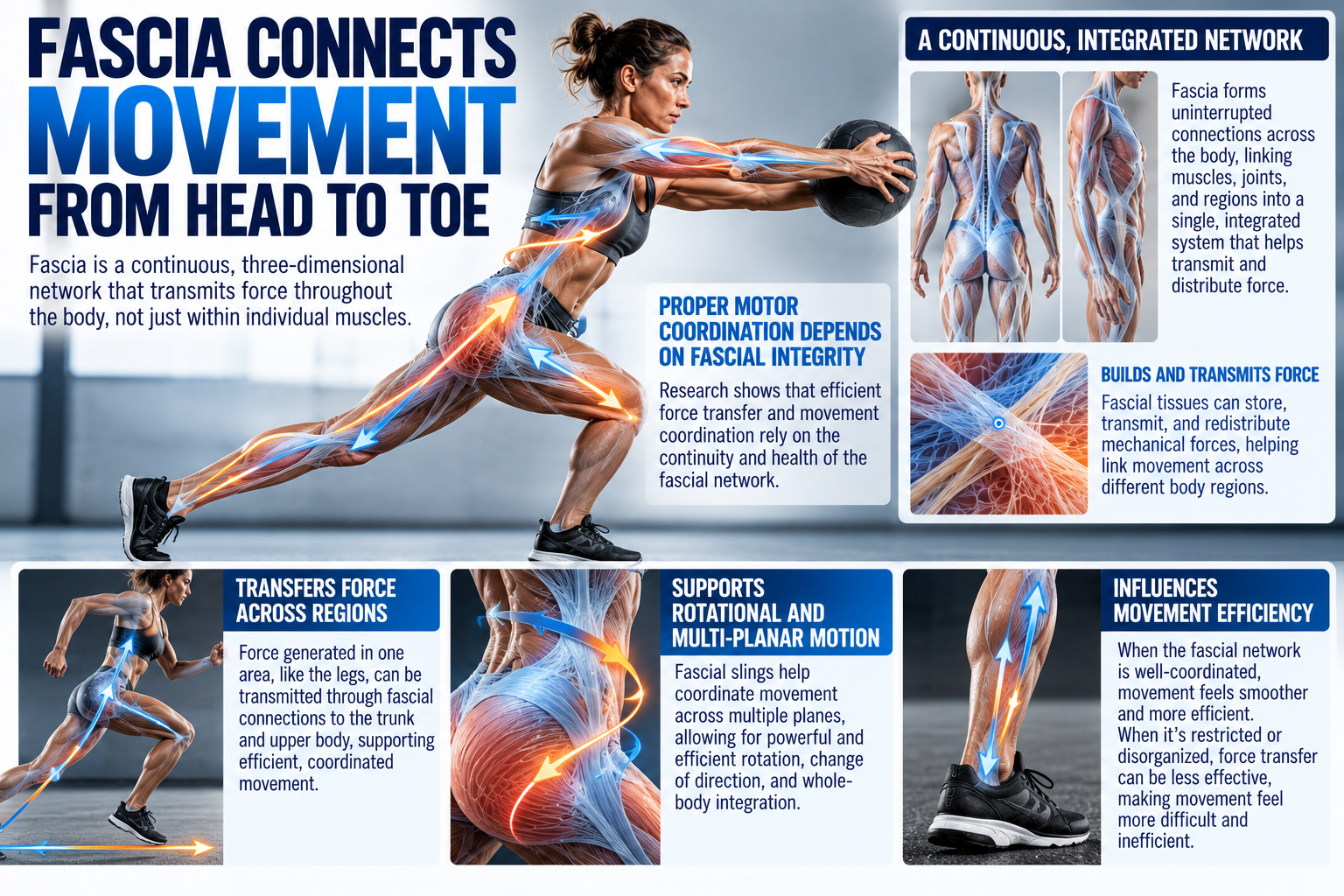
Fascia is also rich in mechanoreceptors, sensory structures that respond to touch, tension, and movement, feeding information back to the nervous system about position, tension, and load. That sensory feedback plays a meaningful role in coordination and movement quality, which is exactly why movement-based approaches tend to outperform passive ones for lasting change.
And loading matters enormously. Movement, progressive loading, and strength training are what keep fascia healthy and adaptable over time, not foam rolling alone, not stretching alone, and not any single “release” technique marketed as a cure-all.
Why This Is Exactly the Thinking Behind Myofascial Integrated Movement
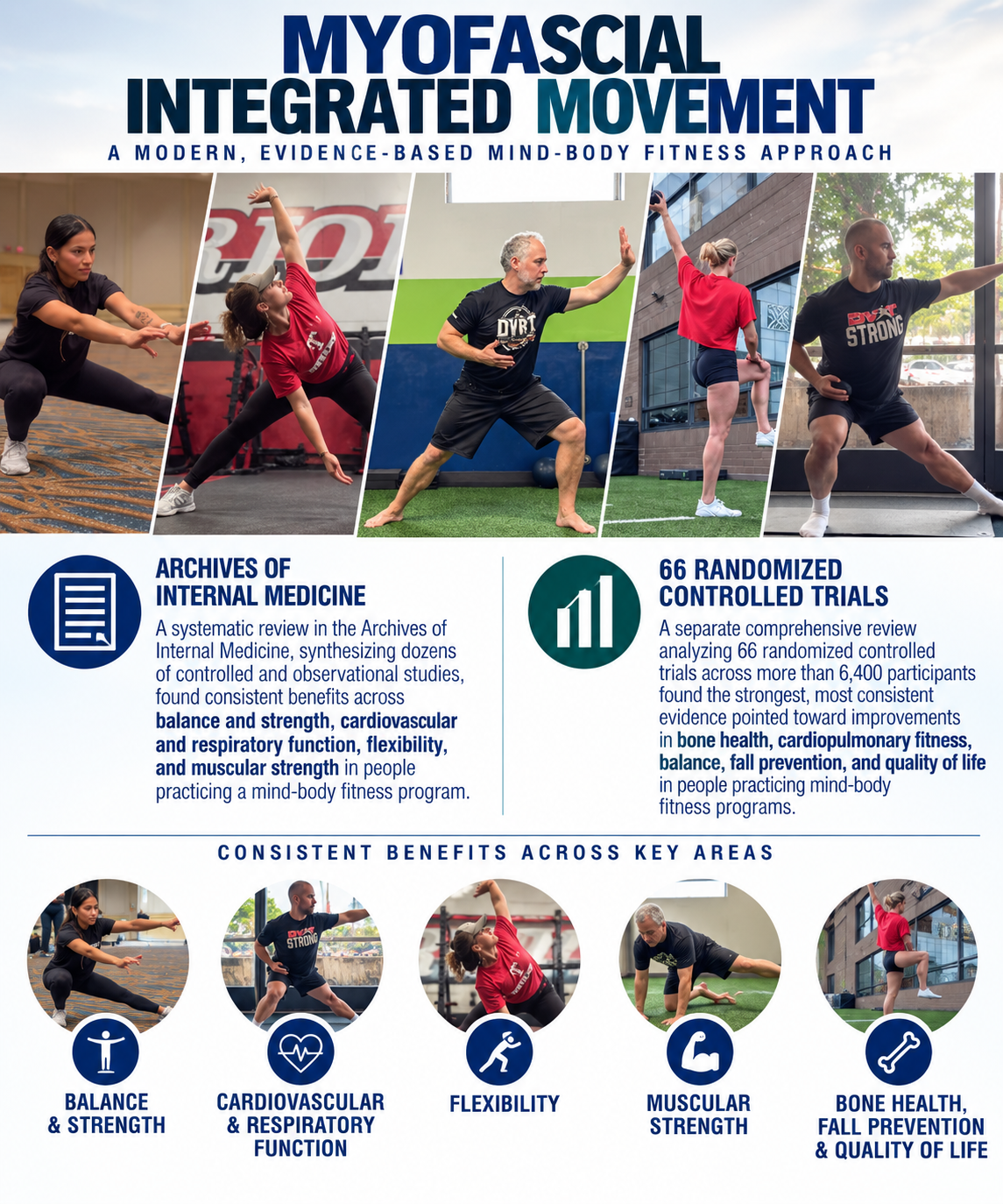
This is precisely where Myofascial Integrated Movement training earns its name. Instead of treating fascia as something to chase down and “release” in isolation, MIM trains it the way it actually behaves, as a connected, load-responsive, sensory-rich network running through the entire body.
Multiplanar, diagonal, and kinetic chain-based movement loads fascia across multiple directions instead of a single plane, which better matches how force actually transmits through the body during real movement. Reflexive stability work taps directly into those mechanoreceptors, sharpening the sensory feedback loop research shows matters for coordination. And progressive, integrated loading, rather than isolated stretching or passive release work, is exactly the stimulus the evidence points to for keeping fascia healthy, resilient, and adaptable long-term.
Fascia is important. It’s just not magic, and it’s definitely not the single explanation for every ache, pain, or tight muscle you’ve ever experienced. The research points toward a tissue that genuinely matters for force transmission, sensory feedback, and movement efficiency, and that responds best to the same thing most tissues in your body respond to: smart, progressive, varied loading.
See how we use the concepts around fascia to create smarter strength and movement training programs with our NEW Myofascial Integrated Movement online certification. Pick up this great new program with TONS of CEUs for 30% off with code “mim30” HERE