How I Train Even When I Don’t Feel Great

I’ll be honest with you: there are plenty of days I don’t feel inspired to train.
My health conditions mean I’m competing for energy on a daily basis, and my chronic pain isn’t consistent, some days it’s manageable, other days it’s significant enough that the idea of a full workout feels almost laughable. And yet, I still train pretty much every day. Not because I’ve found some secret reserve of willpower, but because I’ve built a few specific strategies that make training possible even on the days I genuinely don’t feel like it.
I want to share them, because I think a lot of people assume consistency requires feeling good first. It doesn’t. It requires a different approach entirely.

Step 1: Be Willing to Modify
The first shift, and probably the most important one, is giving yourself permission to modify what you had planned.
So many people are hard on themselves the moment they can’t do the exact workout they had written down. If the plan said five sets and today only has three in it, that gets treated as a failure. But here’s what actually drives results: consistency, not any single workout’s intensity.
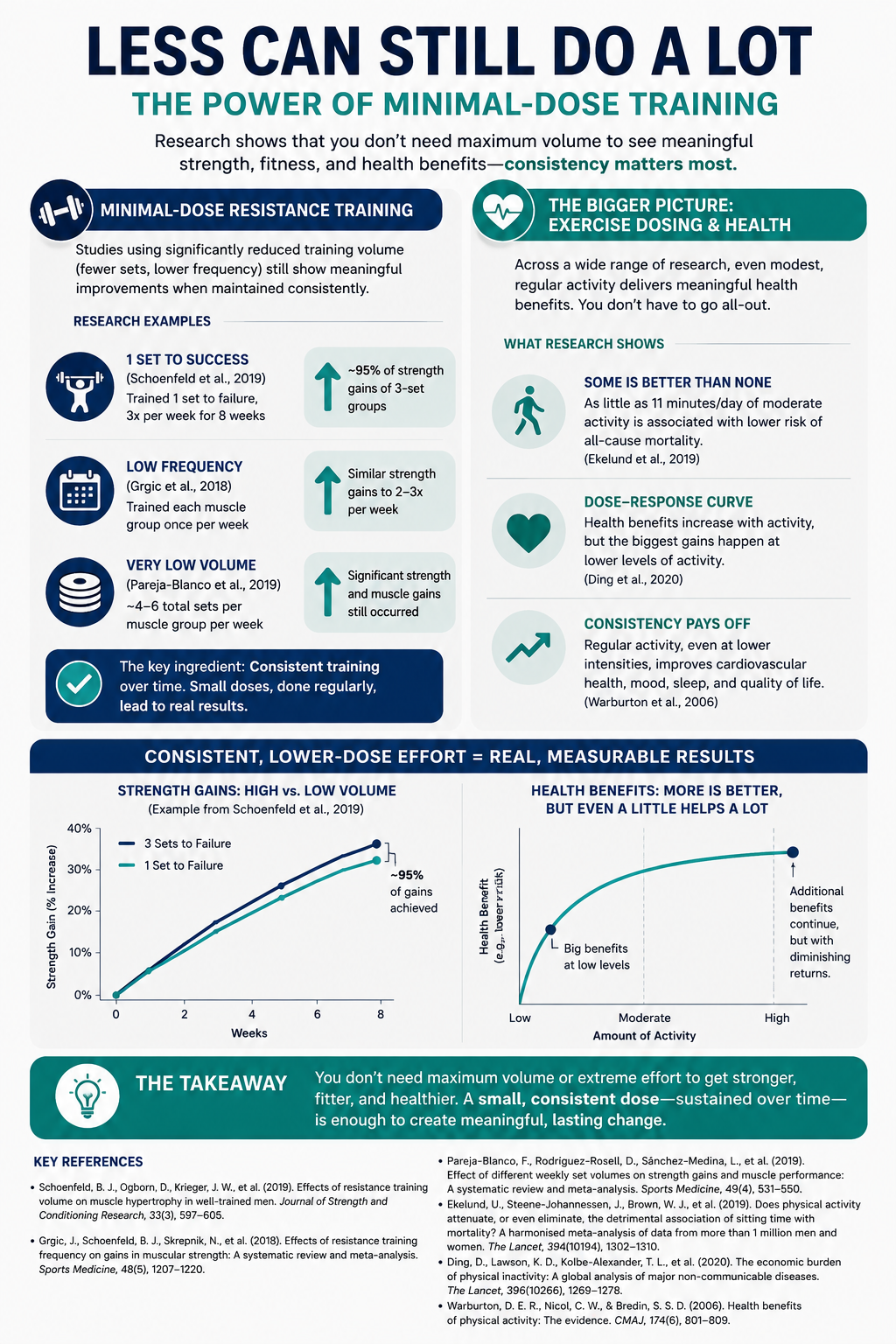
There’s real research behind this. Studies on minimal-dose resistance training have found that even significantly reduced training volume fewer sets, lower frequency, sessions well below typical standards still produces meaningful improvements in strength and fitness, particularly when that reduced dose is sustained consistently over time. Broader research on exercise dosing has found similar patterns: even modest, regular amounts of activity produce real, measurable health benefits, and the returns from consistent, lower-intensity effort don’t disappear just because you didn’t go all-out.
This matters because it directly challenges the assumption that anything less than full intensity is basically wasted. It isn’t. You don’t become fit from one great workout, and you don’t become unfit from one modified one. Adjusting your sets, your reps, your load, your progressions, or even the entire style of training you do that day isn’t giving up, it’s exactly how you stay consistent long enough to actually see results.
Step 2: Just Get Started
The second strategy is deceptively simple, and it’s the one that saves me more than any other: I just start.
There are plenty of days I genuinely don’t know if training is possible. My energy is low, my body feels questionable, and the idea of a full session feels like too much to commit to. On those days, I don’t tell myself I have to complete a workout. I tell myself: just start with the warm-up. Not even the whole warm-up, just the first exercise in it.
I can’t tell you how many times that’s all it took. Starting the first warm-up movement, with zero commitment to anything beyond it, has led to me completing an entire workout more times than I can count. Something about removing the pressure of the whole session and just asking for one small, low-stakes action, makes it possible to begin. And once you’ve begun, momentum tends to take over in a way that deciding in advance never could.
If you’re waiting to feel ready before you start, you might be waiting a long time. Start small enough that “ready” isn’t a requirement, and let the decision about the rest of the session happen after you’re already moving.
This 10 minute Myofascial Integrated Movement series is a great example of how to “just get started” and can be a whole workout for some during some days.
Step 3: Find Something Fun
The third strategy is about redefining what counts. Sometimes the goal isn’t a structured workout at all it’s simply staying physically active in a way that doesn’t feel like a chore.
One of my favorite things to do is take my dogs for a walk. It’s not a workout in the traditional sense, but it keeps me moving, and on the days when a real training session isn’t realistic, that movement still counts for something.

This isn’t just a personal preference, it’s genuinely one of the strongest predictors researchers have found for whether people stay physically active long-term. Enjoyment matters. When activity feels good rather than obligatory, people are far more likely to keep doing it, especially through the stretches when motivation and energy are both running low. Finding something you actually enjoy isn’t a lesser substitute for “real” training. It’s often the very thing that keeps you consistent enough for the real training to matter.
None of these strategies require you to feel good first. That’s the whole point. Being willing to modify removes the all-or-nothing trap. Just starting removes the pressure of committing to something big before you know if you have it in you. And finding something enjoyable gives you a fallback that still counts, even on the hardest days.
I don’t train every day because I feel great every day. I train every day because I’ve stopped requiring myself to feel great in order to start.