How to Stay Consistent With Exercise When You Don’t Feel Motivated
Being “disciplined” when life is going generally well can sound like logical motivation. I mean, if we just aren’t super excited about training, but we know we have time, that life isn’t throwing us some major curve balls, and such, relying on some discipline may sound like a reasonable idea.
The reality is, most of us don’t live these lives. The majority of people feel like keeping their head above water is a struggle most days. That means we aren’t just dealing with a very general “eh, I don’t feel like it mentality.” The majority are dealing with a feeling of being overwhelmed, stressed about finances, relationships, their own/their family members’ health, and even stress about the state of the world has become a BIG issue for people.
So, telling people to just be “disciplined”, or find motivation isn’t actually advice that works. THIS does….
People often start looking for a solution in the wrong place.
Maybe I need a new program.
Maybe I need more motivation.
Maybe I need to become more disciplined.
But the research on long-term physical activity suggests something much more useful:
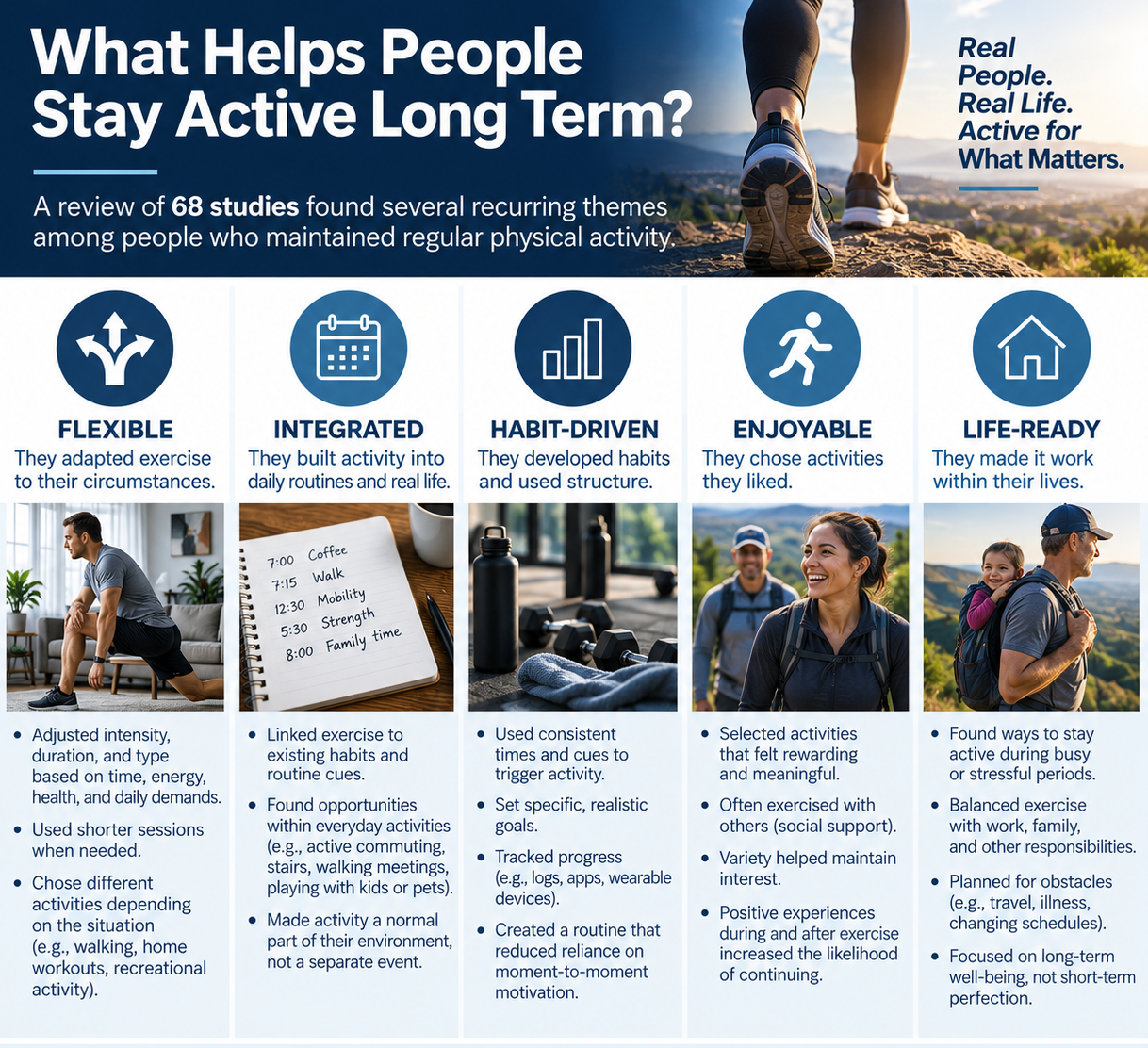
A recent qualitative synthesis examining 68 studies on maintaining physical activity found several recurring themes among people who remained active: they made exercise flexible, integrated it into their routines, developed habits, enjoyed what they were doing, and found ways to make activity work within their lives. (PMID: 39557793)
In other words, the answer probably isn’t another magical workout.
It’s learning how to exercise when life isn’t ideal.
Here are three strategies that can help.
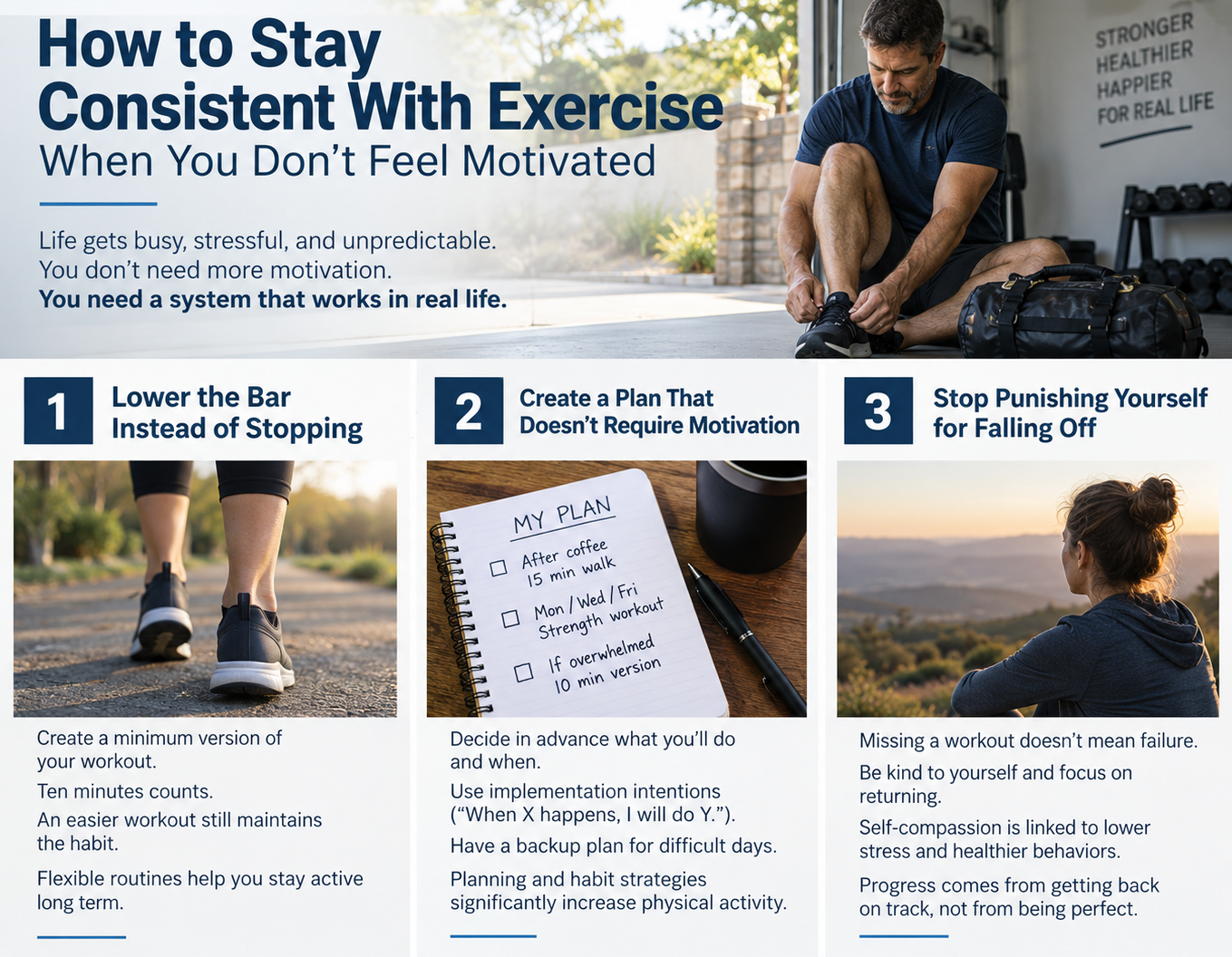
Strategy #1: Lower the Bar Instead of Stopping
One of the biggest mistakes we make during stressful periods is maintaining an all-or-nothing definition of exercise.
If our normal workout is 60 minutes, then 15 minutes feels pointless.
If we normally train hard, an easier workout feels like we’re “slacking.” So we do nothing. The better strategy is to create a minimum version of your exercise habit.
Your normal workout might be:
-45 minutes of strength training.
But your difficult-day version might be:
-10 minutes of mobility and two strength exercises.
Your normal walk might be:
-45 minutes.
Your minimum might be:
-10 minutes around the neighborhood.
This matters because the immediate goal during an overwhelming period doesn’t always need to be maximizing fitness. Sometimes the goal is simply maintaining the behavior.
Research on exercise maintenance consistently highlights flexibility and integrating activity into everyday life rather than requiring perfect circumstances. (PMID: 39557793). This also gives us permission to choose movement that feels better.
Research examining the affective experience of exercise suggests that how people feel during and after exercise matters for adherence. Exercise doesn’t always need to be punishing to be productive. (PMID: 37496882)
Ask yourself:
“What is the smallest meaningful version of today’s workout that I can realistically do?”
Twenty minutes counts, ten minutes counts, going for a walk counts.
You aren’t lowering your standards forever, you’re adapting your strategy to your current capacity.
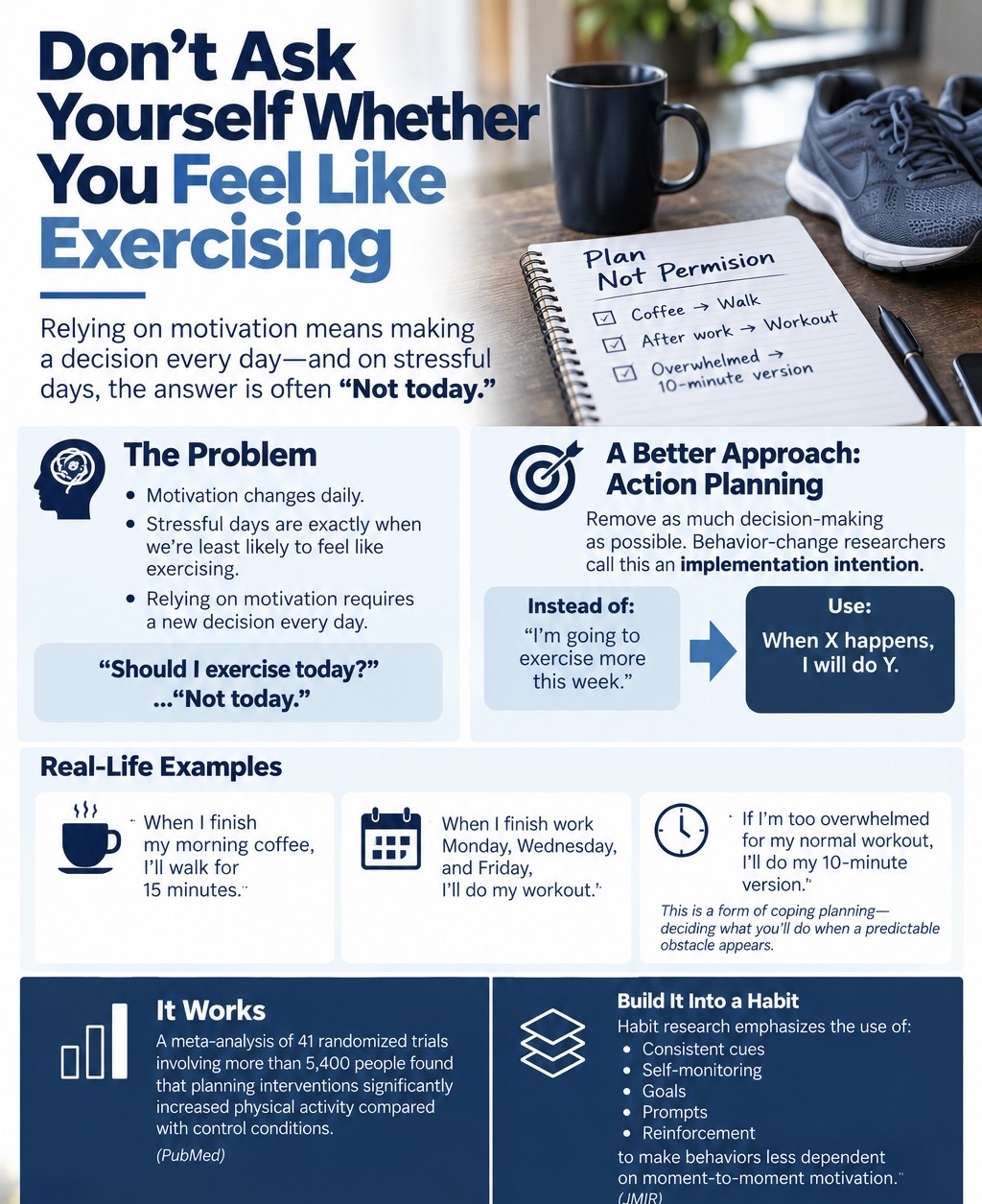
Strategy #2: Don’t Ask Yourself Whether You Feel Like Exercising
There’s another problem with relying on motivation, it requires you to make a decision every day.
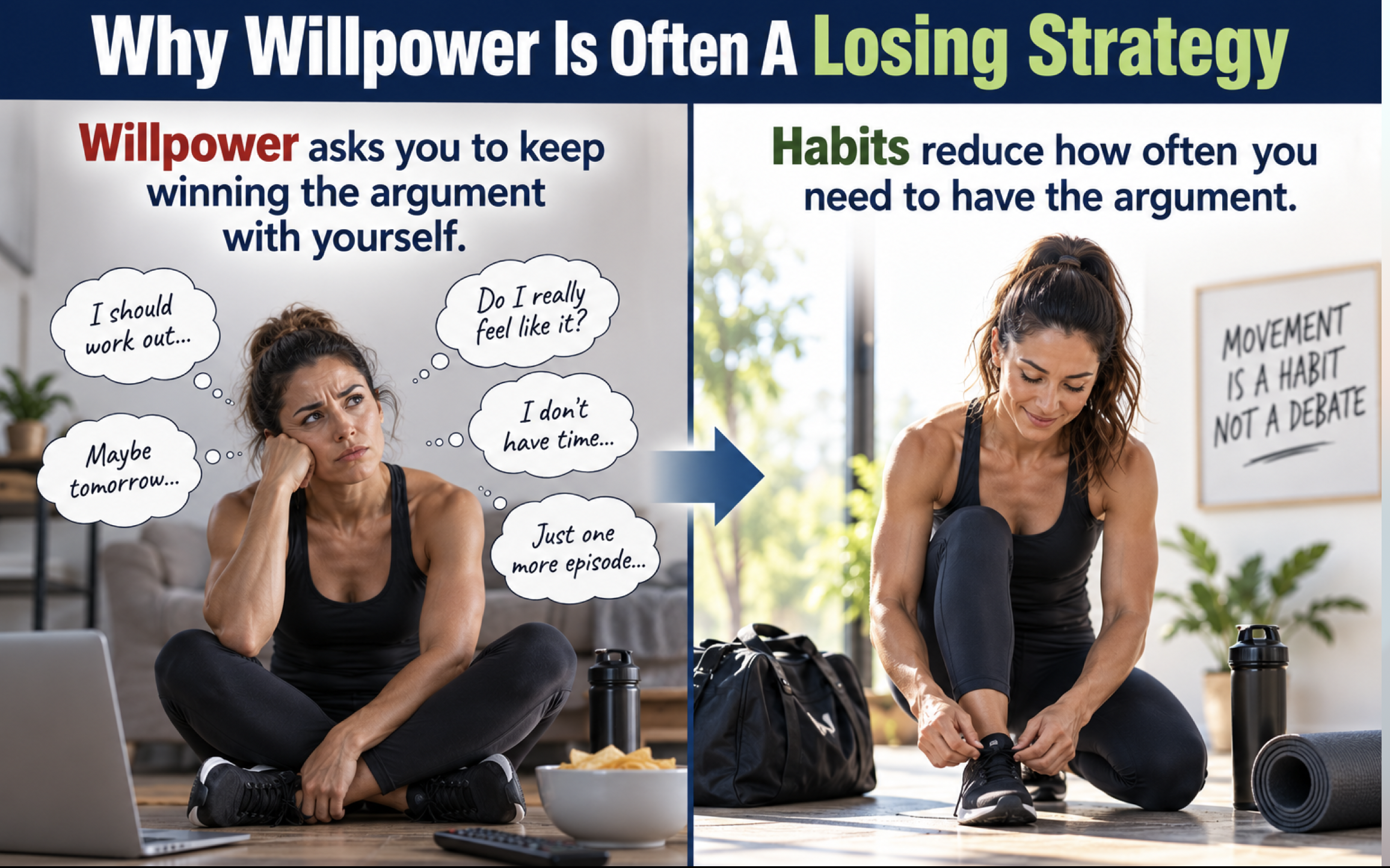
“Should I exercise today?”
Unfortunately, stressful days are exactly when our answer is most likely to be:
“Not today.”
Instead, remove as much decision-making as possible.
Behavior-change researchers call one useful approach action planning or an implementation intention.
Instead of saying: “I’m going to exercise more this week.”
You establish: When X happens, I will do Y.
For example…
“When I finish my morning coffee, I’ll walk for 15 minutes.”
“When I finish work Monday, Wednesday, and Friday, I’ll do my workout.”
“If I’m too overwhelmed for my normal workout, I’ll do my 10-minute version.”
That last example is particularly important because it is a form of coping planning—deciding what you’ll do when the predictable obstacle appears.
A meta-analysis of 41 randomized trials involving more than 5,400 people found that planning interventions significantly increased physical activity compared with control conditions. (PMID: 35742582)
Habit research similarly emphasizes consistent cues, self-monitoring, goals, prompts, and reinforcement as tools for making behaviors less dependent upon moment-to-moment motivation.
You don’t need to feel motivated at 5:00, you already decided what happens at 5:00.
Strategy #3: Stop Punishing Yourself for Falling Off
This may be the most overlooked strategy of all. You miss Monday’s workout, then Wednesday, by Friday, the internal conversation starts:
“I’m so lazy.”
“I always do this.”
“I’ve completely fallen off.”
Ironically, beating yourself up may not be the motivational tool we imagine it to be.
A 2026 systematic review and meta-analysis involving 19 studies and 9,660 adults found that greater self-compassion was associated with lower stress and greater engagement in health-promoting behaviors. Stress itself was negatively associated with health-promoting behaviors. (PMID: 42640104)
Research specifically examining physical activity has also found relationships between self-compassion and healthier responses to exercise lapses. (PMID: 39822319)
Self-compassion doesn’t mean giving yourself permission to quit. It means eliminating the unnecessary emotional punishment that makes restarting harder.
Instead of: “I blew my program this week.”
Try: “This was a difficult week. What can I realistically do today?”
That question moves you from judgment back into action and maybe that is the most important lesson about consistency. Contrary to what social media may tell you, consistency doesn’t mean never missing a workout. Rather, it means becoming better at returning.
The people who exercise for decades aren’t necessarily people whose lives cooperate with their fitness plans.
Their kids get sick.
Their jobs become stressful.
They travel.
They sleep poorly.
They lose motivation.
Life gets overwhelming.
The goal isn’t to find the perfect program that somehow prevents those things from happening.
Build a system that expects them.
Lower the bar when necessary, create plans that don’t depend upon motivation and when you fall off, practice returning instead of judging yourself.
The best exercise program isn’t simply the one that’s scientifically optimal.
It’s the one you can keep coming back to when life isn’t.
One thing I particularly like about this framing for your audience is that it makes adaptability part of consistency rather than the opposite of consistency. That is much more realistic for adults dealing with work, family, stress, pain, sleep, and changing energy levels. The newest 2026 meta-analysis on self-compassion and health behavior gives the third strategy especially strong and timely research support.
Learn how we apply these concepts to a whole movement system in our FREE October 6th webinar HERE on increasing adherence, manage stress, stability/mobility, and even better functional strength.