The Most Underrated Shoulder Solution You’re Not Doing

Shoulder mobility is something that limits SOOOO many people from training like they would really like. After over 30 years of coaching, restricted shoulder movement was not something that was unusual, in fact, I would say it was almost expected. Often, this leads to people cranking on their shoulder joints, trying to stretch super hard, and perform any mobility drill possible. Unfortunately, most mobility drills are missing what is most effective in some key ways.
It’s one of the most complete shoulder solutions in our entire system, and it deserves a real place in your programming, not just a passing mention before the “real” training begins. This “mysterious” shoulder mobility drill that can actually deliver on its promises? That is the tea cup exercise.
What the Tea Cup Drill Actually Is
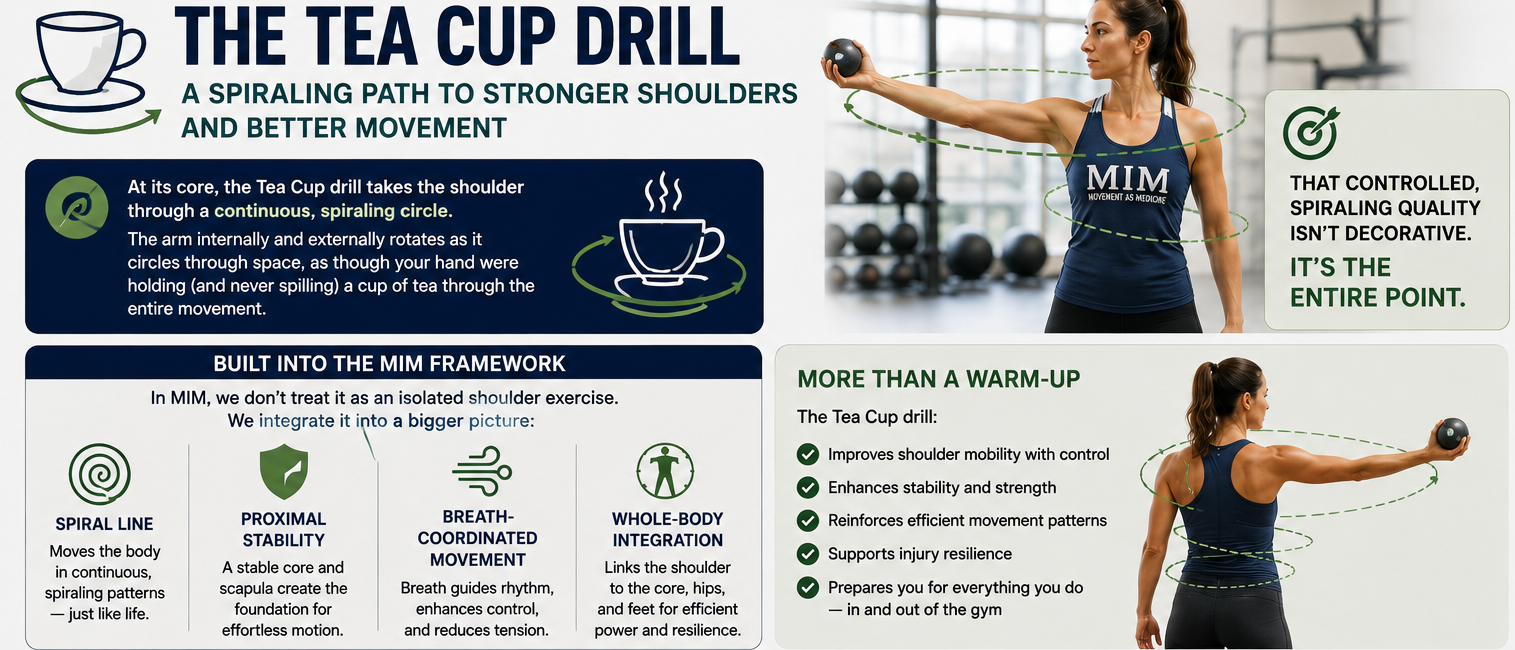
At its core, the Tea Cup drill takes the shoulder through a continuous, spiraling circle. internally and externally rotating as the arm circles through space, as though your hand were holding (and never spilling) a cup of tea through the entire movement. That controlled, spiraling quality isn’t decorative. It’s the entire point.
This movement pattern has roots in traditional Chinese martial arts, and it shows up across a surprising number of movement disciplines for a simple reason: it works. But in MIM, we don’t treat it as an isolated shoulder exercise borrowed from another tradition. We build it directly into our broader framework, the Spiral Line, proximal stability, and breath-coordinated movement, so it does far more than loosen up a tight joint before a workout.
Why It’s a Mobility Solution, Not Just a Mobility Exercise
Most shoulder mobility work asks the joint to move through range passively a stretch held, a band pulled, a position sustained. The Tea Cup drill is different because it demands active, continuous control through that entire range, not just a static end position. As the arm spirals through internal and external rotation, the surrounding musculature has to organize itself dynamically the whole way through, not just brace at the finish line.
This matters because mobility you build actively, under your own control, is mobility your nervous system actually trusts and trusted range of motion is range of motion you’ll actually be able to access under real, dynamic conditions, not just on a mat during a warm-up.
Why It’s a Stability Solution, Not Just a Mobility One
Here’s what most people miss about the Tea Cup drill entirely: it’s just as much a stability drill as a mobility one, and separating those two goals misses how the shoulder actually works.
As the arm spirals through its circular path, the rotator cuff and scapular stabilizers are constantly adjusting to keep the joint centered and controlled, not locked rigid, but dynamically stable through continuous motion. This is precisely the kind of reflexive, moving stability we’ve written about throughout our MIM content: real shoulder health isn’t about holding a brace, it’s about the shoulder knowing how to organize itself while it’s actually moving.
The Proximal Stability Connection
We never teach the Tea Cup drill as an arm-only movement, because the shoulder was never designed to function that way. Rooting through the feet, engaging the core, and maintaining a stable trunk while the arm spirals is what actually makes this drill effective. Without that proximal stability, the shoulder ends up compensating for instability elsewhere in the body, the exact pattern that shows up so often in shoulder pain that never seems to fully resolve with shoulder-only treatment.
This is also where the drill connects directly to the Spiral Line covered throughout our MIM system, the diagonal fascial and myofascial pathway linking the hip to the opposite shoulder. Done correctly, the Tea Cup drill isn’t isolating the shoulder at all. It’s teaching the shoulder to move as part of the same connected, whole-body chain everything else in MIM is built around.
Add Breath, and It Becomes Something More
Coordinate the breath with the spiral; inhaling as the arm gathers and rotates one direction, exhaling as it continues through the circle and the Tea Cup drill becomes a genuine nervous system regulation tool, not just a joint mobility drill. This is exactly the kind of layered, multi-purpose training we build throughout MIM: one movement, several outcomes, all reinforcing each other rather than competing for time in a session.
The Tea Cup drill looks simple because it is simple to describe. It is not simple in what it accomplishes. Done with genuine attention to proximal stability, spiral connectivity, and breath, it becomes a shoulder solution that builds mobility and stability simultaneously, exactly the kind of integrated, connected training that makes MIM different from a collection of isolated exercises.
Learn more in our Myofascial Integrated Movement programs and ALL our DVRT programs and tools 25% off with code “dvrt25” HERE