Top 5 Drills For Strength, Stability, Mobility, & Fascial Movement
There’s a reason Myofascial Integrated Movement (MIM) has become so popular in and beyond our DVRT community. People are drawn to the idea instinctively to not separate the qualities of strength, balance, stability, mobility, and more. I’ve even recently heard from gym owners discussing that they want to include concepts like stress resilience and nervous system regulation training into their programs, but clients end up not enjoying the process. Not so with MIM.
With so many drills, sequences, and entry points in the system, most people freeze at the first question: where do I even begin?
That’s exactly the gap this post is here to close. Rather than overwhelming you with the entire MIM library, we’ve distilled it down to five foundational drills that capture the essence of the method, movements that simultaneously challenge your stability, open up mobility, sync with your breath, and engage the fascial lines that connect it all. Each one was chosen because it delivers outsized, unique benefits relative to how simple it is to learn. Whether you’re brand new to MIM or looking for a smarter way to structure your own practice, these five drills are the perfect place to plant your flag and build from.
MIM Silk Reeling Horse Stance Cable
What makes this MIM Silk Reeling Horse Stance Cable progression so valuable is that it trains the body to produce and control force as an integrated system rather than treating the arms, trunk, and legs as separate parts. The wide horse stance creates a stable lower-body foundation, while the cable introduces an external force that continuously challenges the body to organize around it. Instead of simply “rotating the torso,” the goal becomes transferring force from the ground through the hips and trunk and into the upper body while maintaining posture and control. The circular silk-reeling pattern also encourages coordinated movement through multiple planes rather than the straight-line actions that dominate many traditional strength exercises.
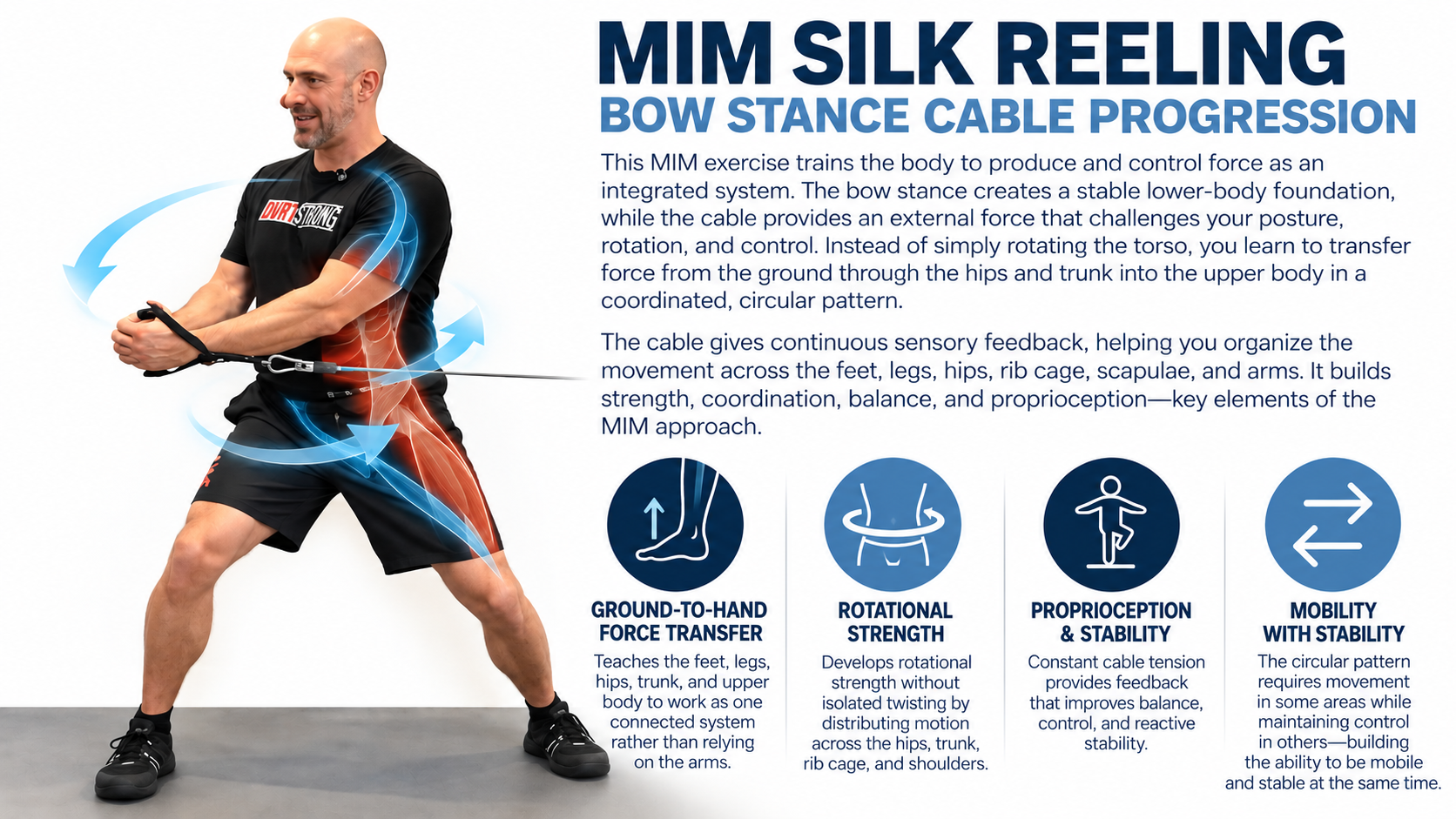
The cable makes the movement especially useful because resistance provides sensory feedback: you can feel where the force is pulling you and learn to adapt your position to it. This combines strength with proprioception, coordination, balance, and motor control. Rather than trying to eliminate rotation, the trunk learns to control and transmit rotational forces while the hips, rib cage, scapulae, and arms contribute to the movement.
MIM Brush Toes
Brush Toes is valuable because it takes what could look like a simple mobility exercise and turns it into a coordinated whole-body movement. As you fold and reach toward the feet and then return to standing, the hips, spine, rib cage, shoulders, and arms have to organize together. Rather than trying to create flexibility by aggressively stretching one isolated area, the movement allows mobility to emerge through coordinated motion across multiple joints. The slow, deliberate nature of the exercise also provides the nervous system with rich proprioceptive information about body position, range of motion, and how tension is being distributed.
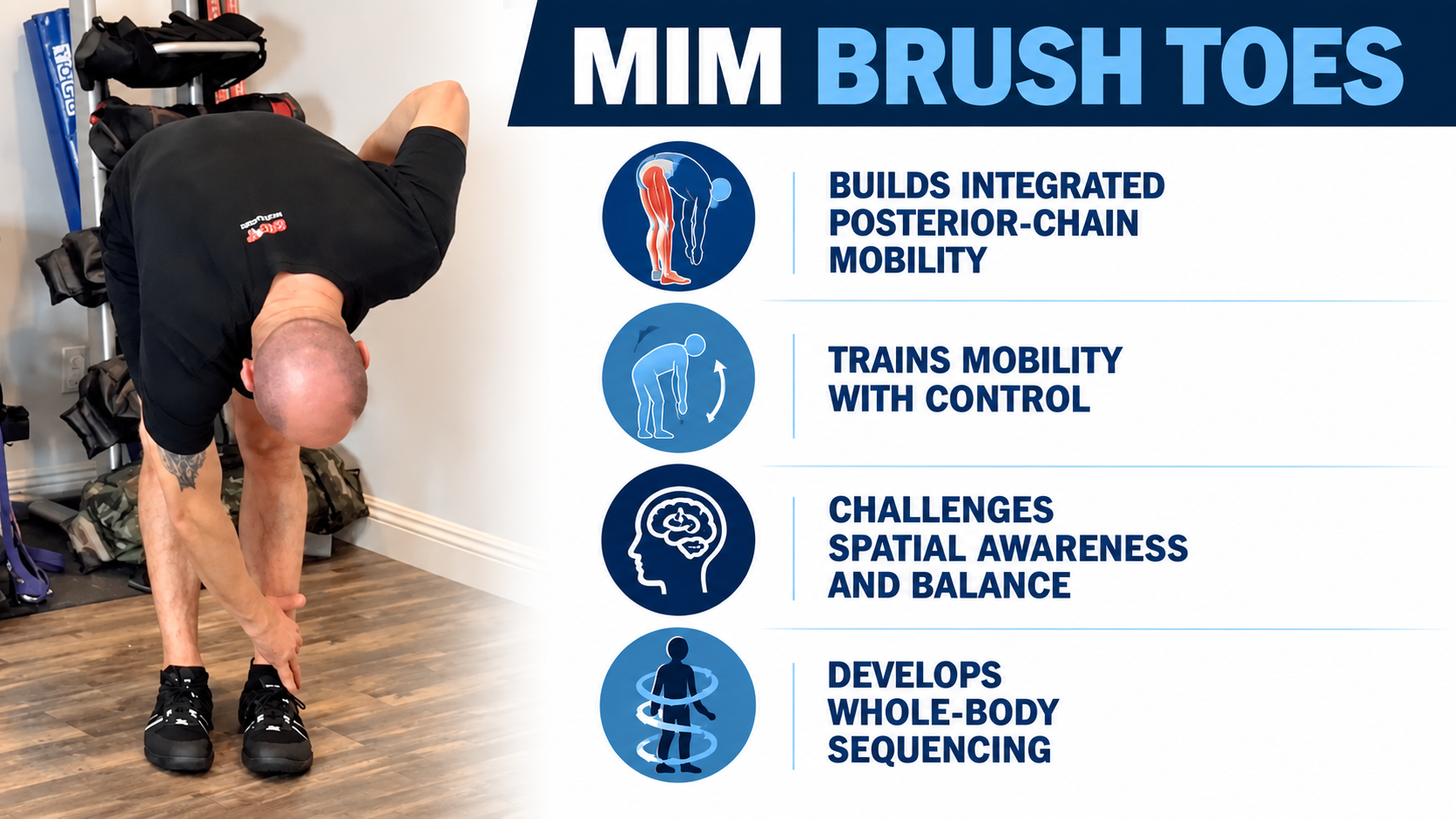
Another important aspect is that you repeatedly transition between a more flexed, folded position and an upright posture. That makes the exercise about more than flexibility, it asks you to control your center of mass while moving through a large range of motion. The eyes, head, trunk, hips, and feet all contribute sensory information as your relationship to gravity changes.
MIM Backward Step With Chop
MIM Backward Step With Chop is especially valuable because it combines locomotion, weight transfer, trunk control, and coordinated upper-body movement into one integrated pattern. Stepping backward changes the base of support and shifts the center of mass, requiring the feet, ankles, hips, and trunk to continually reorganize for balance. At the same time, the diagonal chopping action introduces multiplanar demands, so the body has to manage rotation while maintaining control rather than simply moving the arms independently of the lower body.
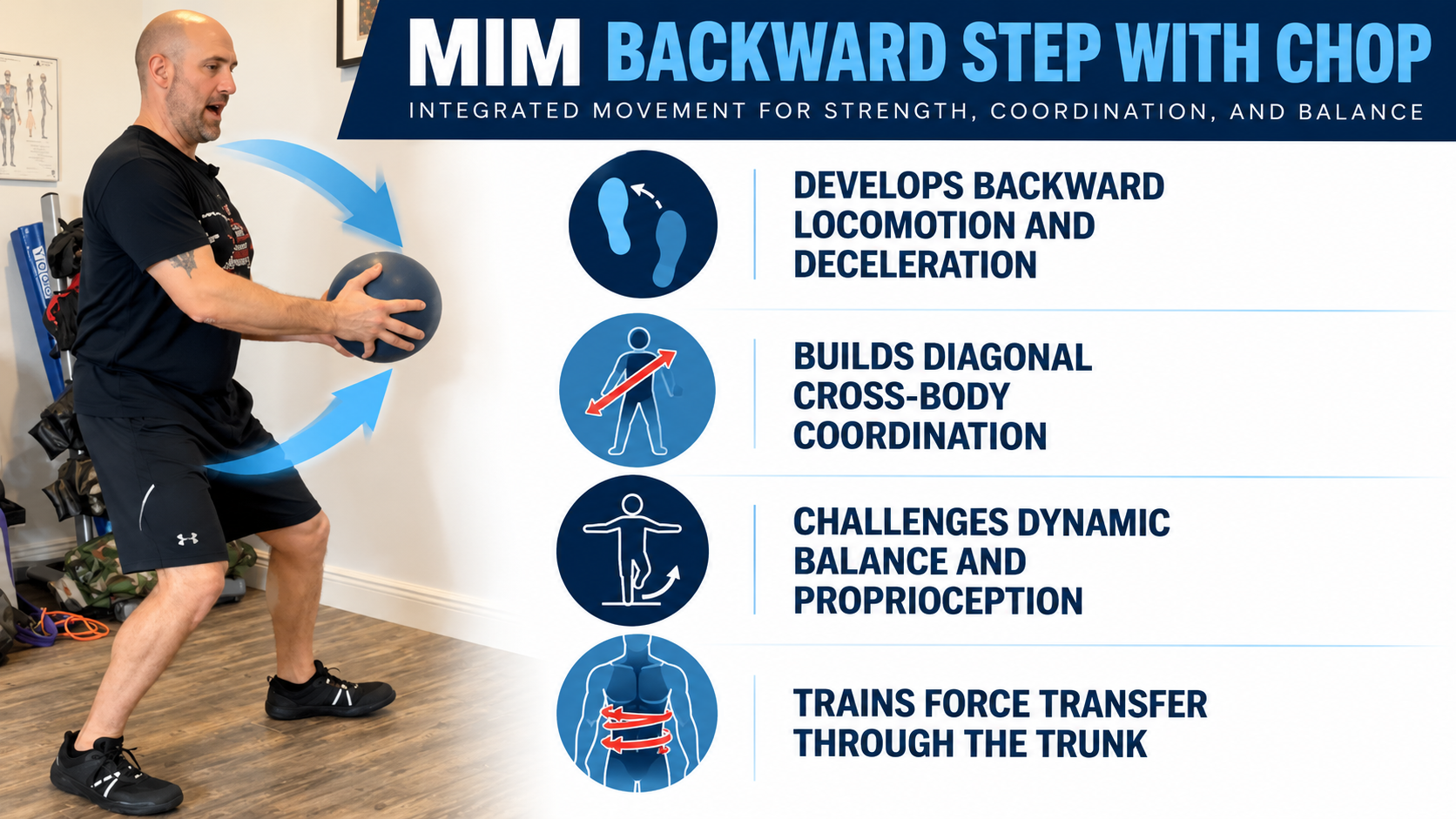
What makes the exercise particularly useful from a MIM perspective is the need to sequence the step, weight shift, trunk, and arms together. The diagonal movement resembles the cross-body patterns used in walking, reaching, changing direction, and many athletic activities. Adding an external load also provides sensory feedback and requires the trunk to transfer forces between the upper and lower body.
MIM Crossover Step With Lateral Side-Bend Reach
The MIM Crossover Step With Lateral Side-Bend Reach is valuable because it combines frontal-plane mobility with a cross-over stepping pattern that immediately makes the movement more neurologically and mechanically demanding than a traditional side bend. As the leg crosses behind and the opposite arm reaches overhead, the body has to coordinate the feet, hips, pelvis, trunk, shoulder, and arm while controlling a shifting center of mass. The result is a movement that integrates mobility with balance and coordination rather than simply trying to increase flexibility in one isolated area.
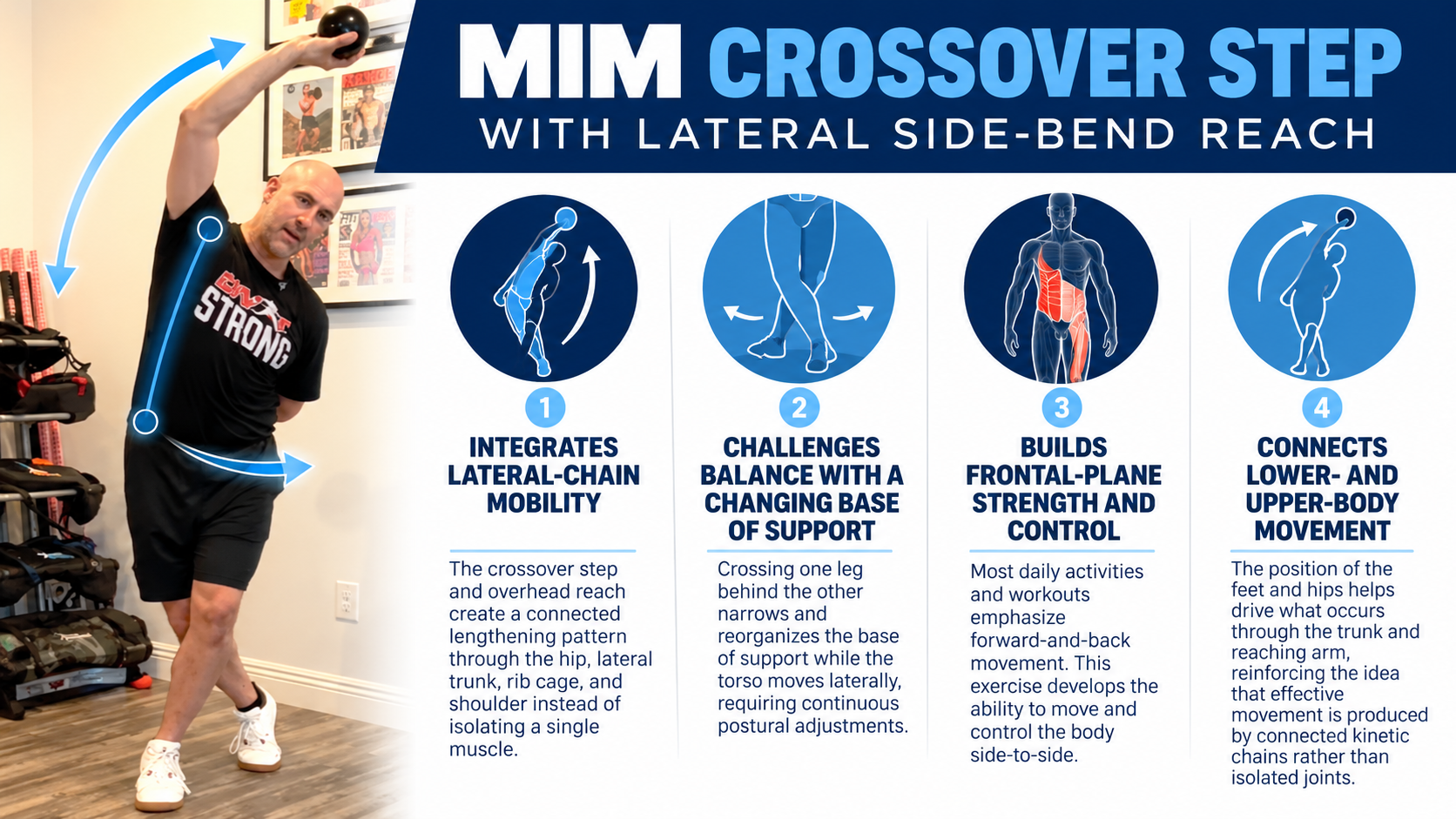
The crossover position is particularly important because it creates a longer diagonal and lateral chain through the body. The stance influences the pelvis, the pelvis influences the trunk, and the overhead reach continues that motion through the rib cage and shoulder. At the same time, the narrow, crossed base of support requires the body to maintain stability while moving outside its usual upright position.
MIM Egyptian
The MIM Egyptian progression is valuable because it trains the body to create coordinated movement through the shoulders, rib cage, trunk, and hips rather than treating mobility as something that happens at one isolated joint. The alternating arm positions create a spiral-like relationship through the upper body while the trunk responds with controlled lateral and rotational motion. Instead of simply stretching the shoulder or side of the torso, the movement asks multiple regions to contribute to the pattern, making mobility more integrated and more representative of how the body actually moves.
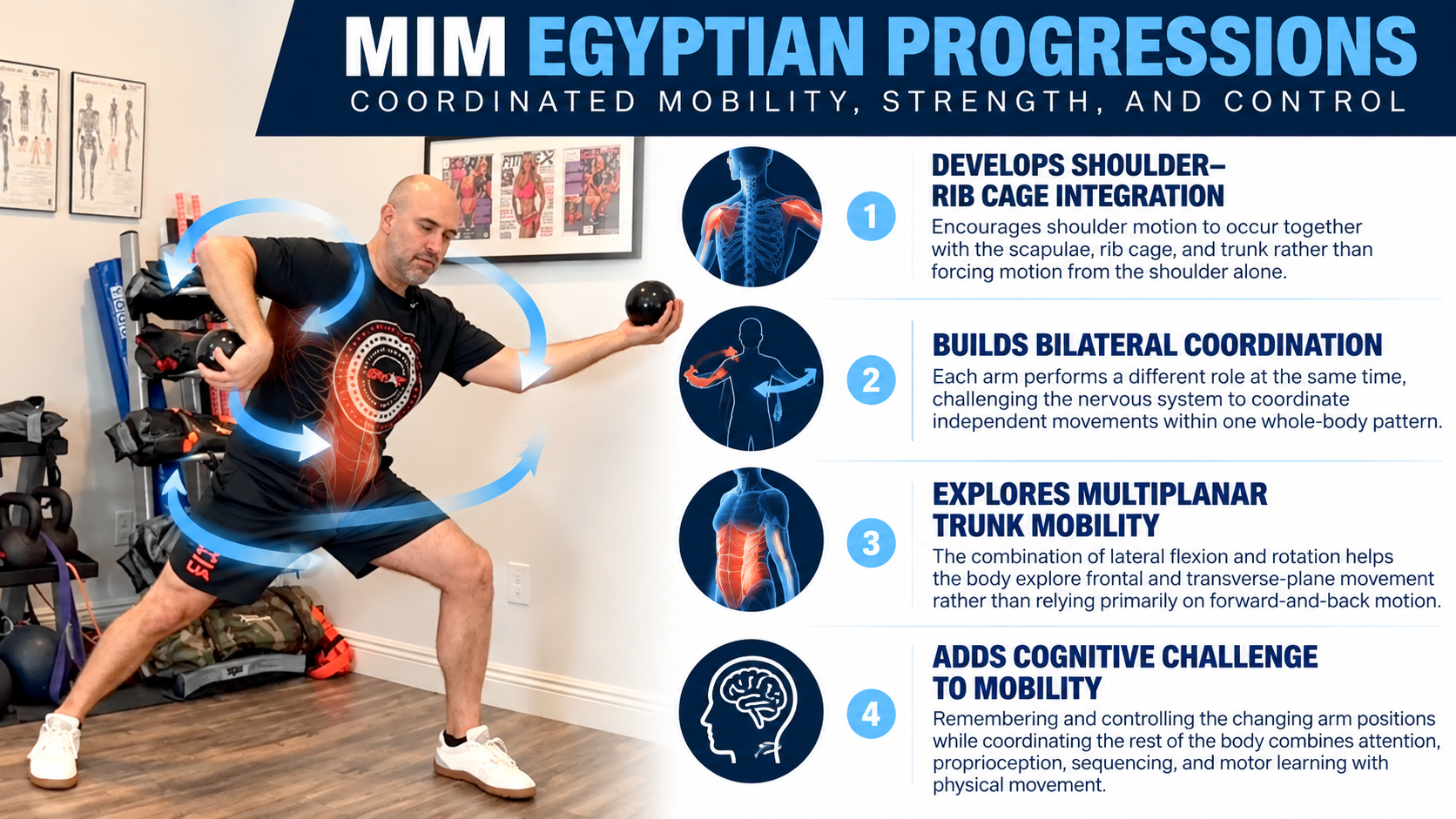
What makes the Egyptian especially interesting from a MIM perspective is the combination of mobility, coordination, sensory awareness, and motor control. The arms are performing different actions simultaneously, so the brain has to continually track where each limb is in space while coordinating those movements with the trunk and lower body. Progressing the pattern can therefore increase not only range of motion, but movement complexity, requiring attention, sequencing, and increasingly refined control. It becomes as much a motor-learning exercise as a mobility exercise.
Want to see these principles translate directly into stronger, more resilient training? Join us live on October 6th at 3pm EST for our brand-new, completely free Mind-Body Webinar HERE. This session is built for anyone serious about performance, you’ll learn how connecting breath, fascia, and movement quality can help you break through plateaus, build strength that actually holds up under load, and move with better efficiency instead of just more effort. We’ll cover how this integrated approach helps prevent the nagging injuries that come from training in isolated patterns, why it improves recovery between sessions, and how it can extend the longevity of your training career so you’re not sidelined by the same overuse issues year after year. Whether you’re an athlete, a coach programming for clients, or someone who trains hard and wants to keep doing so pain-free, you’ll leave with practical tools to apply immediately.