Why Breathing for Mobility, Pain, and Strength Should Look Different
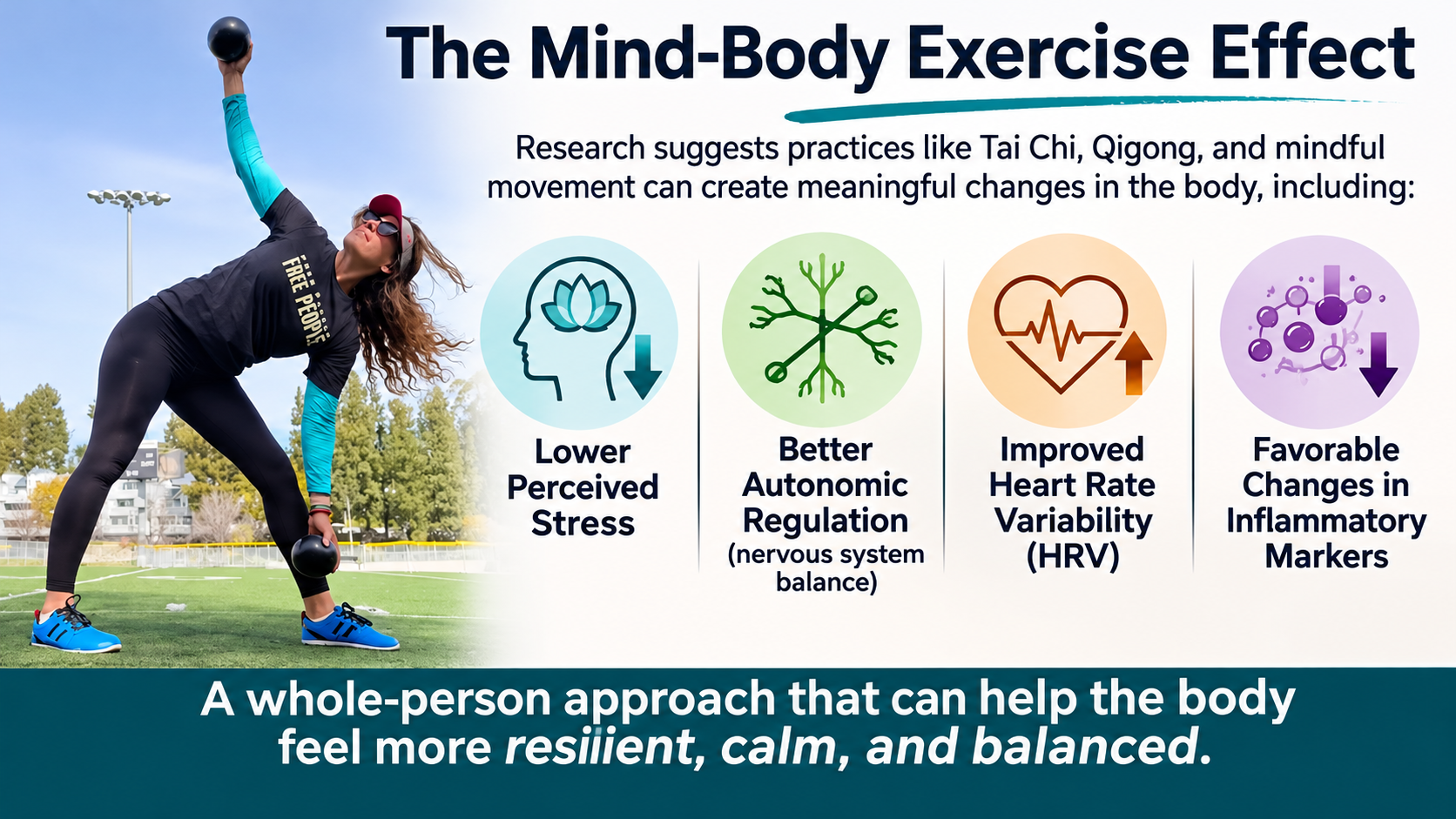
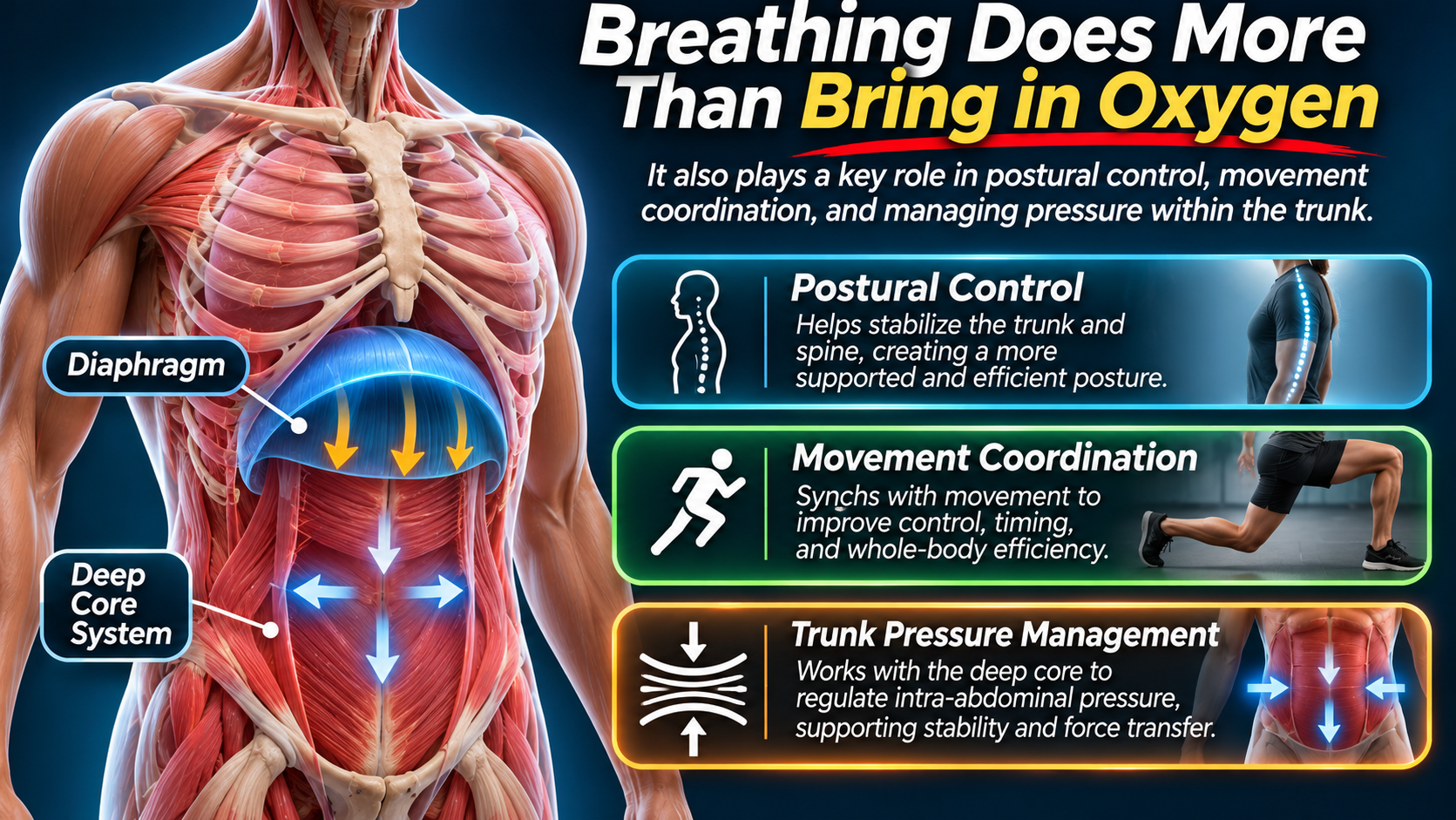
Breathwork has become one of the most popular topics in fitness, and for good reason. Breathing influences much more than our ability to bring oxygen into the body. It interacts with our nervous system, postural control, movement coordination, and how we respond to physical challenges.
However, somewhere along the way, I think we’ve made a mistake in how we teach breathing. We’ve started treating certain breathing techniques as though they are universally beneficial, regardless of what we’re trying to accomplish.
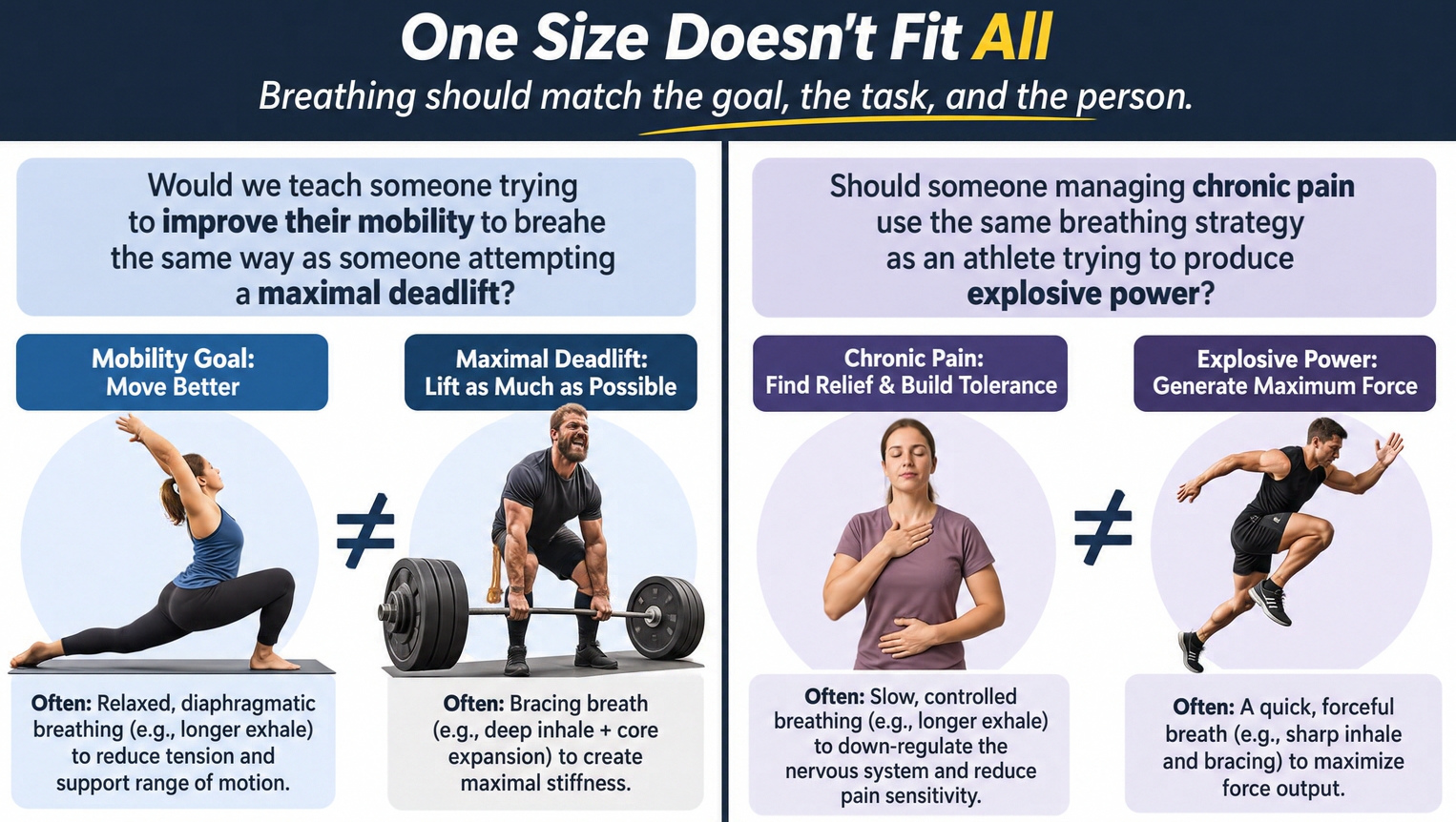
Think about it. Would we teach someone trying to improve their mobility to breathe the same way as someone attempting a maximal deadlift? Should someone managing chronic pain use the same breathing strategy as an athlete trying to produce explosive power?
The answer is no, and understanding why can dramatically improve how we coach movement.
Breathing for Mobility: Creating Opportunities for Better Movement
One of the biggest misconceptions about mobility is that we simply need to stretch muscles until they become longer. However, research increasingly demonstrates that improvements in range of motion can occur through changes in stretch tolerance, sensory perception, and muscle-tendon stiffness, without necessarily producing substantial changes in muscle length.
This is where breathing can become useful.
When someone is performing a mobility exercise, deliberately slowing their breathing and emphasizing a comfortable exhalation may help reduce unnecessary muscular tension and make challenging positions feel more manageable.
This doesn’t mean breathing magically releases fascia or switches off protective mechanisms in the nervous system. Rather, breathing can influence arousal, attention, and how we experience physical sensations.
For example, during a half-kneeling hip mobility drill, we might encourage someone to inhale comfortably and slowly exhale as they move into a gentle stretch. Instead of forcing greater range of motion, we encourage them to explore what they can comfortably control.
The goal isn’t simply to become more flexible. It’s to develop greater movement confidence and usable mobility.
Breathing for Nervous System Regulation and Chronic Pain
Breathing also provides an interesting opportunity to influence our autonomic nervous system.
Research on slow breathing suggests it can influence heart rate variability, baroreflex function, and aspects of parasympathetic regulation. This helps explain why slower breathing can sometimes reduce physiological arousal and support relaxation.
However, we should be careful about suggesting that any specific breathing technique automatically puts someone into a parasympathetic state.
The effects depend on the individual, the breathing pattern, and the context.
This becomes especially important when working with people experiencing chronic pain.
Chronic pain isn’t simply a reflection of tissue damage. It involves complex interactions between sensory processing, expectations, emotions, past experiences, and the nervous system.
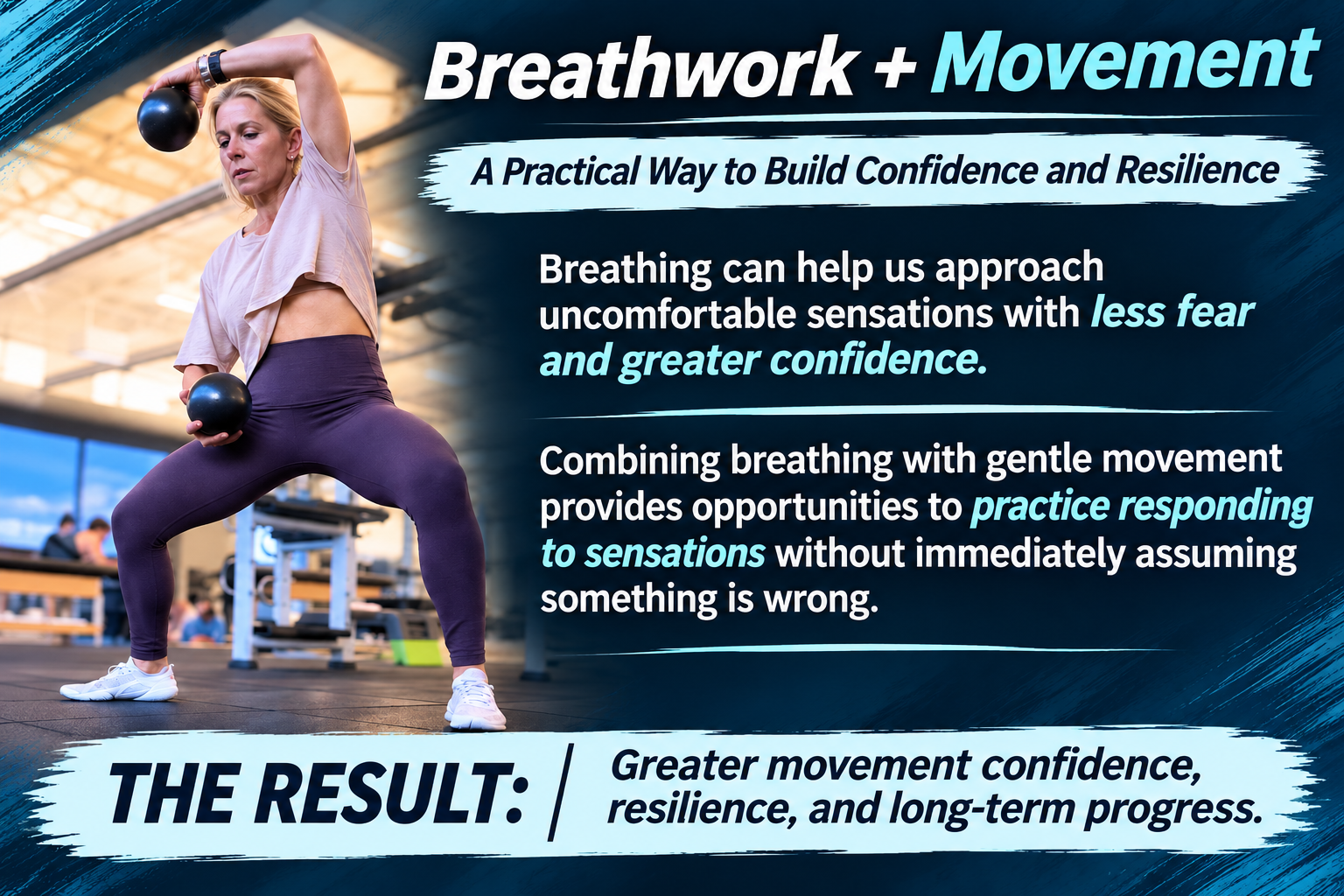
For some individuals, breathing exercises can help them approach uncomfortable sensations with less fear and greater confidence. Combining breathing with gentle movement may also provide opportunities to practice responding to sensations without immediately assuming something is wrong.
Consider a client who experiences discomfort during a controlled rotation exercise. Instead of instructing them to brace harder or avoid movement altogether, we might encourage a comfortable exhalation while moving through a tolerable range.
We’re not trying to breathe their pain away. We’re helping them develop a different relationship with movement and discomfort.
Importantly, breathwork isn’t a stand-alone cure for chronic pain. It is one potentially useful component of a broader approach involving movement, education, progressive loading, and psychological flexibility.
Breathing for Strength: Creating Pressure Rather Than Relaxation
Now consider what happens when someone prepares to lift a heavy weight.
Suddenly, our priorities change.
Instead of minimizing muscular tension, we need to create sufficient trunk stiffness to resist unwanted movement and efficiently transfer forces between the upper and lower body.
This is where the biomechanics of breathing become especially important.
The diaphragm, abdominal wall, pelvic floor, and spinal muscles work together to regulate intra-abdominal pressure. When we inhale, the diaphragm contracts and descends, contributing to changes in pressure within the abdominal cavity.
During heavy lifting, we can use this mechanism to create greater trunk rigidity.
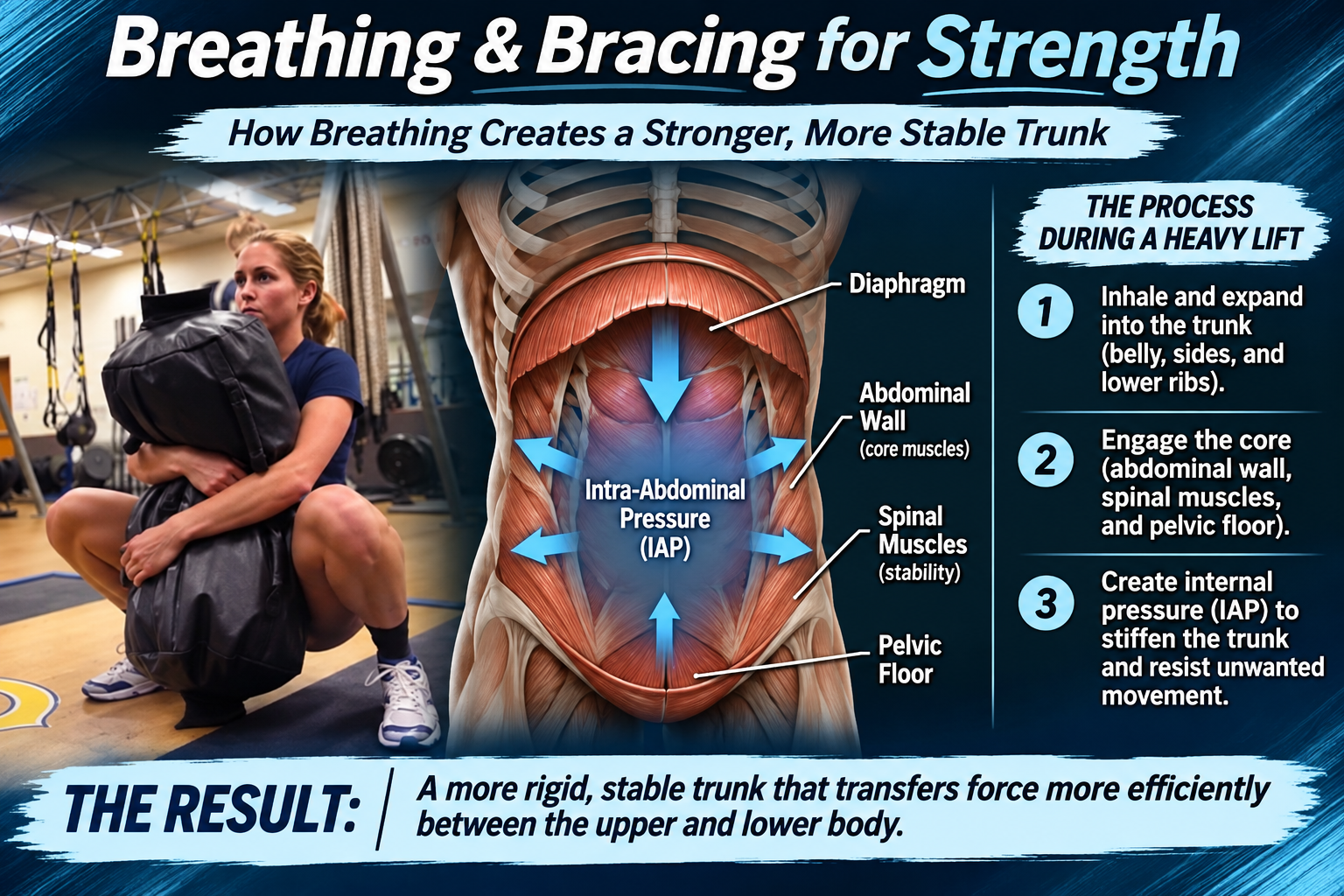
One strategy involves taking a controlled breath into the trunk, expanding the abdomen and lower rib cage, and then contracting the abdominal musculature to create a firm, pressurized cylinder.
Rather than simply sucking the stomach inward, we encourage circumferential expansion and bracing.
Think of it as creating an internal support system that helps the trunk resist unwanted flexion, extension, and rotation.
During particularly demanding lifts, experienced lifters may briefly hold their breath against a closed airway, known as the Valsalva maneuver. This increases intra-abdominal and intrathoracic pressure, potentially improving trunk stiffness during maximal efforts.
Research supports the relationship between heavier resistance exercise and increased intra-abdominal pressure. However, this strategy also produces substantial cardiovascular demands, including temporary increases in blood pressure.
The important lesson is that breathing for heavy lifting is fundamentally different from breathing to encourage relaxation.
Making Breathing Practical for Our Clients
The challenge for coaches is translating these concepts into something clients can actually use without overwhelming them.
We don’t need to begin with complicated breathing assessments or insist that everyone practice lengthy breathing drills.
Instead, we can introduce breathing through familiar movements.
During mobility exercises, encourage comfortable breathing and gentle exhalations as clients explore controlled ranges of motion. During lower-intensity strength exercises, teach clients to coordinate their breathing with movement while maintaining appropriate trunk control.
As resistance increases, introduce the idea of expanding the trunk and creating greater abdominal pressure before initiating a challenging lift. Clients can learn to maintain sufficient bracing while breathing between repetitions rather than holding their breath throughout an entire set.
The progression is about matching the breathing strategy to the physical demands of the exercise.
We should also remember that there isn’t one universally correct breathing pattern. Individual anatomy, exercise intensity, medical history, and experience all influence which strategies are appropriate.
The Real Goal Is Breathing Adaptability
Perhaps the biggest mistake we’ve made in fitness is assuming that better breathing means breathing more slowly, more deeply, or more deliberately all the time.
Sometimes we want breathing to help us settle our nervous system. Other times, we want it to support movement exploration, manage discomfort, or create the pressure necessary to lift challenging weights.
The goal isn’t to master one perfect breathing technique. It’s to develop the ability to adapt our breathing to what our body needs.
That’s what makes breathwork so valuable when integrated into movement. Rather than becoming another isolated exercise, breathing becomes part of how we teach mobility, stability, strength, and resilience.
And perhaps that’s the most important shift we can make as coaches: stop asking whether someone is breathing correctly and start asking whether their breathing strategy supports what they’re trying to accomplish.
Save 30% on our NEW 2-week “Beyond Breath” coach’s corner online course with code “breath30” HERE
References
- Stretching and mobility: A 2025 systematic review examined changes in stretch tolerance, passive stiffness, and muscle fascicle length associated with improvements in range of motion.
- Slow breathing and autonomic regulation: Laborde and colleagues (2022) reviewed evidence linking voluntary slow breathing with improvements in vagally mediated heart rate variability.
- Breathing and pain: Experimental research suggests that autonomic changes during slow breathing do not necessarily produce meaningful reductions in pain intensity.
- Breathing and lifting biomechanics: A systematic review of 16 studies examined intra-abdominal and intrathoracic pressure during high-intensity resistance exercise.