Unlocking Better Shoulder, Hip, & Core Stability & Strength
Most people assume building real strength, stability, and mobility requires more: more weight, more exercises, more separate work for each individual quality. Often training these qualities is done as individual components of a workout, not as a way that takes advantage of the synergistic effect of training them together.
It’s an intuitive approach, but it’s not necessarily an efficient or effective one. Watch Larisa Lotz move through our Myofascial Integrated Movement (MIM) exercises, and you’ll see a different model entirely, one that builds all three qualities simultaneously, often without heavy load, by training the body’s fascial chains directly rather than chasing each quality in isolation.
Why Fascial Chains Are the Real Starting Point
To understand why this approach is more efficient, you have to understand what fascial chains actually are and why isolated training so often falls short of addressing them.
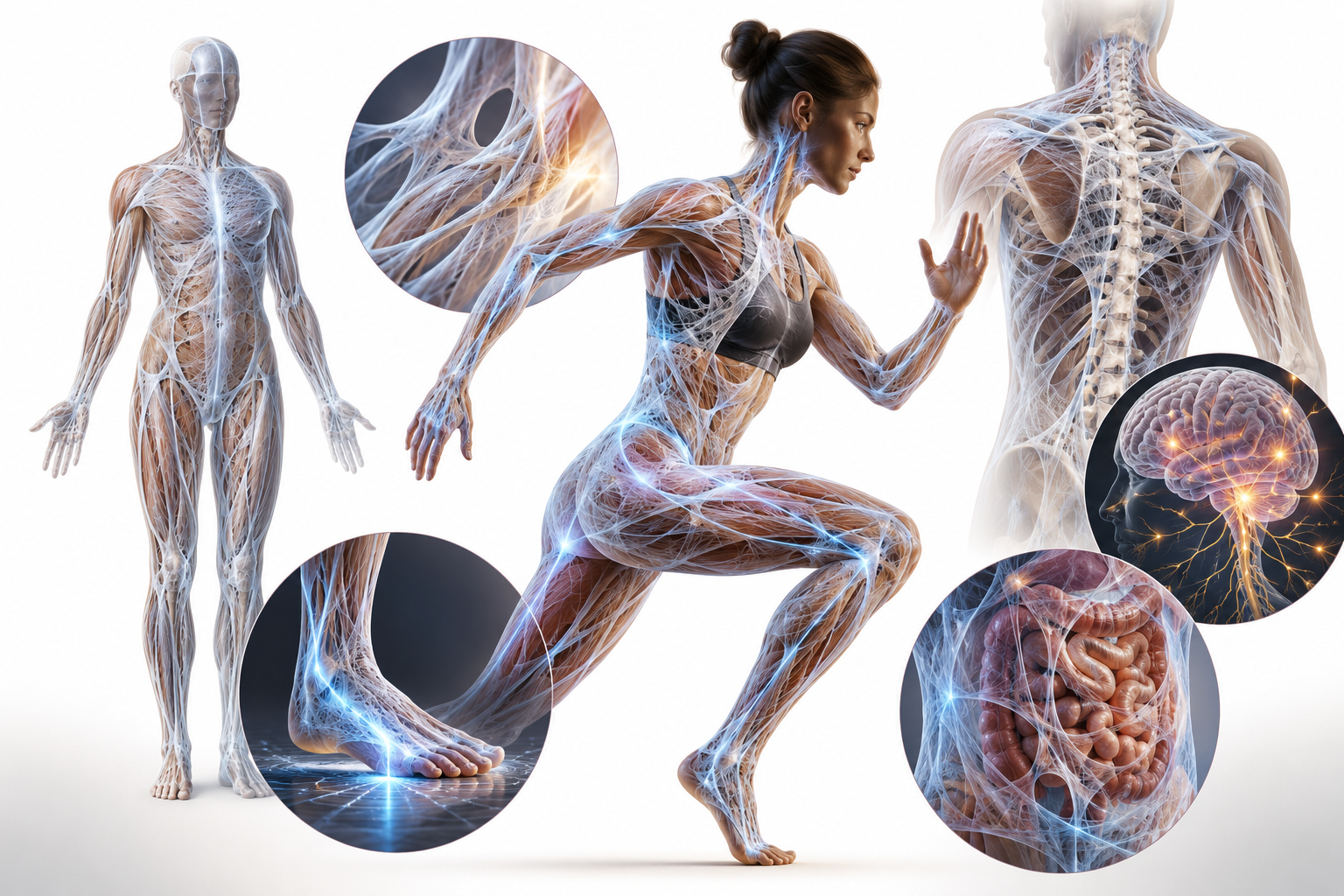
Fascia is the connective tissue wrapping around and linking your muscles, and it doesn’t stop neatly at the edges of individual muscles the way anatomy diagrams often suggest. Instead, it forms continuous lines of tension running throughout the entire body chains that transmit force from one region to another, sometimes across significant distances. When training focuses only on isolated muscles, it frequently misses the actual source of common movement issues: compensation, restriction, and pain that shows up in one area but originates somewhere else along the chain entirely.
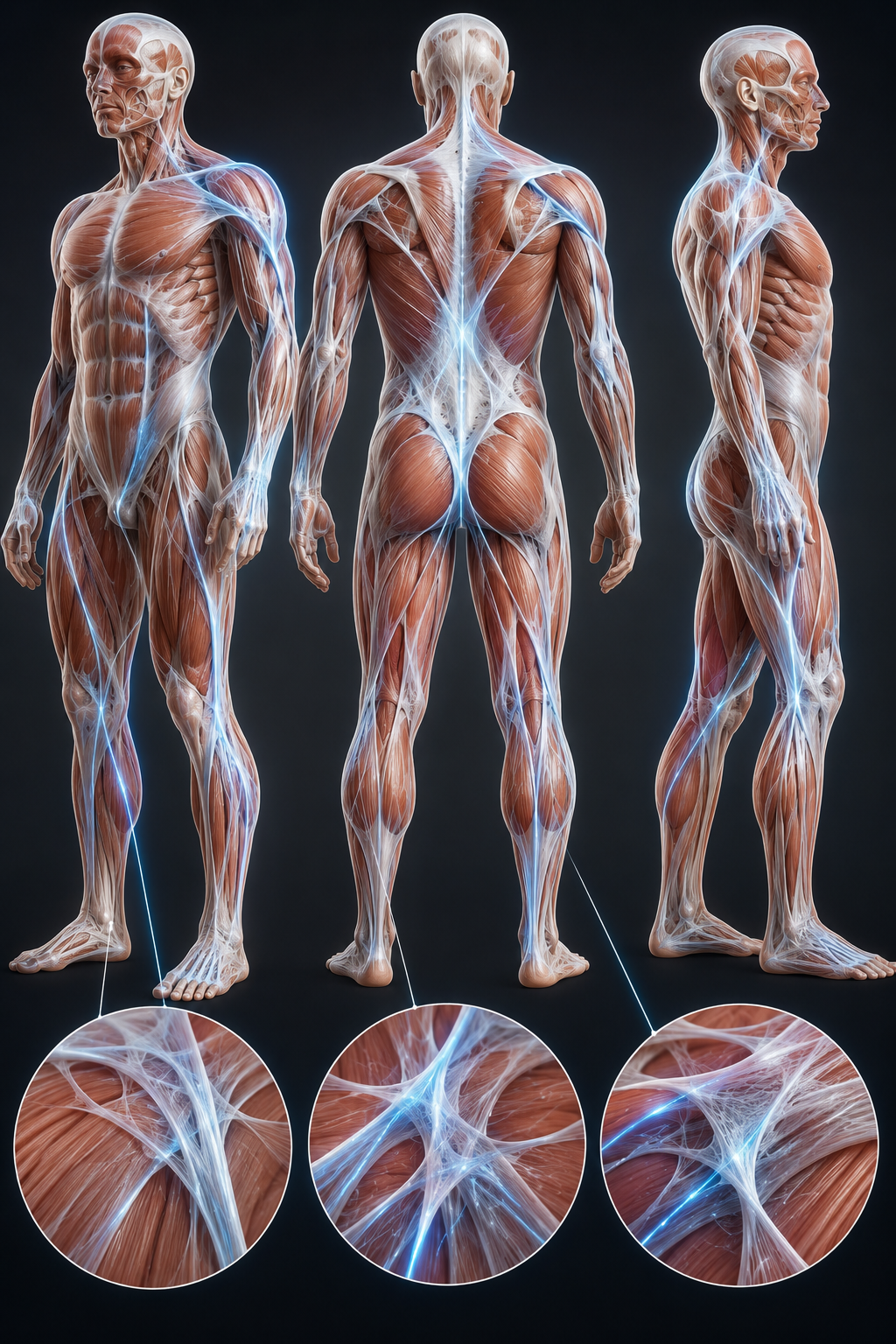
This is precisely why isolated mobility and stability work, on its own, often produces limited or short-lived results. You can mobilize a tight hip repeatedly, but if the restriction is actually being driven by a fascial chain running up through the trunk or down through the ankle, isolated hip work will keep addressing a symptom rather than the source. Training the chain as a connected system, rather than one isolated segment, is what actually resolves the issue efficiently and that’s the model these MIM exercises are built around.
Efficiency Without Heavy Load
Once you understand fascial chains, it becomes clear why these exercises can build real strength and stability with so little external weight. The demand isn’t coming primarily from load it’s coming from manipulating leverage, circular movement, and body position so the working muscles and fascia have to generate and control force through mechanically challenging positions.
A slow, controlled circular arm pattern performed with the arm extended dramatically increases leverage demand on the shoulder and its connected fascial line compared to the same pattern with a bent arm no added weight required. An asymmetrical or compromised stance similarly increases the stability demand on the core and hips, again without extra load. This is a far more efficient way to train: instead of adding weight to force adaptation, you’re increasing the mechanical and fascial demand of the movement itself.
The Front and Back Lines
The front and back lines run vertically along the front and rear of the body, connecting the toes to the top of the skull. These lines are central to posture and basic movement integrity. When either line becomes restricted or poorly conditioned, you often see compensatory patterns show up as forward head posture, tight hip flexors, or a lower back working overtime to compensate for insufficient support elsewhere along the chain.
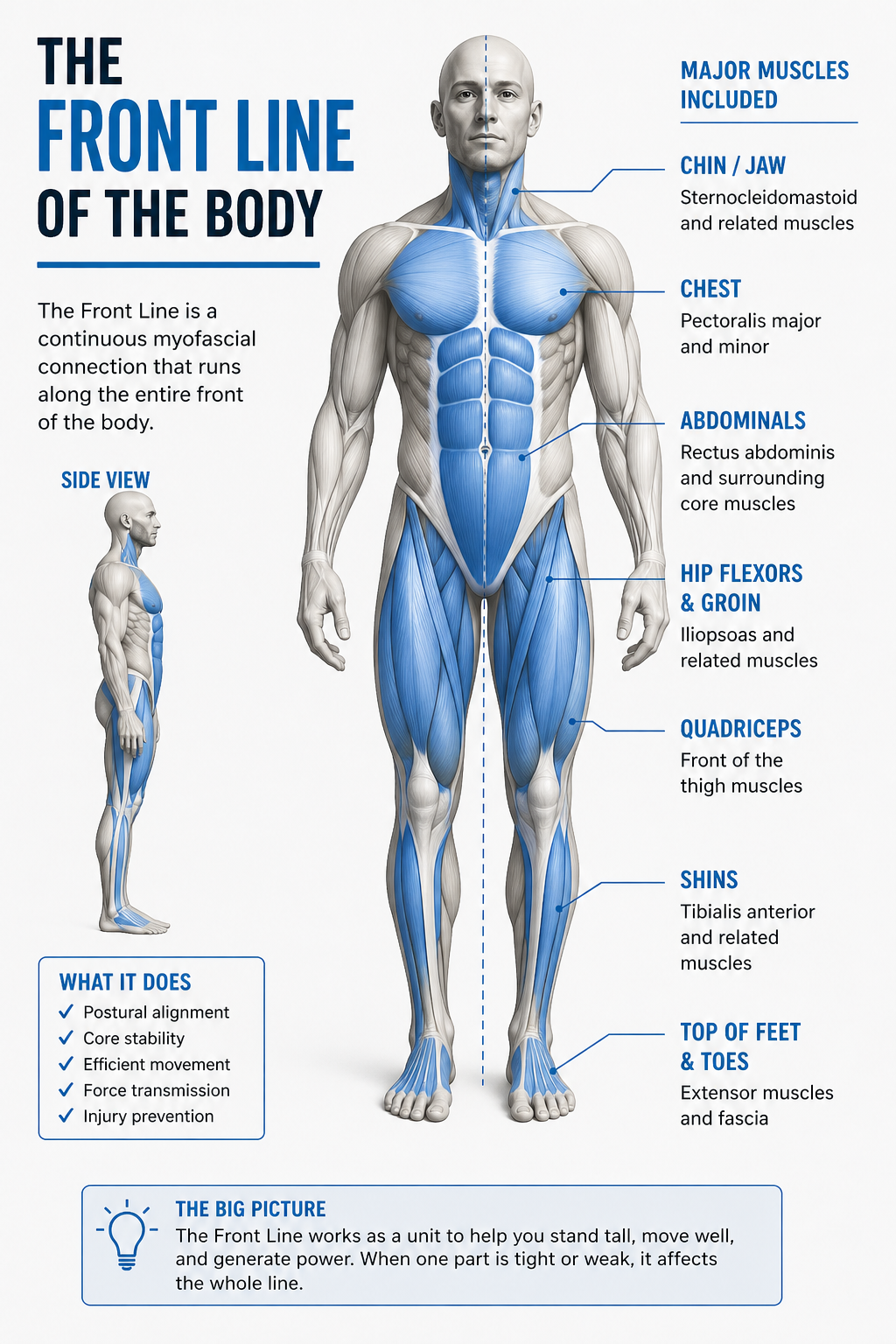
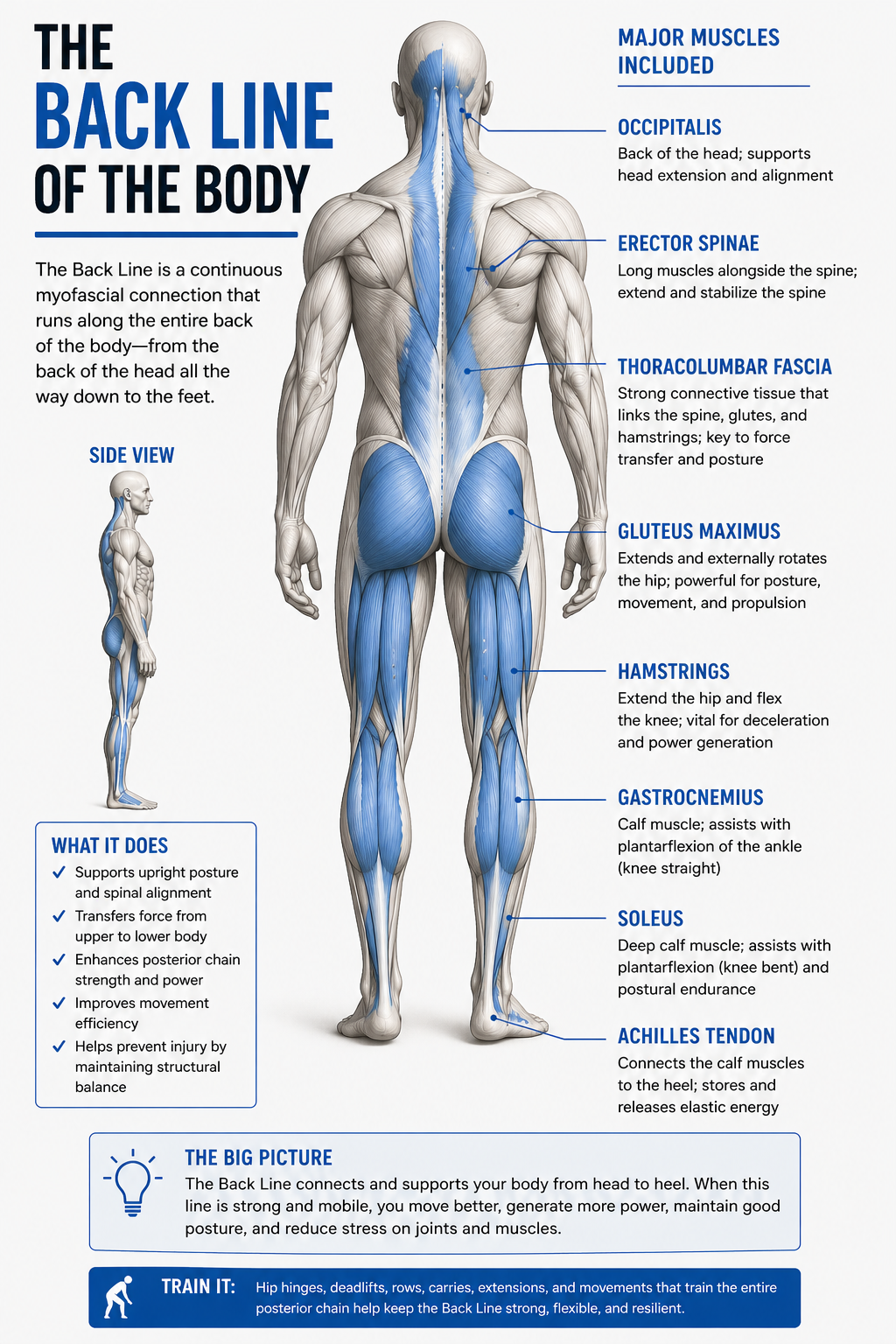
Training controlled flexion and extension through multiple joints simultaneously rather than isolated crunches or back extensions addresses these lines as the connected systems they actually are.
The Arm Lines
The arm lines extend from the fingers and hands, through the wrists, forearms, shoulders, and into the trunk. These lines matter enormously for shoulder health and upper-body function, yet they’re frequently ignored in favor of isolated shoulder or arm exercises that never address the full chain.
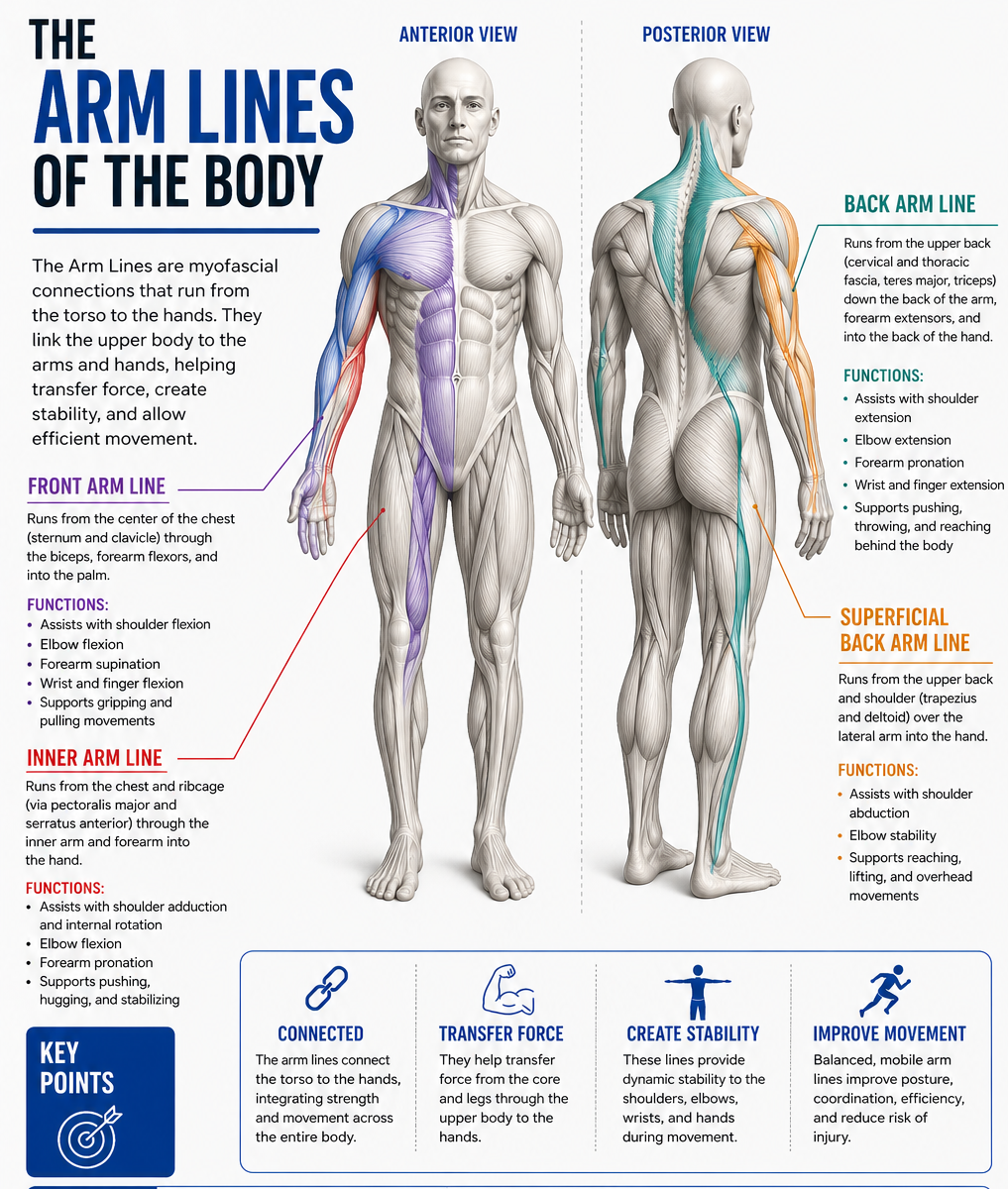
Circular, reaching, and leveraged movement patterns like the ones Larisa demonstrates engage these arm lines as connected systems, which is often exactly what’s needed to resolve shoulder impingement, restricted overhead mobility, or forearm and grip issues that don’t respond well to isolated strengthening alone.
The Lateral Line
The lateral line runs along the outside of the body, from the foot up through the outer leg, hip, ribs, and neck. This line is essential for frontal-plane stability resisting unwanted side-to-side collapse during single-leg movement, walking, or lateral changes of direction.
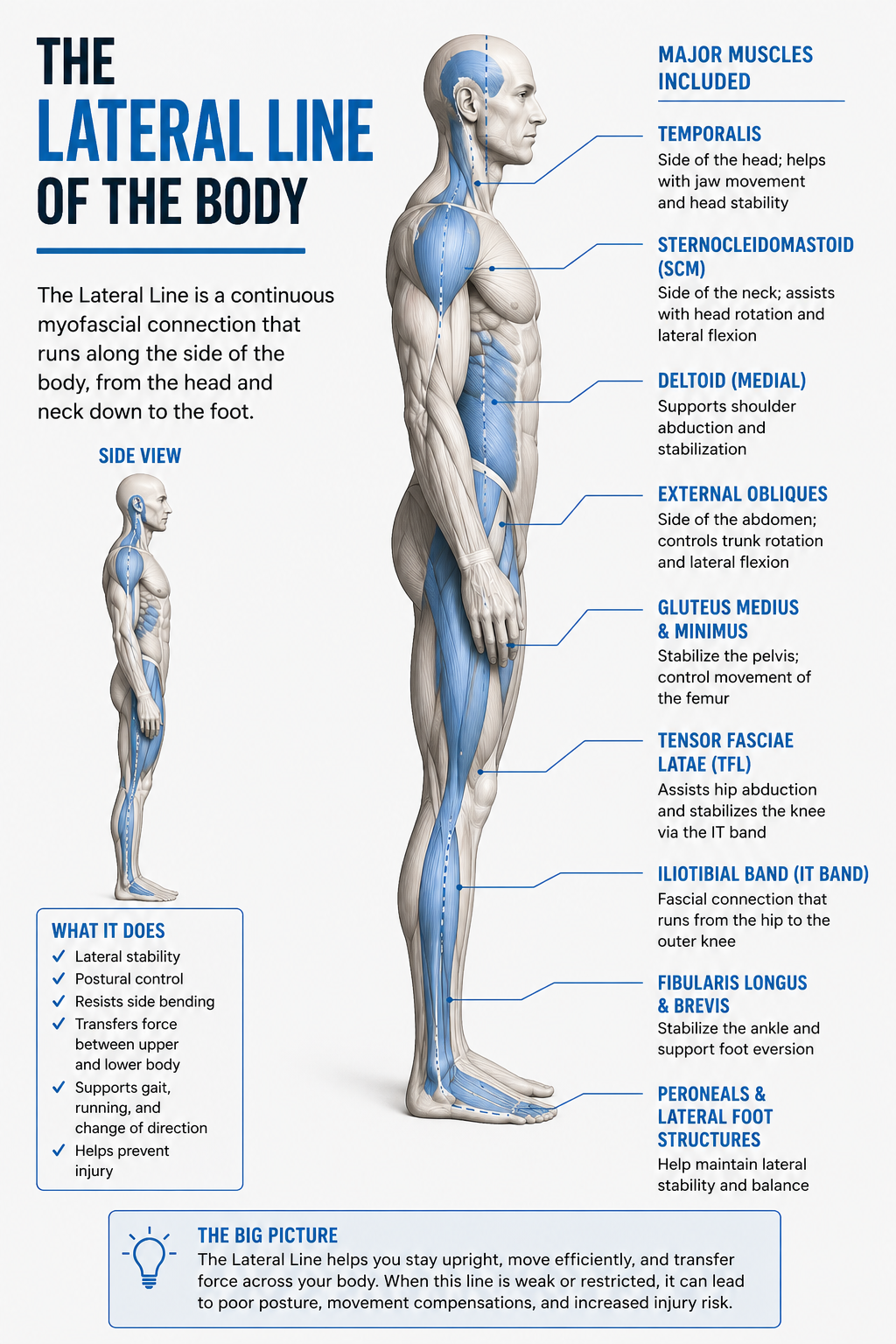
Asymmetrical stances and side-loaded positions challenge this line directly, building the kind of lateral stability that conventional, bilateral-focused training frequently overlooks.
The Spiral Line
The spiral line wraps diagonally around the body, connecting one side of the pelvis to the opposite shoulder through a continuous rotational pathway. This line drives nearly every powerful, coordinated movement the body performs throwing, rotating, changing direction and it’s exactly what circular, diagonal MIM patterns are built to train.
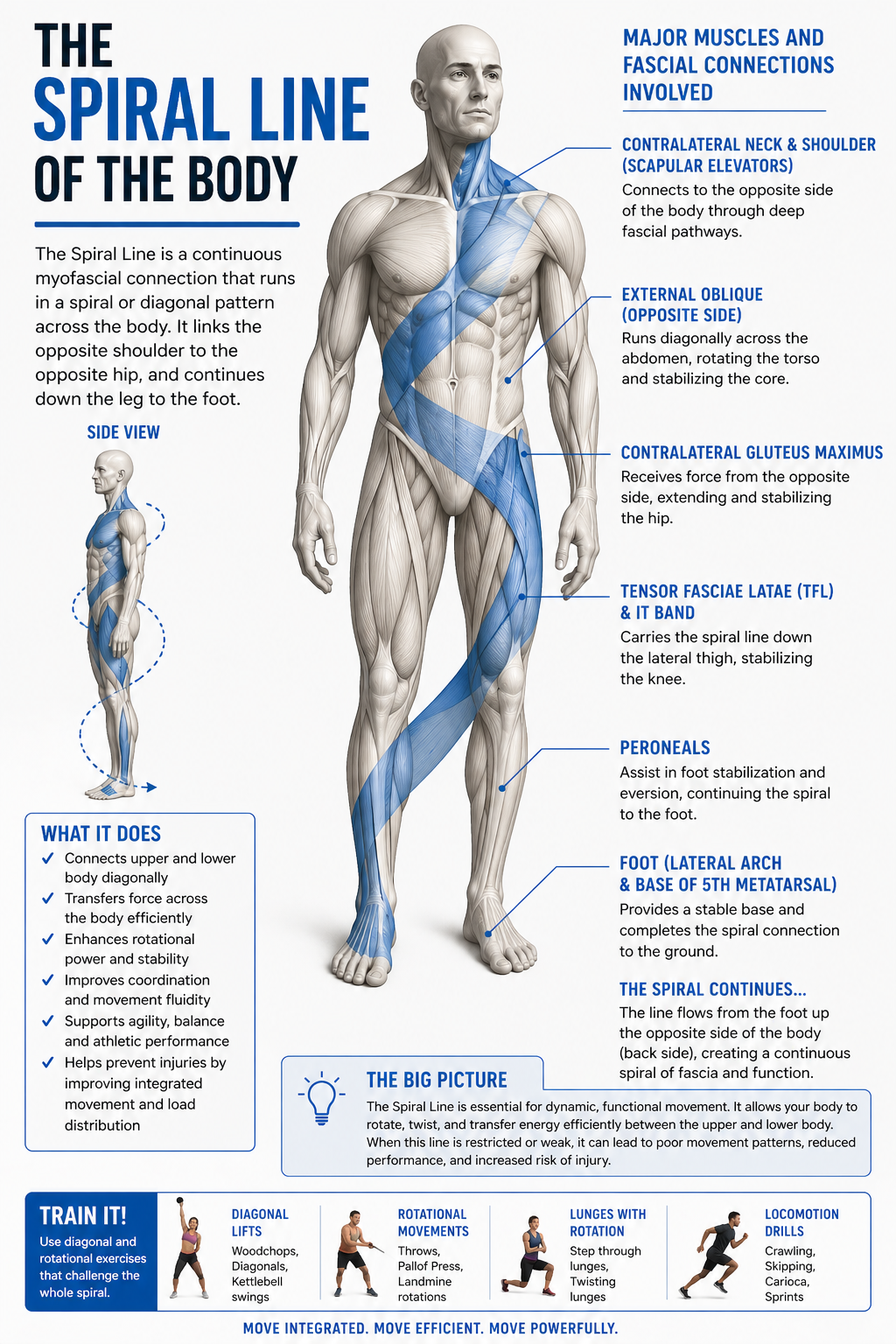
Restrictions along the spiral line frequently show up as reduced rotational power or chronic tightness that seems to move around the body without an obvious, single source. Training this line directly is often the missing piece isolated, single-plane training simply can’t reach.
Once you understand fascial chains, the goal shifts. It’s no longer about how much weight you can add or how many isolated exercises you can stack into a session. It’s about whether a movement is challenging the connected systems the body actually depends on. That shift is what makes this approach to strength, stability, and mobility so efficient and so effective, heavy load or not.
Don’t miss the LAST days to save and register for our 4-week Myofascial Integrated Movement online classes. Use code “mim25” HERE as we start July 28th!
View this post on Instagram