What Fitness Gets Wrong About Explosive Power
For most of my career, if you had told me Tai Chi could teach me something about explosive power, I probably would have been MORE than skeptical.
Like a lot of fitness professionals, I put “mind-body” exercise into a particular box.
Tai Chi, Qigong, yoga, and similar practices could be great for mobility, recovery, balance, managing stress, and helping people feel better.
But serious strength, athleticism, and power training?
No way! That was something different.
After almost 30 years in the fitness industry, I thought I had a pretty good understanding of what power training looked like.
Then I met Tai Chi teacher Master Violet Li.
Violet completely challenged my assumptions.
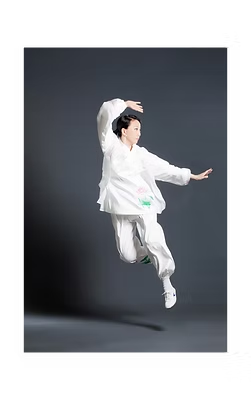
She is a disciple within the Chen family lineage (directly of Grandmaster, Chen Zhenglei) that developed Tai Chi as a martial art. What makes her story even more interesting is that she wasn’t someone who started training at five years old and spent her entire life developing these abilities.
Violet came to Tai Chi as an adult, in part because persistent back problems were interfering with her life.
Today, at 73 years young, her ability to move explosively, athletically, and with remarkable control makes me jealous all the time.
Watching Violet opened my eyes to a side of Tai Chi I knew almost nothing about.
Fa Jin (pronounced “fah gin”).
Tai Chi Has Its Own Concept of Explosive Power
Fa Jin refers to the explosive expression of force.
What fascinated me wasn’t simply that Tai Chi practitioners could move explosively. It was HOW they thought about producing that power.
In fitness, we often associate creating more force with trying harder, contracting harder, and generating more muscular tension.
Fa Jin introduces an interesting paradox:
Sometimes excessive tension makes you LESS powerful.
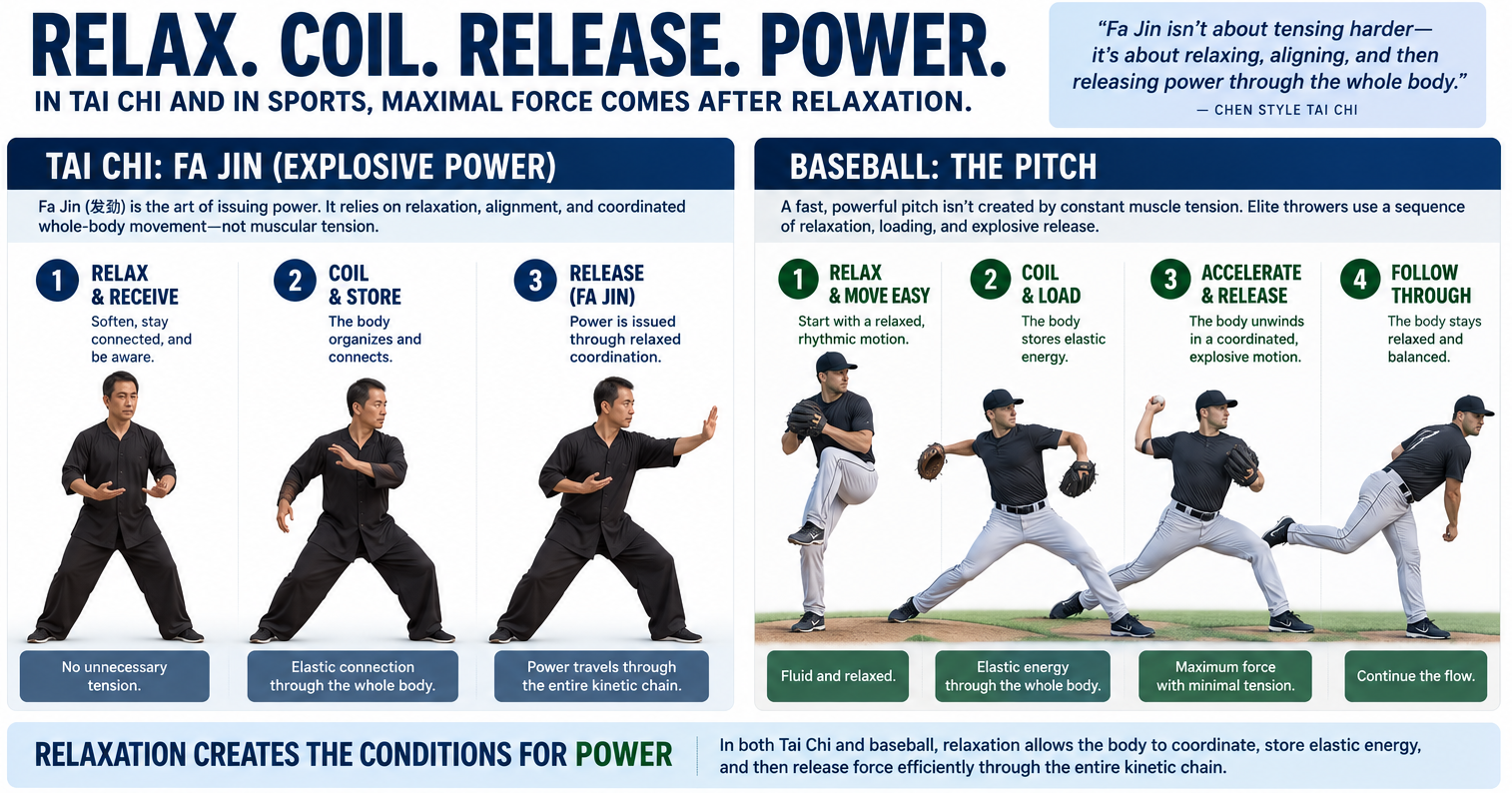
Imagine trying to throw a baseball while consciously contracting every muscle in your body as hard as possible. You would be incredibly stiff, slow, and probably wouldn’t throw very far.
Power requires force, but it also requires timing.
We need enough stability while allowing other parts of the body to move freely. Muscles have to rapidly coordinate, transfer force, and sequence movement.
Suddenly, Fa Jin starts sounding a lot less like an ancient or mystical concept and much more like principles we already discuss in sports performance.
Power Starts at the Ground
One of the biggest lessons Violet emphasized was that powerful movement doesn’t begin at the arm or shoulder.
It starts with our connection to the ground.
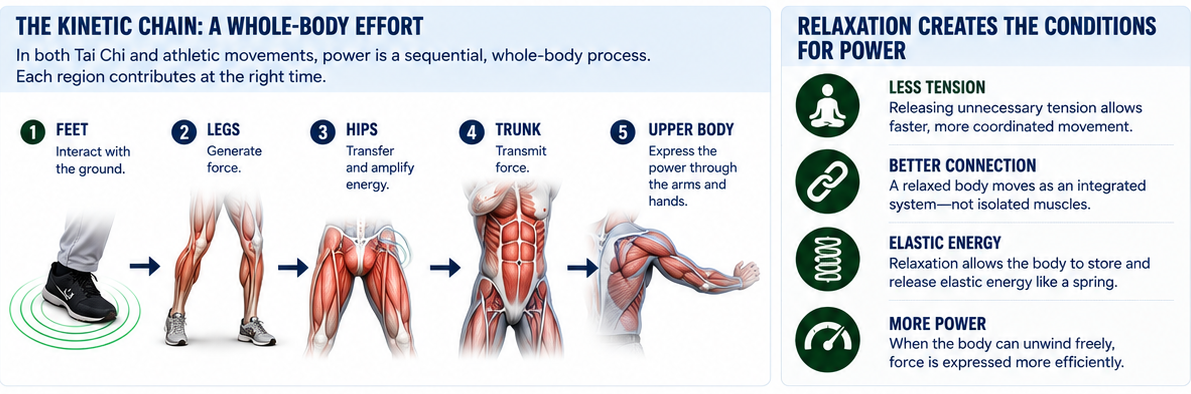
The feet interact with the ground, the legs and hips contribute force, the trunk helps transmit it, and that energy can ultimately be expressed through the upper body and extremities.
Sound familiar?
It should.
That’s the kinetic chain.
Whether you’re throwing a baseball, swinging a racquet, punching, jumping, or performing an explosive rotational exercise, powerful movement depends upon different regions of the body contributing at the right time.
Fa Jin trains this idea relentlessly.
It also emphasizes something we sometimes overlook when chasing bigger strength numbers.
Position matters.
You can possess tremendous strength, but if your body isn’t organized effectively, you may never express that strength efficiently.
The goal isn’t simply making individual muscles stronger. It’s teaching the entire system to work together.
Maybe “Relaxation” Isn’t the Opposite of Performance
This may have been the biggest shift in my thinking.
When fitness professionals hear words like relaxation, breathing, or reducing tension, we tend to associate them with recovery.
But high-level movement requires the ability to regulate tension and move energy.
Being powerful doesn’t mean being maximally tense throughout an entire movement.
It means creating the right amount of tension, in the right places, at the right time, and releasing unnecessary tension just as quickly.
That can make movement faster, smoother, and more efficient.
Suddenly, some of the “soft” qualities I associated with Tai Chi didn’t seem very soft at all.
View this post on Instagram
You Don’t Have to Become a Tai Chi Master
This is probably the most important point.
You don’t have to become a Tai Chi master to benefit from what Fa Jin can teach us.
You don’t even have to be particularly interested in learning traditional Tai Chi.
The three exercises Violet introduces give us opportunities to explore qualities that matter to almost everyone.
Can you create force from the ground instead of relying primarily on your arms?
Can you connect your feet, hips, trunk, and upper body into one coordinated action?
Can you shift your weight, rotate, accelerate, and regain control?
Can you create stability without becoming unnecessarily stiff?
Can you produce force quickly while maintaining balance?
Those aren’t just Tai Chi skills.
Those are human movement skills.
They matter when you play a sport, throw something, lift an awkward object, change direction, catch yourself from a stumble, or simply want your body to remain capable as you get older.
That’s why I don’t view these exercises as an attempt to turn fitness enthusiasts into traditional Tai Chi practitioners.
Think of them as movement education.
For athletes, they offer another way to explore efficient power.
For fitness enthusiasts, they challenge coordination, mobility, balance, and whole-body strength.
And as we get older, they can help us continue practicing something traditional fitness often forgets: the ability to react, redirect, stabilize, accelerate, and move confidently.
That’s ultimately what Violet changed for me.
At 73, she isn’t impressive simply because she can perform Tai Chi forms.
She’s impressive because of what her movement represents: balance, mobility, coordination, athleticism, speed, body awareness, and the ability to suddenly express force through her entire body.
Fa Jin isn’t valuable because everyone needs to become great at Tai Chi. It’s valuable because it gives us another way to practice being athletic, adaptable, resilient, balanced, and powerful in ways that translate to life.
Sometimes becoming more powerful isn’t about learning to work harder.
It’s about learning how to stop fighting your own body.