What Most Knee Exercises Miss In Helping Knee Pain

When someone experiences knee pain, the traditional fitness approach is usually straightforward: strengthen the quadriceps, improve flexibility, and address weaknesses around the joint.
These strategies certainly have value. However, growing research suggests that improving knee function may require looking beyond individual muscles and considering how the entire body coordinates movement, processes sensory information, and responds to pain.
This is where mind-body fitness offers an interesting opportunity, not as a replacement for strengthening, but as a way of integrating physical and neurological aspects of movement.
And the research supporting this approach is becoming increasingly compelling.
Research Shows Mind-Body Exercise Can Significantly Improve Knee Osteoarthritis
One of the strongest pieces of evidence comes from a 2025 systematic review and network meta-analysis published in the Journal of Orthopaedic Surgery and Research.
Researchers analyzed 38 randomized controlled trials involving 2,561 participants with knee osteoarthritis.
They compared different mind-body exercise approaches, the findings were encouraging.
The results showedsignificantly improved knee pain and physical function compared with usual care. Not only did it reduce pain, but also meaningful improvements in quality of life.
Importantly, this doesn’t mean that you have to give up all other knee strengthening exercises, but it probably does point to making mind-body fitness a good part of our programming. It demonstrates that meaningful improvements in knee function can occur through approaches combining movement, coordination, attention, and physical conditioning.
View this post on Instagram
Mind-Body Can Produce Results Comparable to Physical Therapy
Perhaps one of the most fascinating studies was published in Annals of Internal Medicine in 2016.
Researchers recruited 204 individuals with symptomatic knee osteoarthritis and randomly assigned them to either a Tai Chi program or conventional physical therapy.
The Tai Chi group participated in twice-weekly sessions for 12 weeks.
The physical therapy group received supervised treatment followed by a monitored home exercise program.
Both groups experienced substantial improvements in knee pain and physical function.

Tai Chi produced improvements comparable to physical therapy for the primary outcome, while also demonstrating advantages in some secondary psychological outcomes.
These findings are important because Tai Chi doesn’t simply strengthen the muscles surrounding the knee.
It incorporates controlled weight shifts, coordinated stepping, balance, postural adjustments, and continuous movement.
Participants are repeatedly challenged to organize their bodies while managing changing demands.
I know this may sound intimidating to many people that may feel like, “great, but I don’t know anything about Tai Chi!” That is why we created Myofascial Integrated Movement (MIM) training so that we could help bridge mind-body fitness to more familiar functional fitness concepts.
The Knee Doesn’t Function in Isolation
Consider what happens when we walk, climb stairs, change direction, or step over an obstacle.
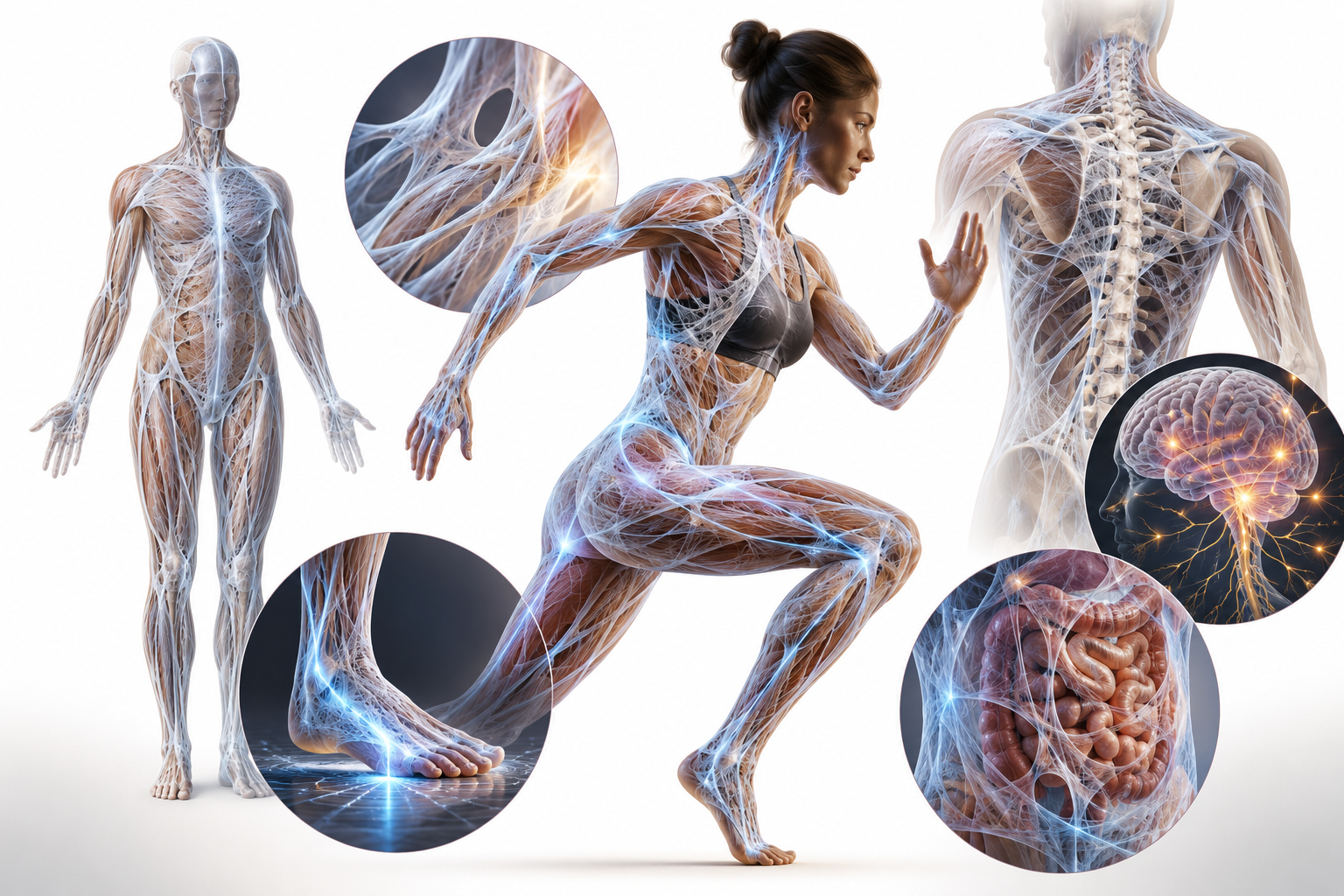
The knee must respond to forces generated and controlled throughout the body.
The foot interacts with the ground. The ankle accommodates movement. The hips and pelvis influence lower-extremity mechanics. The trunk helps organize balance and movement.
These relationships become especially important during single-leg activities.
Mind-body movement practices frequently challenge these connections through controlled stepping, shifting the center of mass, and coordinating movements across multiple joints.
Rather than focusing exclusively on strengthening one muscle, they can develop the ability to coordinate several regions simultaneously.
This doesn’t make isolated strengthening unnecessary.
It suggests that building muscular capacity and learning to use that capacity during integrated movement are complementary goals.
For fitness professionals, this distinction can fundamentally change how we approach knee training.
Knee Pain Isn’t Just About Joint Structure
Another important consideration is how the nervous system processes pain.
Knee osteoarthritis involves changes within the joint, but pain severity doesn’t always correspond directly to the extent of structural changes.
Pain is influenced by multiple biological, psychological, and social factors.
Someone experiencing persistent knee pain may gradually become less confident in their ability to squat, step, rotate, or balance.
Movement can become associated with uncertainty and concern.
Appropriately graded mind-body training may provide opportunities to rebuild confidence through successful movement experiences.
Instead of immediately demanding greater strength or range of motion, a coach can manipulate stance, movement speed, direction, and balance challenges.
The objective is to create manageable experiences that allow someone to explore movement without consistently exceeding their current tolerance.
The goal isn’t to convince someone their pain is imaginary. It’s to help them develop greater physical capacity and confidence despite their symptoms.
Clinical guidelines recognize the importance of exercise, self-management, and psychological factors in osteoarthritis care.
Mind-Body Fitness Is Now Recognized in Clinical Guidelines
The American College of Rheumatology and Arthritis Foundation guidelines provide particularly strong support for this discussion.
Their recommendations include:
- Exercise: Strongly recommended for knee osteoarthritis.
- Tai Chi: Strongly recommended for knee and hip osteoarthritis.
- Yoga: Conditionally recommended for knee osteoarthritis.
- Self-management and self-efficacy programs: Strongly recommended.
These recommendations reflect an important evolution in how knee osteoarthritis is managed.
Treatment isn’t exclusively about addressing joint structures.
It’s also about improving function, maintaining physical activity, developing confidence, and supporting long-term self-management.
Why This Matters for Myofascial Integrated Movement
This research provides an important foundation for how we approach Myofascial Integrated Movement (MIM).
Rather than treating mind-body exercise as something separate from strength training, MIM integrates principles of both.
For example, consider a simple diagonal stepping exercise.
We can challenge the individual to control their foot pressure, coordinate hip and trunk movement, maintain balance, and reach toward a specific target.
We can then manipulate resistance, movement direction, speed, or attentional demands.
One exercise can simultaneously challenge strength, balance, coordination, sensory awareness, and movement confidence.
MIM provides a practical framework for applying several principles consistent with the broader evidence supporting integrated mind-body movement.
Better Knees Require More Than Stronger Muscles
Strength remains essential for maintaining healthy, functional knees.
But strength alone doesn’t capture everything required for successful movement.
We also need coordination, balance, adaptability, and confidence in our ability to move.
The growing research on mind-body practices suggests that combining these qualities can meaningfully improve pain and function, particularly for people managing knee osteoarthritis.
The future of knee training may not be about choosing between strength training and mind-body exercise.
It may be about understanding how to intelligently combine them to build a body that moves better, adapts more effectively, and remains capable throughout life.
Learn how to bring these ideas to real world workout programs with our NEW Myofasical Integrated Movement online certification HERE! Save 30% and get CEUs with code “mim30”
Key Research References
1. Wang et al. (2025). Comparative efficacy of mind-body exercise for pain, function, and quality of life in knee osteoarthritis: A systematic review and network meta-analysis. Journal of Orthopaedic Surgery and Research.
38 randomized trials, 2,561 participants.
2. Wang et al. (2016). Comparative Effectiveness of Tai Chi Versus Physical Therapy for Knee Osteoarthritis: A Randomized Trial. Annals of Internal Medicine.
204 participants; Tai Chi demonstrated improvements comparable to physical therapy.
3. Kolasinski et al. (2020). 2019 American College of Rheumatology/Arthritis Foundation Guideline for the Management of Osteoarthritis of the Hand, Hip, and Knee. Arthritis Care & Research.
Strong recommendations for exercise and Tai Chi in knee osteoarthritis.
4. Yoga and Knee Osteoarthritis (2026). Systematic review and three-level meta-analysis involving 14 studies and 1,183 participants.
Found improvements in pain and physical function, although the certainty of evidence was low.