What Really Makes Better Core Training? The Science of Stability, Strength, and Reflexive Control

It is kinda crazy that in 2026 I still see core stability as being one of the most controversial training topics out there. A lot of it comes from a lack of understanding some nuance of core training as well as people creating arguments no one actually makes (thanks social media!)
So the question that we should really ask is “does having stronger abdominal muscles actually mean you have better core stability?’
The research suggests the answer is more complicated than a simple yes or no, but we can still give you some answers. Effective core training isn’t simply about how much tension we can produce, but how well our nervous system coordinates that tension with the rest of the body to create efficient movement.
Understanding this distinction changes not only how we define core stability, but how we should train it.
Core Stability Isn’t What Most People Think
One of the most influential papers on this subject came from Kibler, Press, and Sciascia in 2006, published in Sports Medicine. Their work challenged the idea that core stability was primarily about isolating or strengthening abdominal muscles.
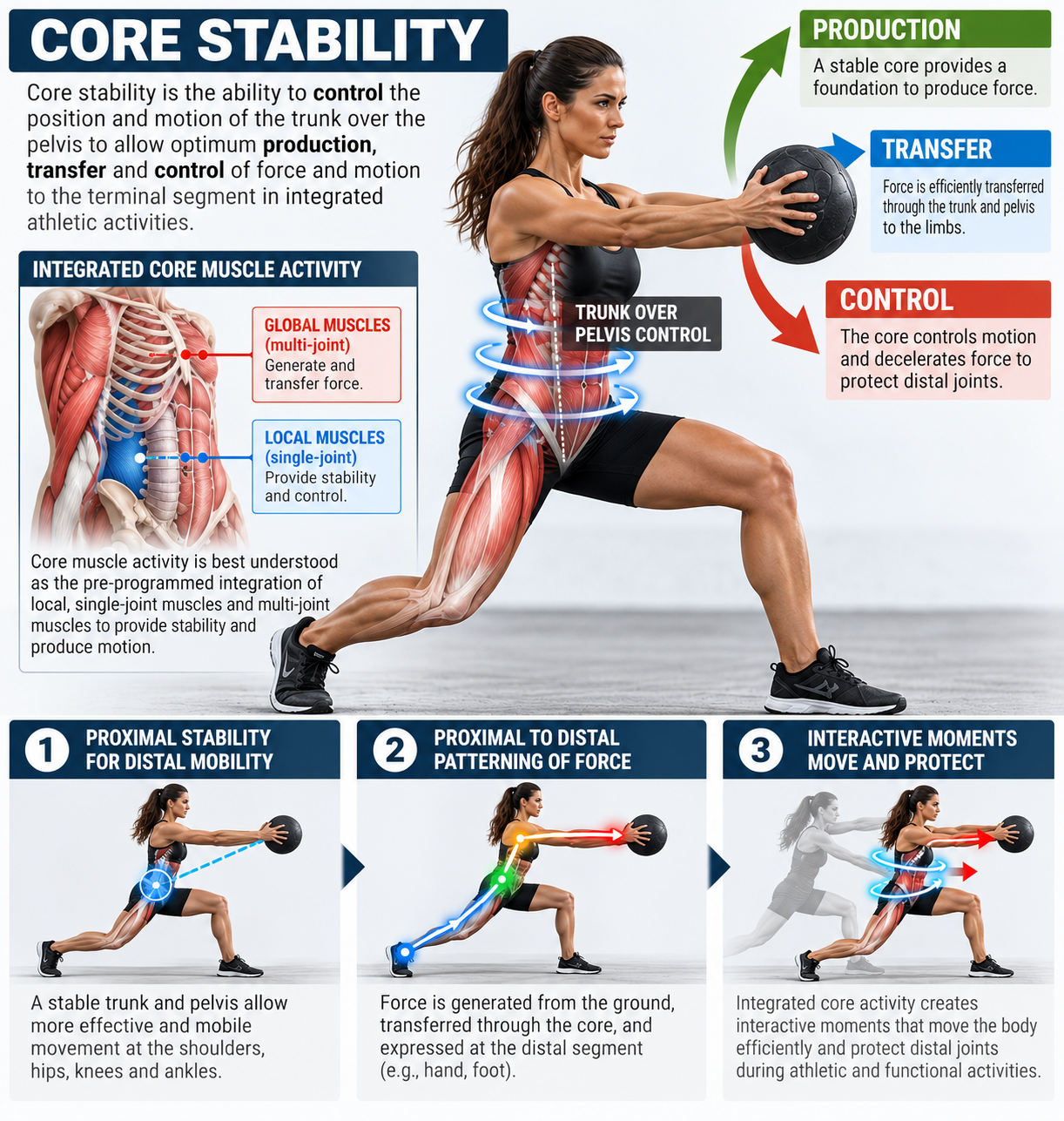
Instead, they described core stability as the ability to control the position and movement of the trunk over the pelvis so that force can be effectively produced, transferred, and controlled throughout the body.
This definition is important because it shifts our attention from individual muscles to coordinated movement.
Think about walking, throwing, lifting, or even reaching overhead. None of these movements requires the trunk to remain completely rigid. Instead, the nervous system must continuously coordinate the hips, pelvis, spine, and extremities to create the appropriate amount of stability for the task.
A stable core isn’t necessarily a motionless core. It’s a core that can control movement while allowing movement to occur elsewhere.
Proximal Stability Creates the Foundation for Distal Mobility
One of the most important concepts discussed by Kibler and colleagues is proximal stability for distal mobility.
In simple terms, the body needs sufficient control closer to its center to allow the arms and legs to move effectively.
Consider someone reaching overhead. The shoulder doesn’t operate independently of the trunk, rib cage, or pelvis. The nervous system must coordinate these regions to provide an appropriate foundation for arm movement.

The same principle applies to walking or standing on one leg. The muscles surrounding the pelvis and trunk must manage changing forces while the lower extremities move.
However, proximal stability doesn’t mean we should consciously brace our abdominal muscles before every movement. The nervous system normally organizes much of this coordination automatically, adjusting muscle activity according to the demands of the task.
This is why effective core training should involve more than simply holding static positions. It should teach the body to maintain control during reaching, stepping, rotating, carrying, and changing directions.
The Missing Ingredient: Reflexive Stability
Perhaps the most overlooked component of core training is what coaches often describe as reflexive stability.
Reflexive stability refers broadly to the body’s ability to organize rapid, largely automatic muscular responses to movement and changing forces. Scientifically, it is useful to distinguish between anticipatory postural adjustments, which prepare the body for expected movement, and reactive postural responses, which help restore stability after an unexpected disturbance.
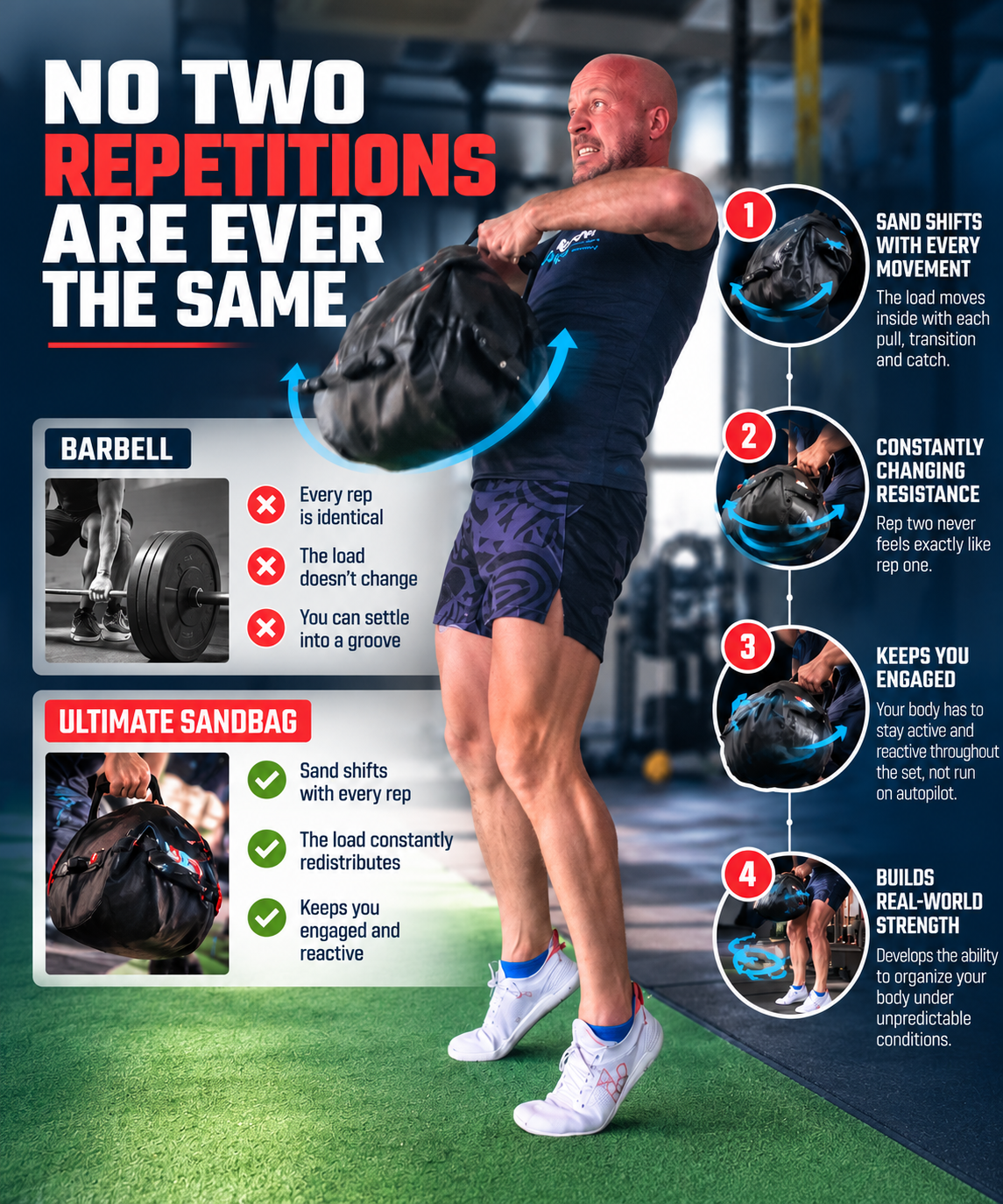
Imagine walking while carrying a heavy bag. As the weight shifts, your nervous system continually adjusts muscular activity to maintain balance and control. You don’t consciously decide which abdominal muscle should contract or how much tension your obliques should produce.
Your nervous system coordinates those responses for you.
Research on perturbation-based training demonstrates that balance responses can adapt through practice, improving how people respond to destabilizing forces.
This has important implications for core training. Rather than always asking people to consciously tighten their abdominals, we can create appropriate movement challenges that encourage the nervous system to organize stability automatically.
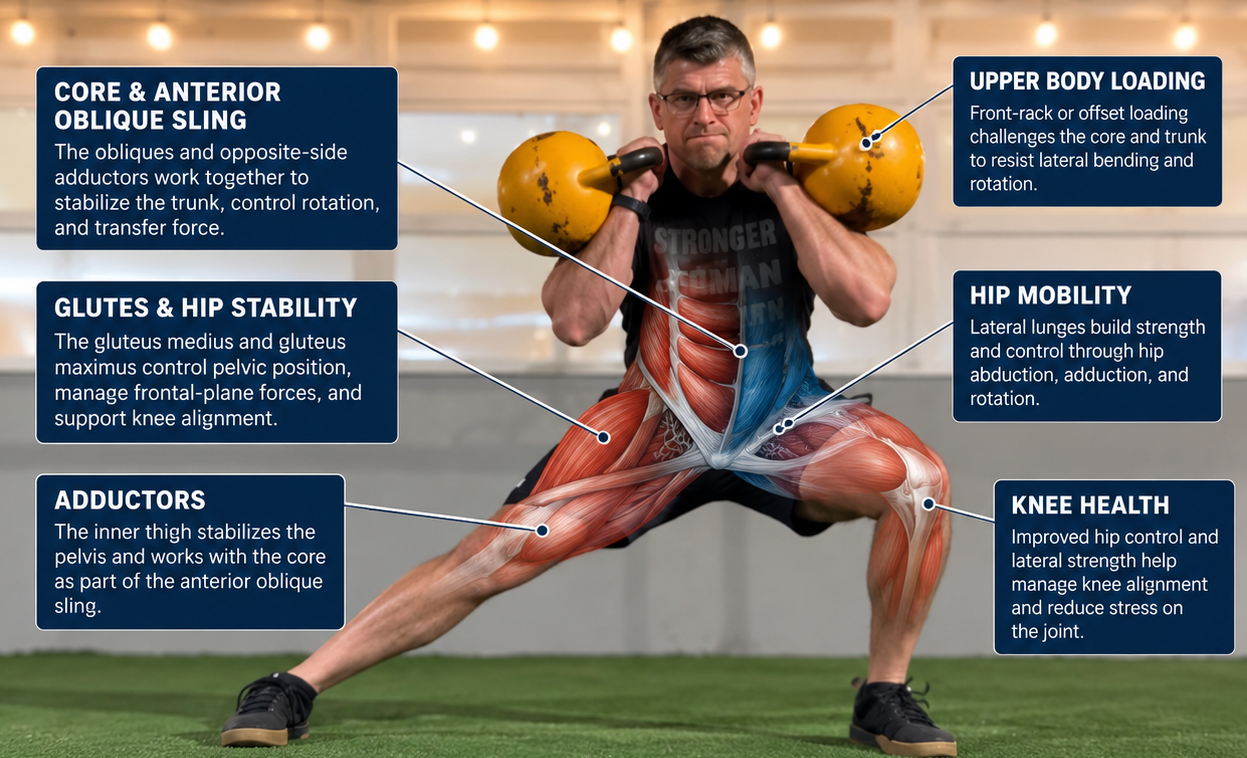
Exercises involving offset loads, controlled rotational movements, and changing bases of support can provide opportunities to practice this coordination.
These exercises aren’t necessarily superior to traditional core exercises in every situation, but they challenge qualities that isolated abdominal exercises may not adequately address.
View this post on Instagram
Why More Core Strength Doesn’t Always Mean Better Performance
A 2012 systematic review examining isolated and integrated core stability training found that improvements in core-focused exercise did not consistently translate into meaningful improvements in athletic performance.
This doesn’t mean core strength is unimportant. Rather, it suggests that developing strength in isolation doesn’t guarantee the nervous system will use that strength effectively during complex activities.
A person might hold an impressive plank yet struggle to control their pelvis during a single-leg movement. Another might demonstrate tremendous abdominal strength but have difficulty managing an asymmetrical load.
The issue isn’t necessarily insufficient strength. It may be insufficient coordination, task-specific control, or exposure to different movement demands.
Core stability also involves the interaction of passive structures, muscular capacity, and neural control. Training should therefore address more than one quality.
View this post on Instagram
What Better Core Training Actually Looks Like
The most effective approach isn’t to abandon planks, side planks, or traditional strengthening exercises. These movements can develop valuable strength and endurance.
Instead, we should recognize that they represent only part of a comprehensive approach.
Better core training progressively challenges the body to coordinate stability with movement. This can include resisting unwanted rotation, controlling the trunk during single-leg activities, managing asymmetrical loading, and maintaining balance as forces change.
The goal isn’t to make every exercise unstable or unpredictable. It is to develop sufficient strength and control, then progressively introduce the movement demands that matter to the individual.
A beginner recovering from an injury may need simple, predictable exercises. A more experienced athlete may benefit from dynamic movements that challenge timing, coordination, and rapid postural adjustments.
Both approaches can be appropriate when matched to the person’s abilities and goals.
The Bigger Picture: Train Stability to Support Movement
The greatest misunderstanding about core training may be the assumption that stability means rigidity.
Research supports a more useful perspective: stability is the capacity to control the trunk and pelvis in response to the demands of movement.
Sometimes that requires substantial muscular stiffness. Other times it requires mobility, subtle adjustments, and rapid changes in muscle activity.
The best core training develops the ability to do both.
The goal isn’t simply to build a stronger core. It’s to develop a core that knows when, how, and how much stability to provide so the entire body can move more effectively.
That’s where core training begins to become truly functional.
Learn more in our DVRT online courses HERE or our training programs HERE and save 30% with code “dvrt30”
Research References
- Kibler WB, Press J, Sciascia A. (2006). The role of core stability in athletic function. Sports Medicine, 36(3), 189–198. PMID: 16526831. https://pubmed.ncbi.nlm.nih.gov/16526831/
- Reed CA, Ford KR, Myer GD, Hewett TE. (2012). The effects of isolated and integrated core stability training on athletic performance measures: A systematic review. Sports Medicine, 42(8), 697–706. PMID: 22784233. https://pubmed.ncbi.nlm.nih.gov/22784233/
- Enoki S, Hakozaki T, Shimizu T. (2024). Evaluation scale and definitions of core and core stability in sports: A systematic review. Isokinetics and Exercise Science. https://doi.org/10.3233/IES-230177
- Lederman E. (2010). The myth of core stability. Journal of Bodywork and Movement Therapies, 14(1), 84–98. PMID: 20006294. https://pubmed.ncbi.nlm.nih.gov/20006294/
- Perturbation-based balance training: Principles, mechanisms and implementation in clinical practice. (2022).Frontiers in Sports and Active Living. https://doi.org/10.3389/fspor.2022.1015394