
Why Better Upper Body Exercises Start Below the Shoulders
2026-09-13

Walk into almost any gym and “upper body day” still looks remarkably similar. Benches, shoulder presses, rows, curls, and triceps work dominate the session, often performed while sitting or lying on benches that intentionally minimize the contribution of the lower body. While these exercises certainly build muscle, they don’t necessarily prepare the body for how the upper extremities actually function during sport, work, or everyday life.
The human body wasn’t designed to produce force in isolated segments. It was designed to generate, transfer, and absorb force through an integrated kinetic chain. Whether you’re throwing a baseball, lifting a suitcase into an overhead compartment, pushing a heavy object, carrying groceries, or simply reaching across your body, the feet, hips, trunk, and shoulders all contribute to the movement. Modern research continues to reinforce what many physical therapists, biomechanists, and experienced coaches have appreciated for decades: stronger, healthier shoulders are rarely built by focusing on the shoulders alone.
One of the greatest misconceptions in strength training is that the core exists primarily to create movement. In reality, one of its most important jobs is to create a stable yet adaptable platform that allows force to pass efficiently between the lower and upper body. The trunk acts less like a prime mover and more like a transmission. Just as a powerful car engine accomplishes little if the drivetrain cannot transfer force to the wheels, powerful arms are limited if the trunk cannot efficiently transmit force generated from the ground.
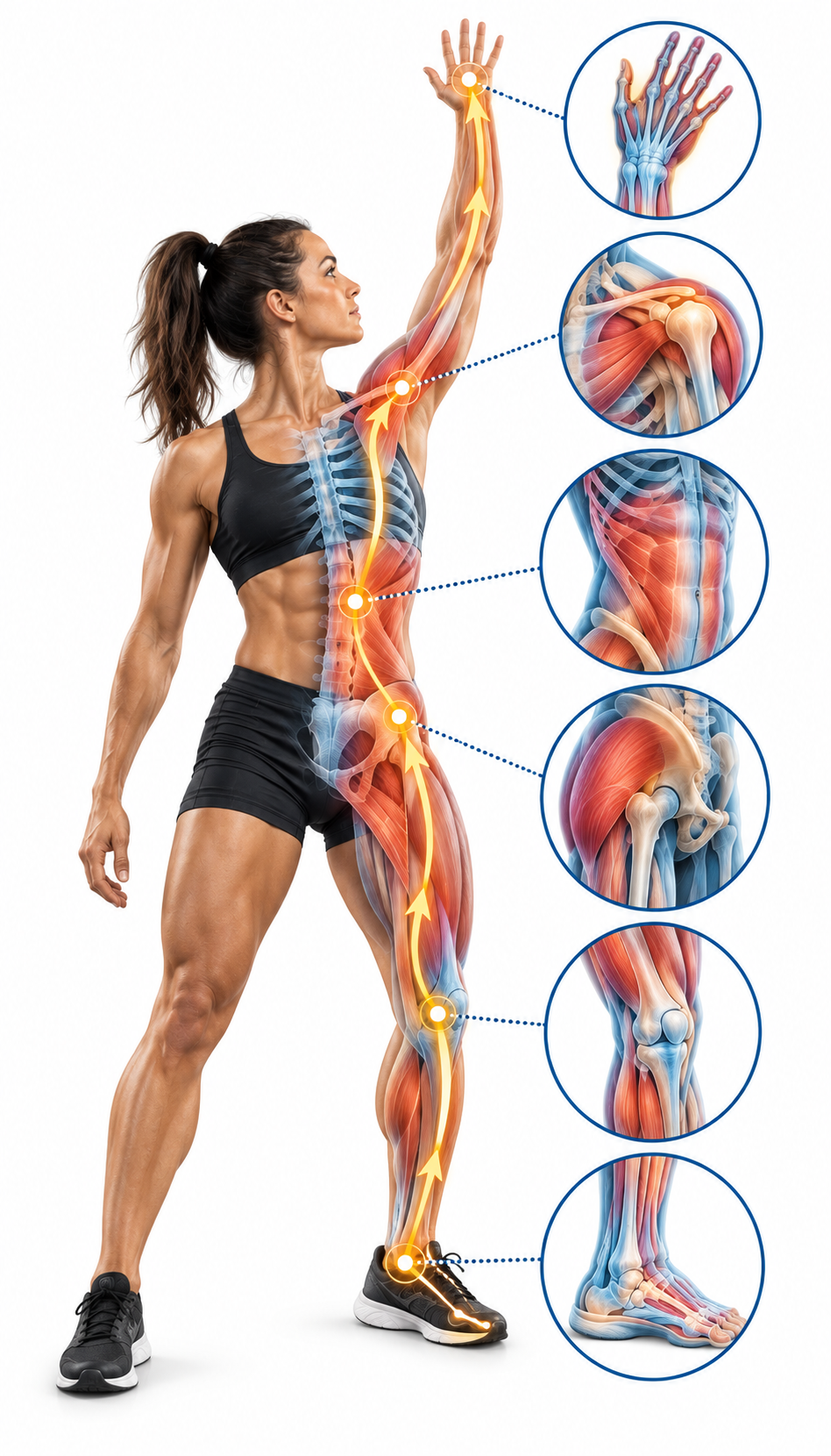
This concept becomes especially apparent during explosive activities. Studies of throwing athletes consistently demonstrate that a substantial portion of ball velocity originates from forces produced by the legs and pelvis before being transferred through the trunk into the shoulder, elbow, wrist, and hand. The arm is often the final link in a sequence that began when the foot contacted the ground. If energy leaks occur anywhere along that chain, the shoulder must compensate by generating more force on its own, increasing mechanical stress while reducing efficiency.
This is one reason coaches often say, “Power starts at the ground.” That statement isn’t motivational, it reflects basic biomechanics. The feet create a stable interaction with the ground. The hips generate substantial force. The trunk transfers and amplifies that force. Only then can the shoulder and arm efficiently express it.
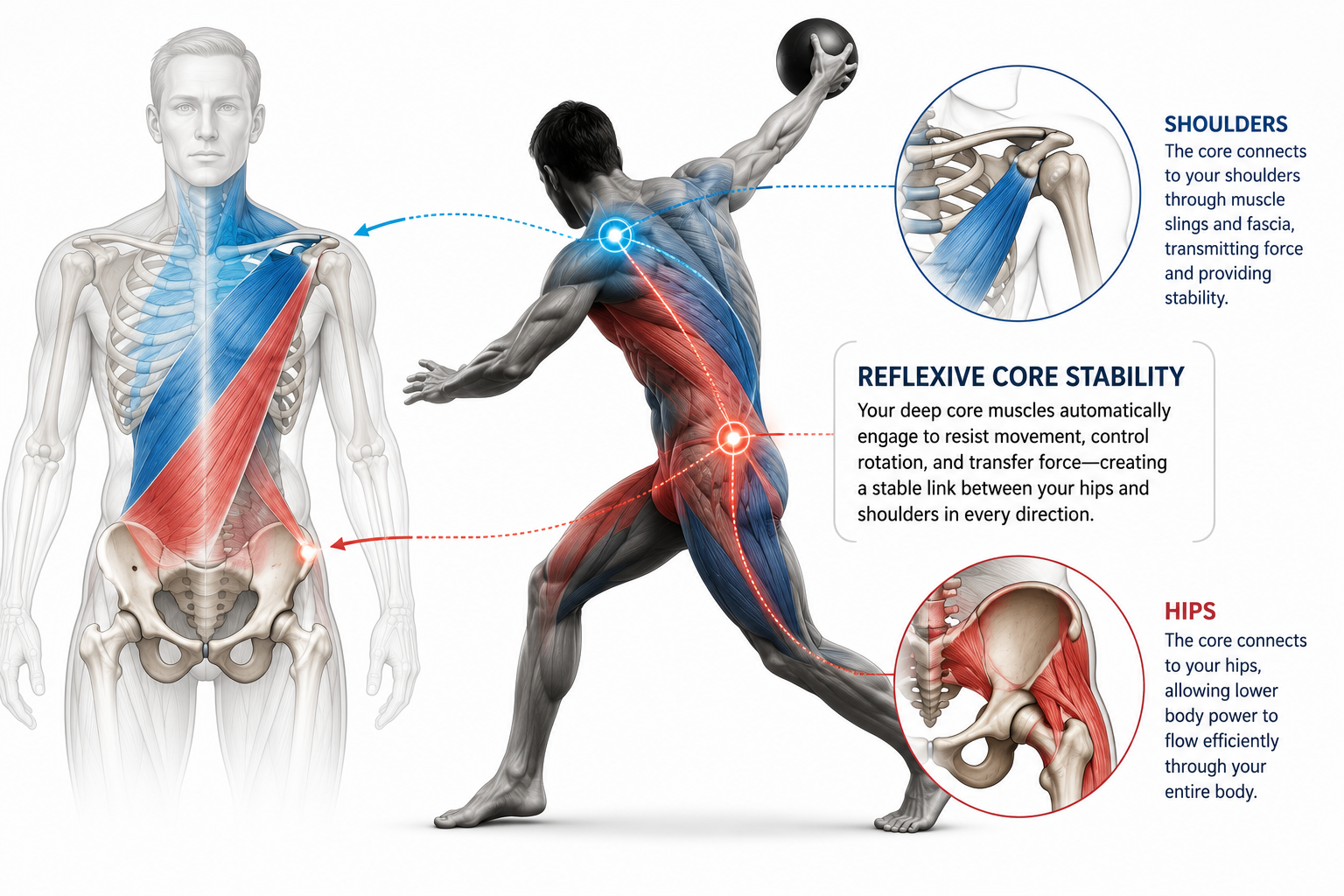
Research examining strengthening exercises through the lens of kinetic chains has reached a similar conclusion. Rather than viewing muscles as isolated structures, current evidence supports examining how groups of muscles work together to stabilize and transfer force across multiple joints. Exercises that integrate these kinetic chains tend to recruit coordinated activity throughout the body rather than concentrating stress within a single region.
The shoulder may be one of the best examples of why this matters. Despite its tremendous mobility, it relies heavily on the rest of the body for stability. Unlike the hip, which sits within a deep socket, the shoulder sacrifices structural stability for movement. That freedom requires precise coordination among the scapula, trunk, pelvis, and lower extremities.
Emerging evidence suggests that individuals with shoulder pain frequently demonstrate impairments beyond the shoulder itself. A recent systematic review found that people with shoulder pain often exhibit reduced hip strength and endurance, altered thoracolumbar function, and deficits in lower-extremity neuromuscular control. These findings support the growing clinical perspective that evaluating only the shoulder may overlook important contributors to pain and dysfunction.
View this post on Instagram
This doesn’t mean every shoulder problem originates in the hips. It does mean that the shoulder often reflects how well the rest of the system is functioning.
That realization should fundamentally change how we think about upper-body training.
Instead of asking how to make an exercise harder for the arms, we should ask how to better connect the arms to the rest of the body.
Consider the difference between a seated shoulder press and a standing single-arm press. Sitting removes much of the lower body’s contribution and reduces the demand for whole-body stabilization. Standing immediately changes the task. The feet establish the base of support. The legs create stability. The hips resist unwanted movement. The trunk manages rotational forces. The shoulder now performs its intended role while interacting with the rest of the kinetic chain.
View this post on Instagram
The same progression can occur with rows, presses, carries, chops, lifts, medicine ball throws, and resisted reaching patterns. These exercises don’t simply make the upper body stronger—they improve how the upper body communicates with the rest of the system.
Anti-rotation exercises are another excellent example. Holding a cable press, performing a single-arm kettlebell carry, or pressing an Ultimate Sandbag while resisting trunk rotation teaches the body to transfer force without allowing unnecessary motion. The shoulder becomes stronger because the trunk becomes more efficient at providing a stable foundation.
Even pulling exercises can benefit from this perspective. Rather than isolating the lats during seated rows, incorporating split stances, stepping patterns, or contralateral loading encourages the hips, trunk, and shoulder to coordinate as a single unit. This mirrors the demands of walking, climbing, lifting, and nearly every athletic movement far more closely than fixed-machine exercises.
Perhaps just as important is injury resilience.
One reason integrated exercises may reduce excessive shoulder stress is that they distribute mechanical demand across multiple joints and muscle groups instead of concentrating it within one area. When the hips, legs, and trunk contribute appropriately, the shoulder doesn’t have to compensate for missing force production elsewhere. While no exercise guarantees injury prevention, movement patterns that improve whole-body coordination likely reduce the need for repeated compensatory strategies that can overload tissues over time.
This systems-based thinking is increasingly reflected in injury-prevention research. Programs that combine lower-body strengthening, core training, movement mechanics, and stability work consistently outperform isolated approaches for reducing injury risk in athletic populations, highlighting the value of training integrated movement rather than disconnected muscles.
View this post on Instagram
The future of upper-body training isn’t about abandoning traditional strength exercises. Bench presses, pull-ups, rows, and overhead presses remain valuable tools. The difference is recognizing that they shouldn’t exist in isolation.
The most effective upper-body programs teach the shoulders to function as part of an integrated system. They encourage the feet to establish a stable base, the hips to generate and absorb force, the core to transmit energy efficiently, and the shoulders to express that force with precision rather than compensation.
Ultimately, better upper-body training isn’t really about the upper body at all.
It’s about teaching the entire body to work together.
When the feet connect to the ground, the hips contribute force, the trunk transfers energy, and the shoulders simply finish what the rest of the body has already begun, strength improves, movement becomes more efficient, and resilience follows. That isn’t just functional training, it reflects how the human body was designed to move.
Learn more with our DVRT educational courses HERE and workout programs HERE with code “save20”
View this post on Instagram
Featured in





© 2026 Ultimate Sandbag Training. Site by Jennifer Web Design.