Why Mind-Body Fitness Beats Isolated Shoulder Exercises (According to the Research)
Ask most people how to fix a stiff, painful shoulder, and you’ll get some version of the same answer: do more shoulder exercises. External rotations with a band, wall slides, maybe some pendulum swings. And to be fair, those exercises have a place. But a growing body of research suggests that practices most people wouldn’t even categorize as “shoulder exercises,” mind-body fitness may outperform isolated work for improving shoulder mobility and reducing pain, and understanding why gets right to the heart of what we teach through Myofascial Integrated Movement Training.
The Research Is Building a Real Case
Start with Pilates. A 2025 study ( PMID: 40616045) of adults with chronic neck and shoulder pain found that eight weeks of clinical Pilates significantly reduced pain while improving cervical mobility, most measures of shoulder range of motion, and scapular dyskinesia. Rather than viewing the shoulder only as an isolated joint, clinical Pilates incorporates trunk control, posture, coordinated movement, and breathing factors that can influence how the scapula and shoulder complex function (so against what social media will tell you, lol)
Yoga tells a similar story. A study on college students with shoulder tightness from prolonged sitting found that a structured yoga-based mobility practice produced significant improvements in shoulder flexion and extension after eight weeks, gains that came from slow, controlled, whole-body movement rather than isolated stretching. Separate trials on frozen shoulder have found that yoga-based interventions added to conventional therapy improved pain and disability outcomes, reinforcing that a mind-body approach can meaningfully add value even in more stubborn, clinical shoulder conditions.
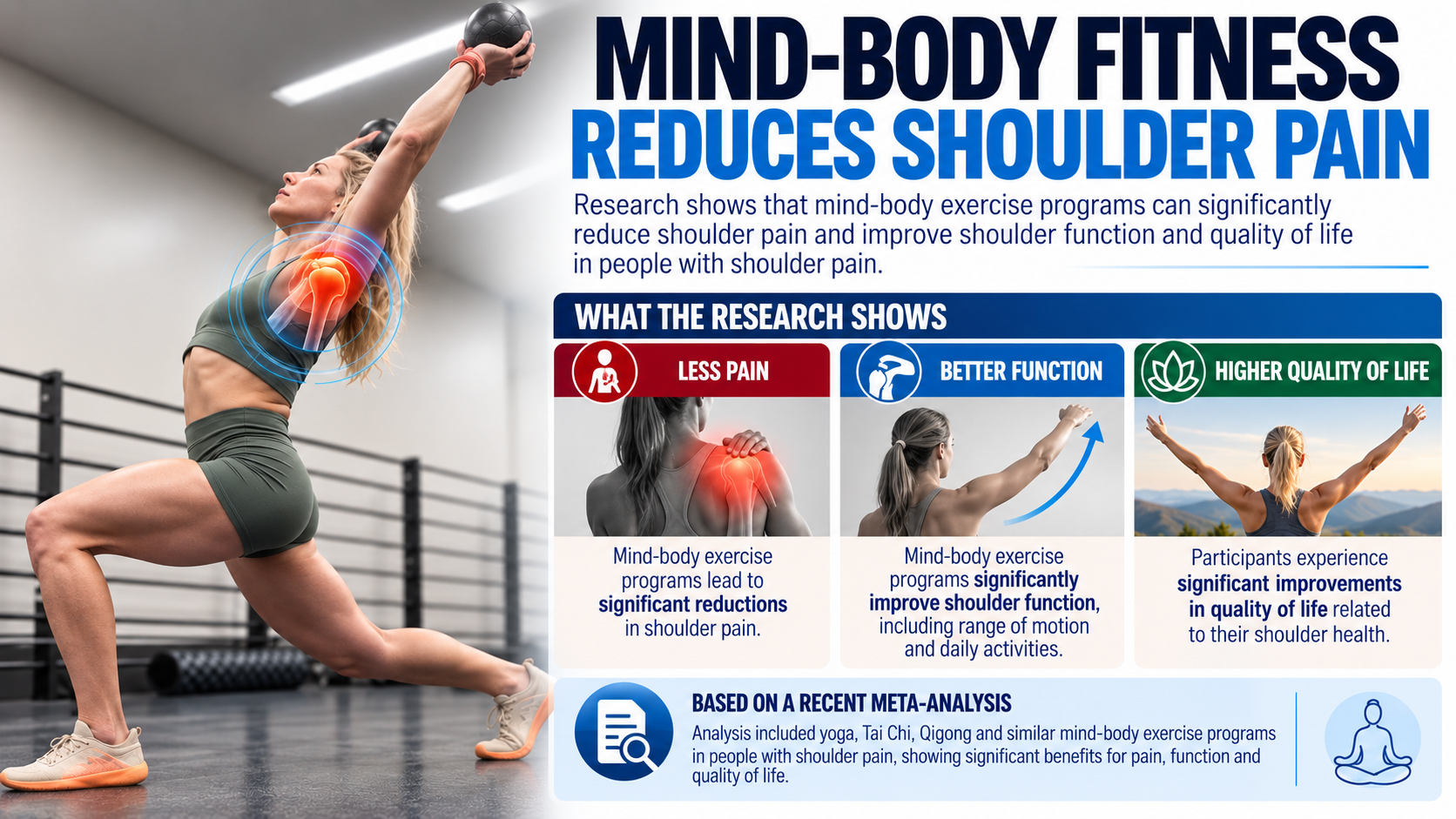
Then there’s the broader comparison research, and this is where it gets especially interesting. A review comparing exercise approaches for chronic neck pain, closely tied to shoulder function, found that motor control training and mind-body approaches like yoga, Pilates, Tai Chi, and Qigong performed comparably to, and in some analyses better than, traditional strengthening exercise alone for reducing pain and disability (PMID: 37339388). That’s not a minor finding. It suggests the “just isolate and strengthen it” model that dominates most gyms and clinics may be missing something these mind-body approaches are getting right.
View this post on Instagram
Why Would This Be True?
The shoulder is one of the most mobile, least inherently stable joints in the body. It relies almost entirely on surrounding musculature, postural control, and coordinated movement through the trunk and scapula to function well. Isolated shoulder exercises train a muscle or a motion. They rarely train the coordination, control, postural awareness, and whole-body integration the shoulder actually depends on.
Mind-body practices train exactly that emphasizing slow, weight-shifting, whole-body movement paired with breath, building the kind of postural control and proprioceptive awareness that isolated exercises simply don’t touch. Such practices also combines mobility work with sustained postural holds and breathing patterns that challenge the shoulder to stabilize in a wide range of positions, not just move through one plane. We can use exercises that builds core and scapular control simultaneously, addressing the postural foundation the shoulder sits on top of.
View this post on Instagram
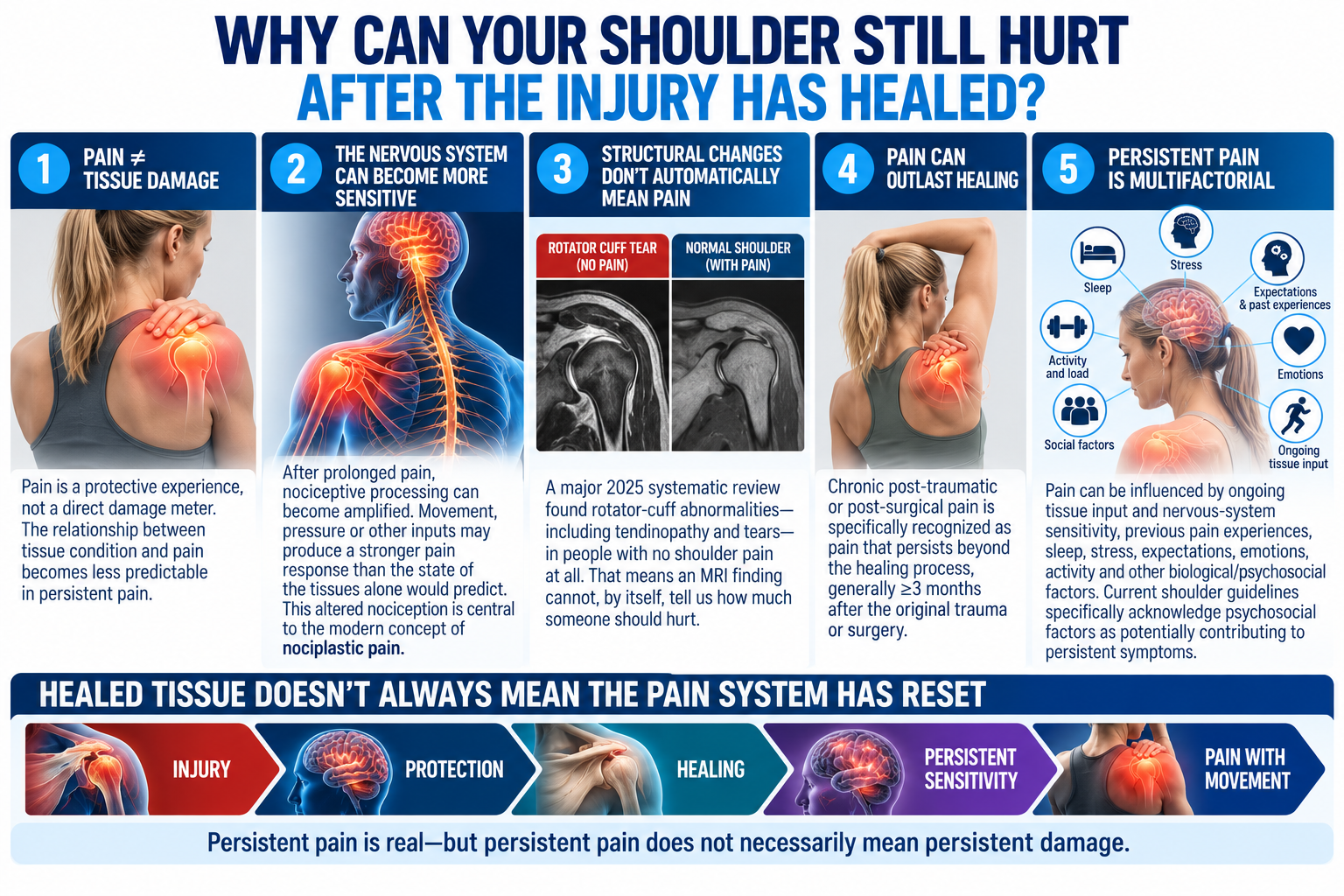
There’s also a nervous system piece worth mentioning. Persistent shoulder pain often involves more than tissue damage, it involves a nervous system that has learned to protect the area, sometimes long after healing has occurred. The slow, breath-linked, mindful nature of these practices appears to help calm that protective response, which may partly explain why pain outcomes improve even when the “exercise” looks nothing like traditional rehab.
Where Myofascial Integrated Movement Training Fits In
This is precisely the gap Myofascial Integrated Movement Training was built to address. Rather than treating mind-body work as a separate wellness category and shoulder rehab as a separate strength category, MIM blends them deliberately. Breathwork, mindful attention, and whole-body coordination aren’t add-ons tacked onto the end of a shoulder program, they’re built into the movement itself, alongside mobility, stability, and strength work through the fascial and kinetic chains the shoulder actually relies on.
View this post on Instagram
That’s a meaningfully different approach than handing someone a resistance band and three isolated exercises. It teaches the nervous system that the shoulder is safe to move through a full range, builds the postural and core control the joint depends on, and incorporates the breath and mindful attention research increasingly shows matters for pain outcomes, not despite being unconventional, but because of it.
The research doesn’t say isolated shoulder exercises are useless. It says they’re incomplete. Mind-body fitness consistently outperform, or at least match, isolated approaches because they train the shoulder as part of an integrated system, not a joint working alone. If your shoulder program still lives entirely in isolated planes and single-muscle exercises, the evidence suggests it might be time to think bigger, and slower, than that.
Find MUCH more at our FREE & NEW Mind-Body Fitness coming Tuesday October 6th 3pm EST HERE