
Why THIS Single Leg Exercise Builds Greater Mobility, Strength, & Stability
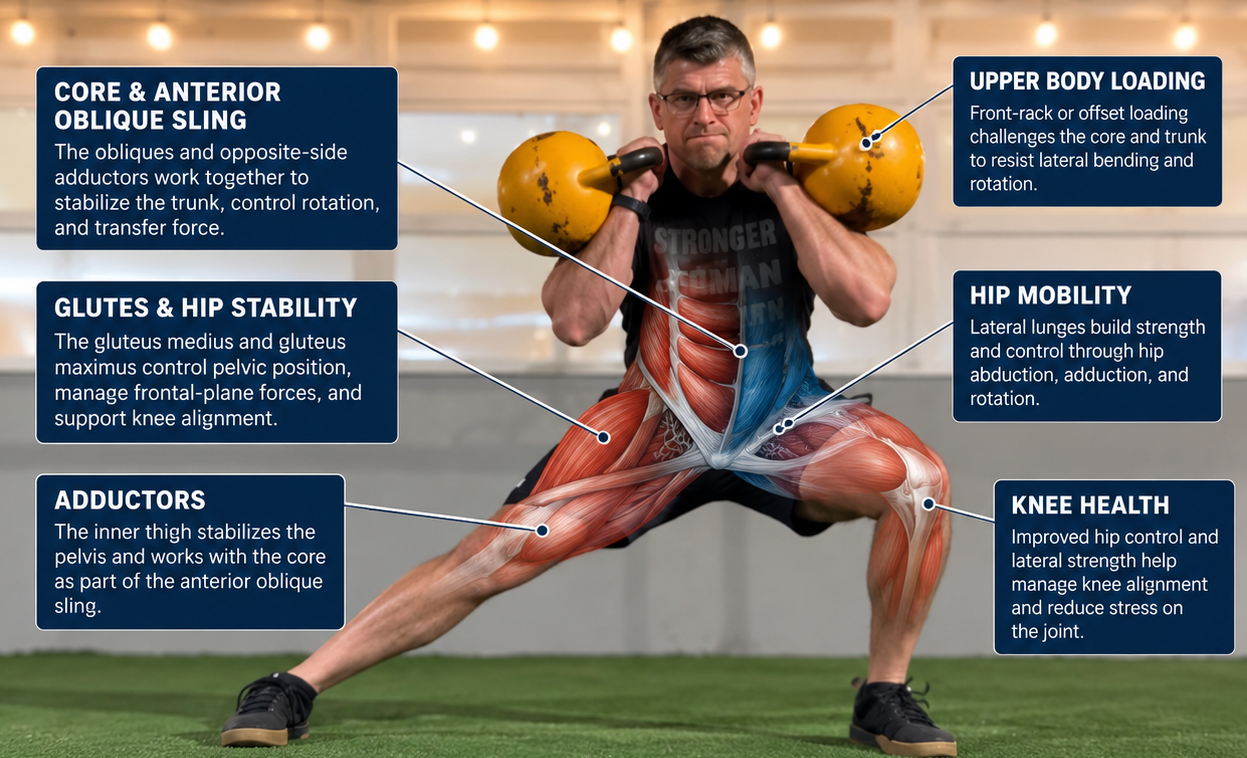

If I had to guess the single most under-trained quality across the programs I’ve seen over the last 30 years, it wouldn’t be power, and it wouldn’t be mobility in the way most people think about it. It would be lateral strength and stability, genuine control of the body in the frontal plane.
Most programming lives almost entirely in forward and backward movement. Squat, hinge, press, row, repeat. Meanwhile, the research on knee health, hip function, and balance keeps pointing in the same direction: a lot of what goes wrong in the lower body happens because the frontal plane was never properly trained in the first place.
What the Research Actually Shows About Knee Health
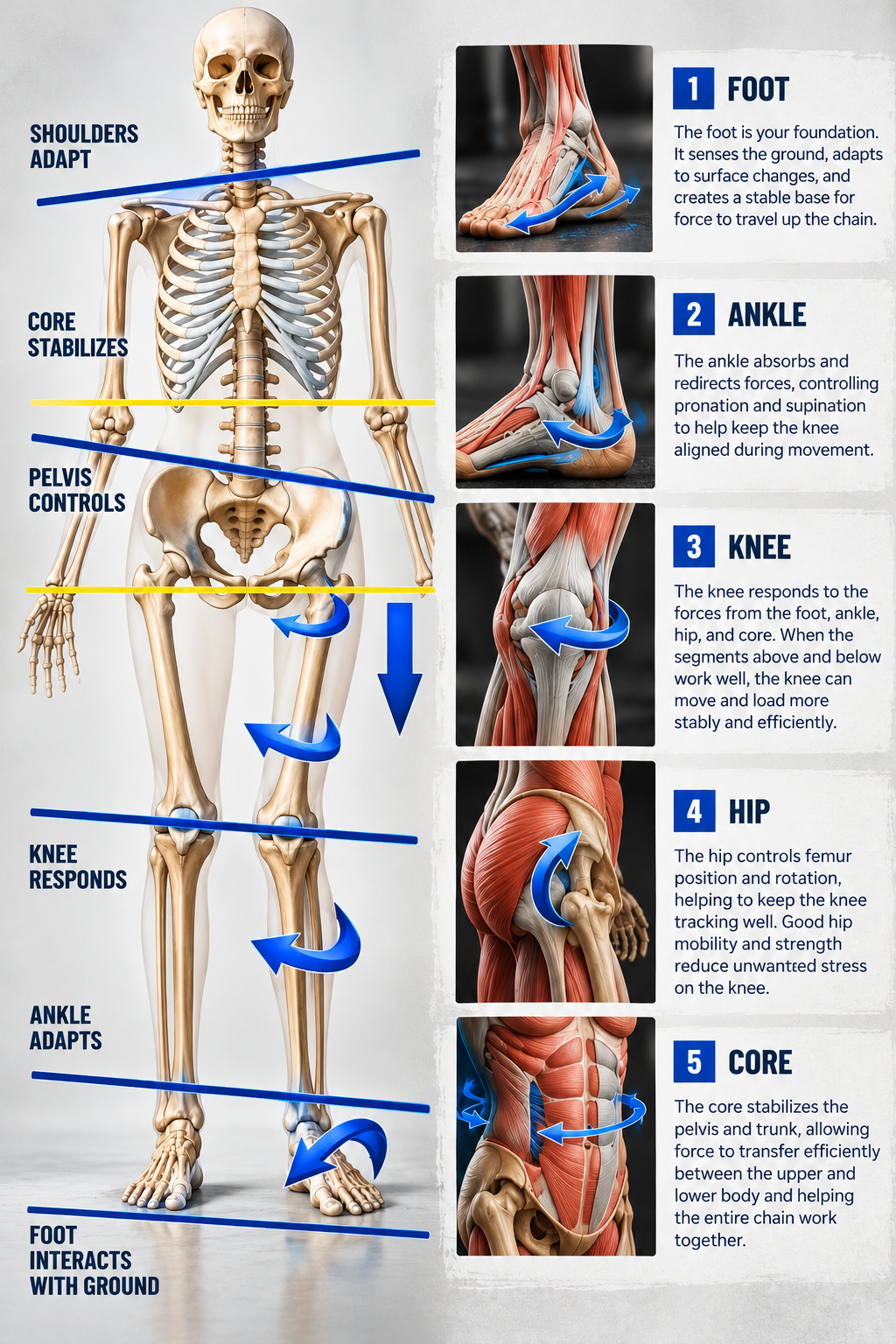
Let’s start with the knee, because this is where the evidence is most direct. Research on gait and lateral knee stability has found that frontal-plane control at the knee isn’t passive, it requires active muscle force from the hip and knee working together, and a lack of that stability is a documented risk factor in the progression of knee osteoarthritis.
This connects directly to sports injury research. A study on sidestepping and change of direction found that trunk lateral lean was one of the single strongest predictors of the knee abduction moments associated with ACL injury risk, more predictive than almost any other variable measured. Separate research on single-leg jumping found that gluteus medius activity, not just hip abduction force, was what actually determined how well the knee stayed stable in the frontal plane. And a study specifically measuring dynamic knee valgus found that frontal plane knee alignment was best predicted by a combination of hip internal rotation range, ankle dorsiflexion range, and trunk endurance, not knee strength in isolation.
Translation: the knee’s frontal plane stability is inherited from the hip, the ankle, and the trunk working together. That’s not a hip exercise problem or a knee exercise problem. It’s a systems problem.
View this post on Instagram
Hip Mobility and the Anterior Oblique Sling
Lateral and rotational control also plays directly into hip mobility and the Anterior Oblique Sling, the fascial and muscular connection linking the adductors on one side to the obliques on the other. This sling exists specifically to manage frontal and transverse plane demands, stabilizing the pelvis while resisting unwanted rotation during movements like walking, cutting, and lifting.
When lateral stability is missing, the body often compensates by restricting hip motion as a protective strategy, since the nervous system is reluctant to grant range it doesn’t feel capable of controlling. Build genuine lateral strength first, and hip mobility frequently becomes more available as a direct result, not because the tissue changed, but because the system now trusts the position.
Balance and Postural Control
The balance research tells a similar story. Studies on lateral perturbation training have found that medial-lateral balance control relies on distinctly different strategies than forward-backward stability, requiring active adjustment of foot placement and hip strategy rather than the passive mechanisms that largely govern sagittal plane balance. Clinical research on populations with hip osteoarthritis and knee replacement has consistently found that improving frontal plane postural control produces measurable gains in balance performance that generic sagittal-plane training doesn’t replicate.
How We Actually Build This: From Feedback to Reflexive Control
This is exactly why our progressions move the way they do. We don’t start by throwing someone into an unstable, reactive environment and hoping their nervous system figures it out. We start with external feedback and support, positions and loading that give the body clear information about where it is in space, so it can build genuine lateral strength without guessing.
From there, we progress deliberately toward reflexive stability. Diagonal patterns get introduced because real life doesn’t move purely side to side, it moves through combinations of planes, and the body needs to control force along those diagonals, not just resist pure lateral load. Offset loading comes next, placing weight asymmetrically so the body has to organize stability in real time rather than relying on a predictable, symmetrical setup.
That progression matters. Jump straight to unpredictable, offset, multiplanar loading before the nervous system has built a foundation of controlled lateral strength, and you’re not training resilience, you’re just asking for compensation. Build the foundation first, add the diagonal complexity second, and let reflexive stability develop as a product of that sequence rather than something you demand on day one.
Knee health, hip mobility, balance, and real-world resilience all share a common thread the research keeps confirming: the frontal plane isn’t optional. It’s foundational. Train it deliberately, progress it intelligently, and the rest of the system, the knees, the hips, the balance you’re chasing, tends to fall into place because you finally gave it the training it was always missing.
Learn SO much more in our DVRT Rx and Myofascial Integrated Movement courses. Save 30% on our education, workout programs, and training tools with code “dvrt30” HERE

