
3 Keys to Building Pain-Free Squats
2026-04-3
If there’s one movement that exposes both strength and dysfunction, it’s the squat. Yet, for many clients, squatting becomes associated with knee pain, hip tightness, or low back discomfort. The issue isn’t the squat itself, it’s how we prepare the body to handle it.
When we look at both research and real-world coaching, three key principles consistently emerge for building strong, pain-free squats: proximal stability, intelligent loading strategies, and progressive asymmetry.
Proximal Stability Drives Hip Mobility
One of the biggest misconceptions in fitness is that limited squat depth or “tight hips” are primarily a mobility issue. In reality, for most clients, the problem is a lack of proximal stability, the ability to control the trunk and pelvis.
When the core and pelvis lack stability, the body will instinctively limit motion at the hips to protect itself. This shows up as:
- Excessive forward lean
- Knee collapse
- Shallow squat depth
- “Tight” hips that don’t improve with stretching
In other words, what looks like a mobility restriction is often a stability problem.
From a coaching perspective, this shifts our strategy. Instead of chasing more flexibility, we prioritize:
- Core engagement (especially resisting spinal flexion and extension)
- Pelvic control
- Integrated tension through the trunk
When stability improves, the nervous system allows more hip motion, and mobility often “unlocks” without aggressive stretching.
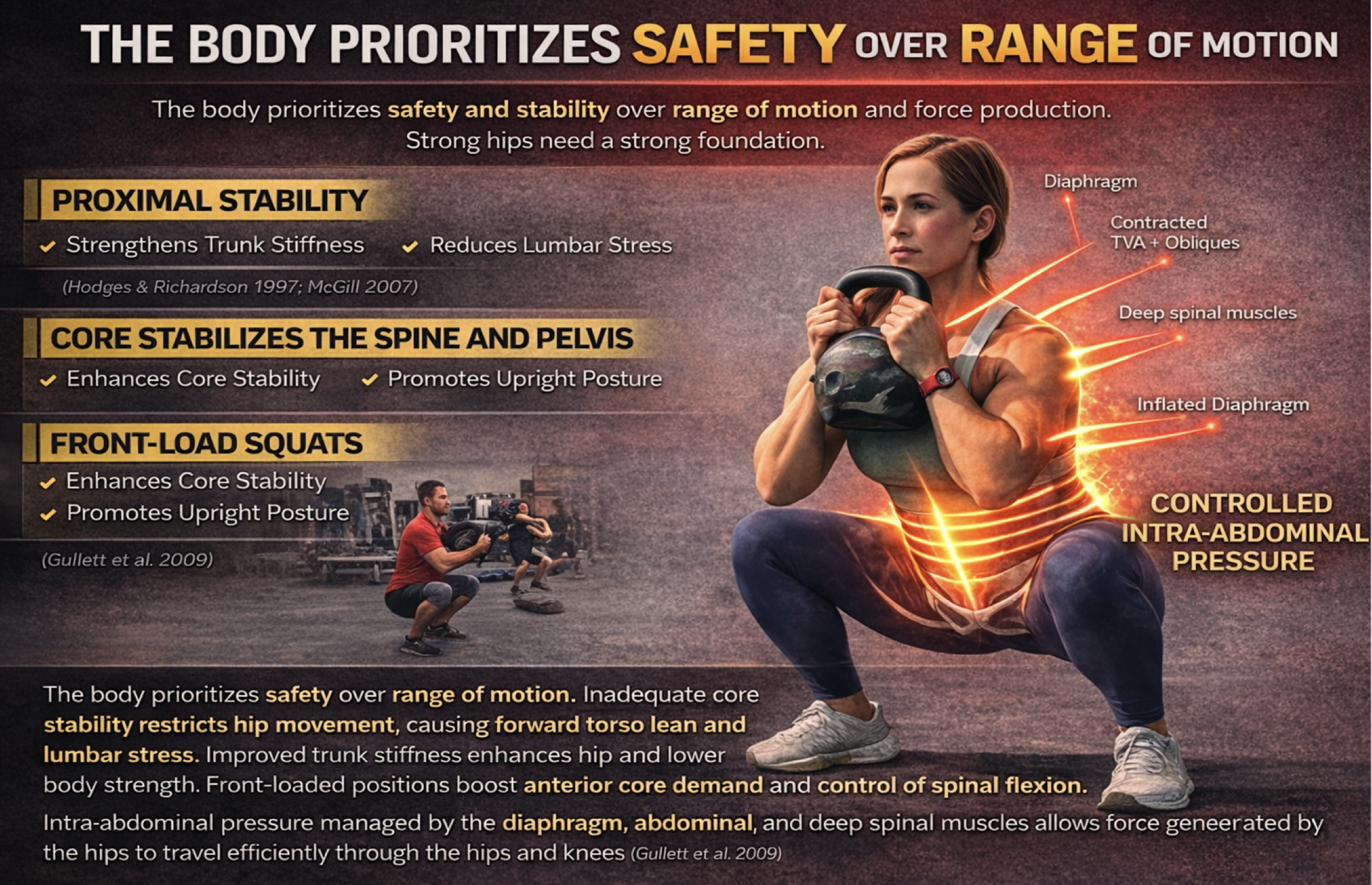
This is why exercises that integrate the core with lower body movement like press out squats or resisted patterns, often produce immediate improvements in squat depth and quality.
Anterior Loading Improves Mechanics and Joint Stress
How we load the squat dramatically changes both movement quality and joint stress.
Research comparing front and back squats provides a powerful insight. Gullett et al. (2009) found that:
- Front squats produced similar overall muscle activation as back squats
- But with significantly lower compressive forces on the knee and lower knee extensor moments
This is a critical takeaway for coaches.
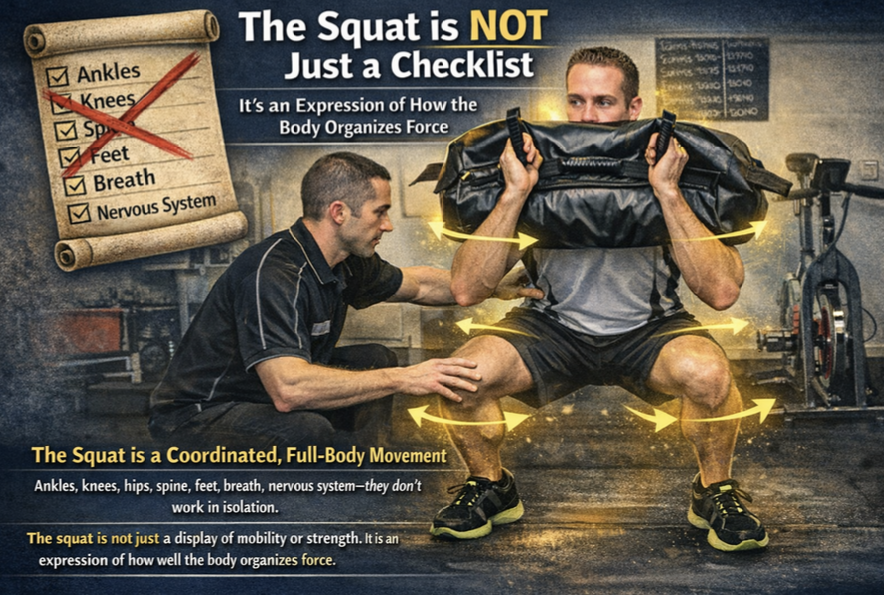
Despite typically using lighter loads, front squats:
- Maintain strength stimulus
- Reduce joint stress
- Encourage more upright posture
Why does this matter?
Because anterior loading (holding weight in front of the body):
- Forces greater core activation
- Promotes a more vertical torso
- Improves alignment of hips, knees, and spine
This creates a more efficient and often safer squat pattern.
This is also where systems like DVRT Ultimate Sandbag Training shine.
Using Ultimate Sandbags or kettlebells in front-loaded positions (such as goblet or front-loaded squats):
- Automatically reinforce core engagement
- Improve posture without excessive cueing
- Create “reactive stability” as the load subtly shifts
Instead of telling clients to “stay upright,” the load placement teaches it.
For general fitness clients, especially those dealing with pain or movement limitations, anterior loading is often a better starting point than traditional back squats.
Asymmetrical and Single-Leg Progressions Build Real Strength
While bilateral squats are valuable, they don’t always reveal or fix underlying imbalances.
Research consistently shows that unilateral or asymmetrical training:
- Increases muscle activation
- Improves neuromuscular coordination
- Exposes side-to-side weaknesses
More importantly, it builds the kind of stability that carries over to real life.
When clients struggle with squats, the issue is often not just strength, it’s control.
This is where asymmetrical loading becomes powerful.
Examples include:
- Rear-foot elevated split squats
- Front-loaded split squats
- Offset or uneven loading (holding weight on one side)
View this post on Instagram
These variations:
- Increase core demand
- Challenge pelvic stability
- Improve hip control under load
In DVRT, this is taken even further by manipulating load position:
- Holding the Ultimate Sandbag off-center
- Using sprinter or staggered stances
- Progressing from bilateral to asymmetrical to single-leg
This creates a progression where stability is constantly challenged, but in a way that’s scalable for all levels.
The result?
Clients develop:
- Better joint alignment
- Greater muscle activation
- More resilient movement patterns
If your goal is to help clients squat deeper, stronger, and without pain, the solution isn’t just adding weight or stretching more.
It’s about building the system that supports the squat.
The 3 Keys:
- Proximal stability → unlocks hip mobility
- Anterior loading → improves mechanics and reduces joint stress
- Asymmetrical progressions → build real-world strength and control
When these elements are combined, squats become:
- More efficient
- More comfortable
- More effective
Instead of asking:
“How do I get my client to squat deeper?”
Start asking:
“Do they have the stability, loading strategy, and control to earn that depth?”
Because when those three pieces are in place, pain-free squatting isn’t forced it’s the natural outcome.
Find out MORE solutions in our NEW “Squat Blueprint” program you can grab 30% off HERE along with our other new solution based programs. Just use code “stronger”
Featured in





© 2026 Ultimate Sandbag Training. Site by Jennifer Web Design.