
Move Faster, Stay Balanced, Age Powerfully
2026-03-3

Most people think power means jumping as high as possible or throwing something as fast as they can.
And they think balance means standing on one leg… trying not to wobble… looking like you’re auditioning for the circus.
Both views miss the point.
And when we misunderstand power and balance, we limit what they can actually do for us , especially if we care about aging well.
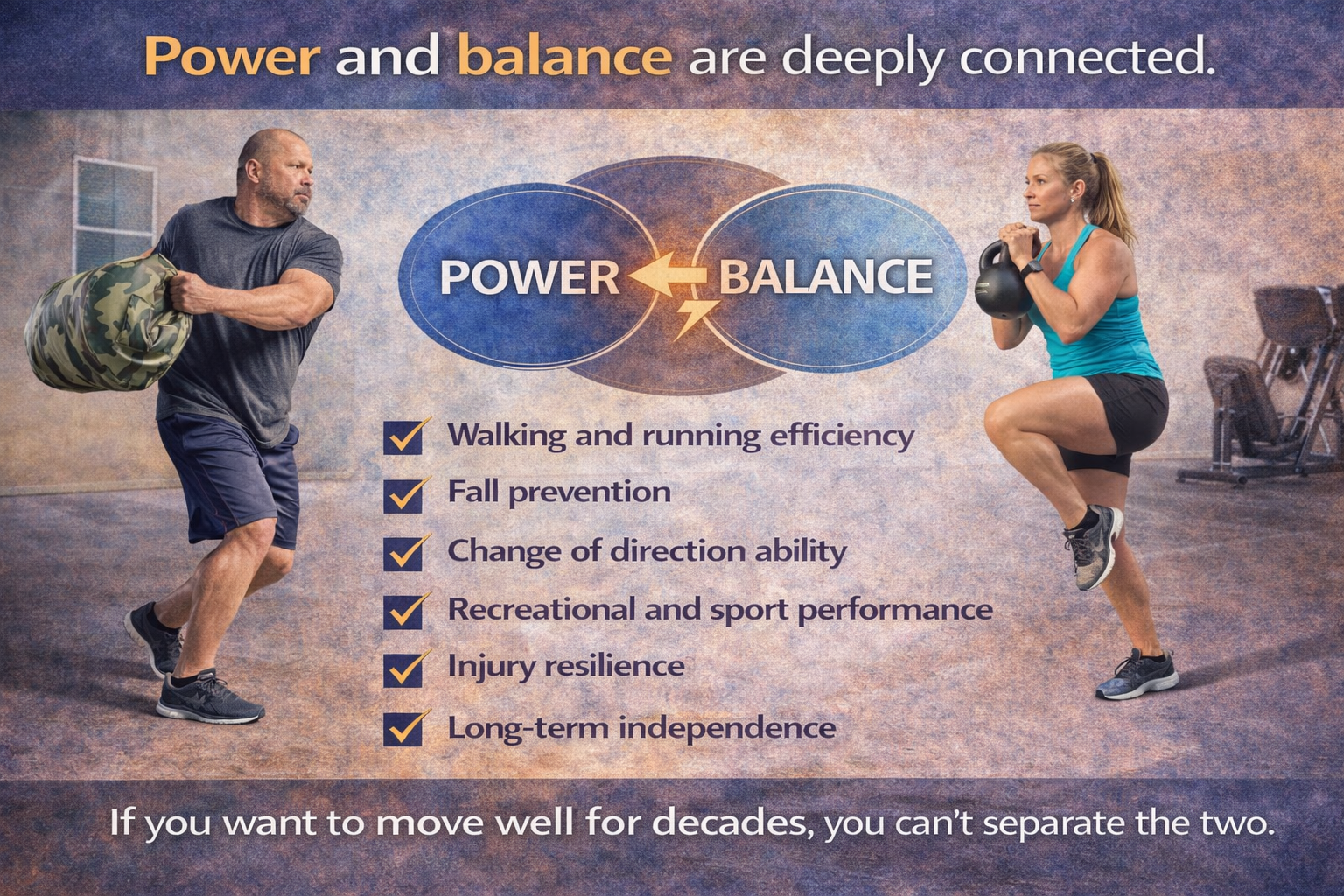
In reality, power and balance are deeply connected.
- They both influence:
- Walking and running efficiency
- Fall prevention
- Change of direction ability
- Recreational and sport performance
- Injury resilience
- Long-term independence
If you want to move well for decades, you can’t separate the two.
Balance isn’t about standing perfectly still.
Balance is your body constantly making rapid, small adjustments to keep you upright especially when:
-
You walk
-
You change direction
-
You react to something unexpected
-
You step off a curb
-
You trip
Those corrections don’t happen slowly.
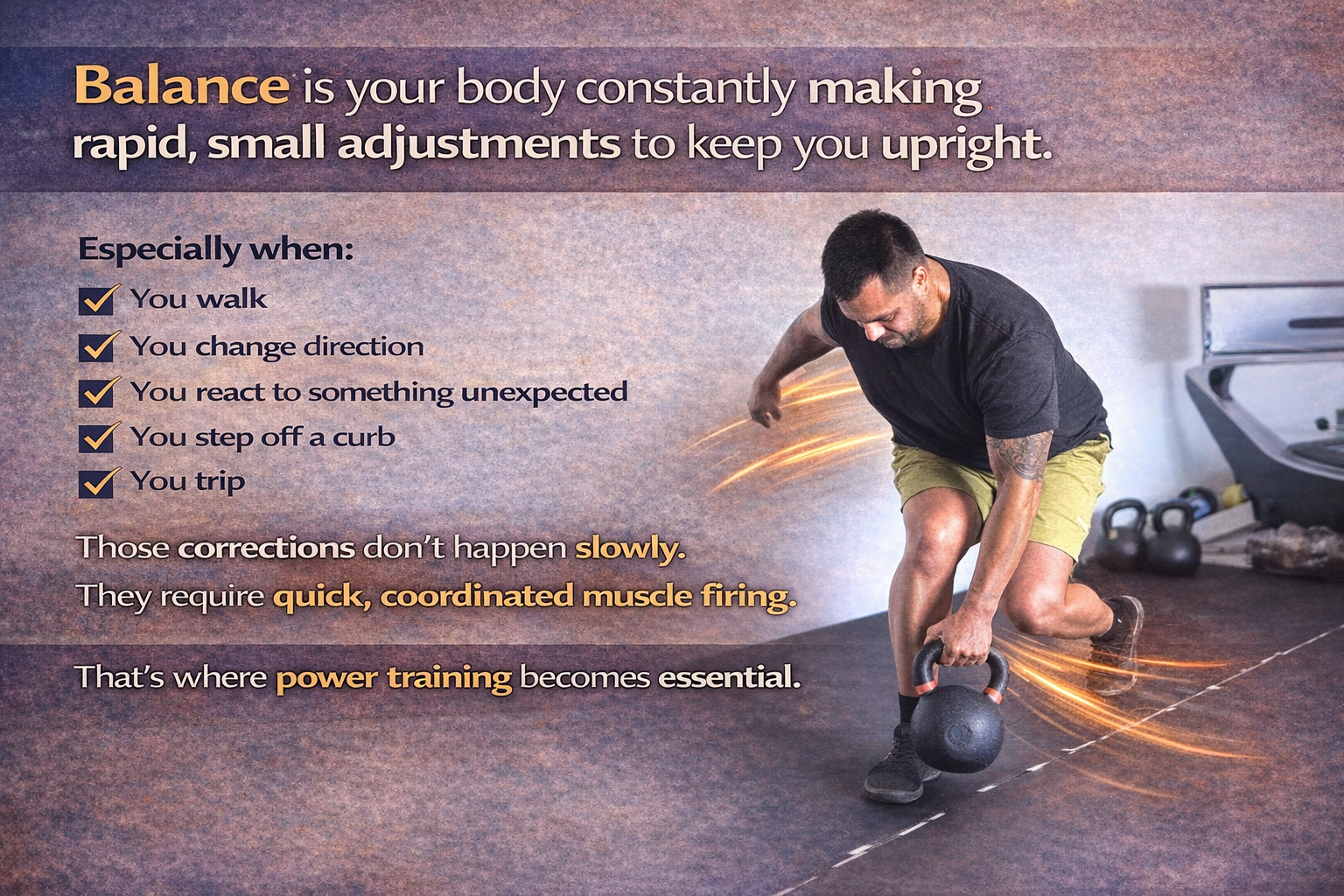
They require quick, coordinated muscle firing.
That’s where power training becomes essential.
Because if your nervous system can’t produce and control force quickly, it can’t correct instability efficiently.
True balance isn’t just holding a position.
It’s having the power to recover when you start to lose it.
Power Isn’t Just Producing Great Force
When people think about power training, they think about acceleration:
- Jump higher
- Move faster
- Drive explosively
But here’s the piece that often gets ignored…DECELERATION!
In real life, balance isn’t just pushing off the ground. It’s…
- Stopping
- Redirecting
- Absorbing force
- Stabilizing when momentum shifts
When you trip, cut, or change direction, your body must rapidly brake before it can re-accelerate.
Training this “controlled braking” ability strengthens the neuromuscular system’s capacity to manage instability.
Deceleration is the bridge between power and real-world balance.
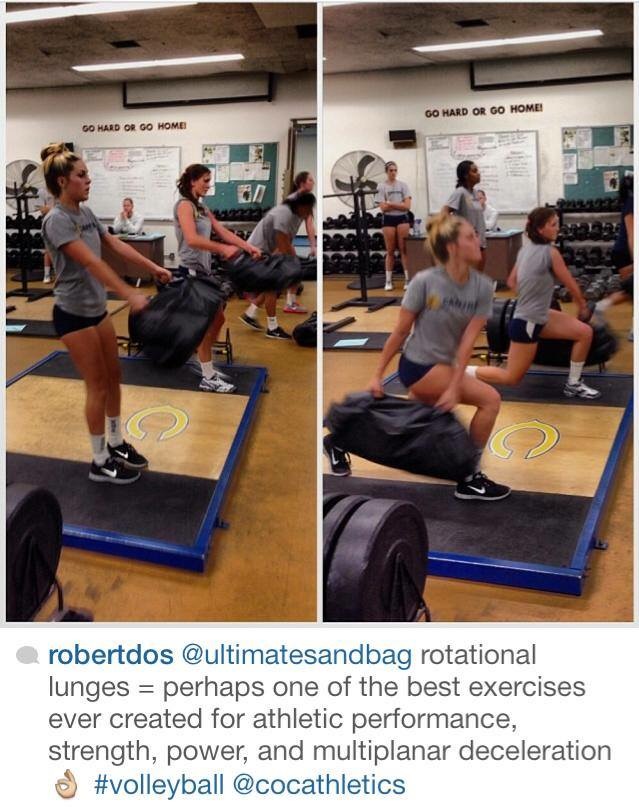
Can’t argue with renowned strength coach, Robert Dos Remedios
As we move beyond foundational drills, power and balance training need to become:
-
Multi-directional
-
Integrated
-
Reactive
-
Context-driven
Because power is fast and fast movement challenges stability.
And balance isn’t just standing on one leg, it’s controlling your body through space, in multiple directions, under changing conditions.
That’s why progressing toward more multi-planar movement is so important.
It teaches the body to:
-
Produce force
-
Absorb force
-
Redirect force
-
Stay organized while doing it
One more important reminder:
Power does not always mean moving at the absolute highest speeds possible.
A great example is the type of drills physical therapist Dan Swinscoe demonstrates in our deadlift matrix controlled, purposeful movements that challenge both force production and force management without requiring reckless speed.
That’s where real-world power lives.
Once you understand how subtle changes to our stance, the direction we move, or even how we load our body allows us to build more power and balance training together, you see not just more that you can do but it makes what you can do better! This is where understanding what we need to do is JUST build more muscle helps us create better solutions to smarter training as we age.
Get a jump start on the holiday with saving 30% ALL throughout with code “laborday” HERE
Featured in





© 2026 Ultimate Sandbag Training. Site by Jennifer Web Design.