
3 Popular Exercises We Should REALLY Rethink!
2026-04-28

There’s no shortage of exercises that look smart, feel intentional, and even get labeled as “functional”, but when you step back and look at how the body actually works, some of these popular movements don’t quite deliver what people think they do. The issue isn’t that these exercises are useless. It’s that they’re often misunderstood, misapplied, and sometimes even take us further away from building real-world strength and resilience.
Let’s look at three common examples.
The first is the incline bench dumbbell row, performed face down on a bench. The rationale is simple: by supporting the torso, you take the core and lower body out of it, allowing you to focus purely on the upper body and, in theory, lift more weight. On the surface, that sounds efficient. In reality, it strips away one of the most important aspects of human movement, how the body works as an integrated system.
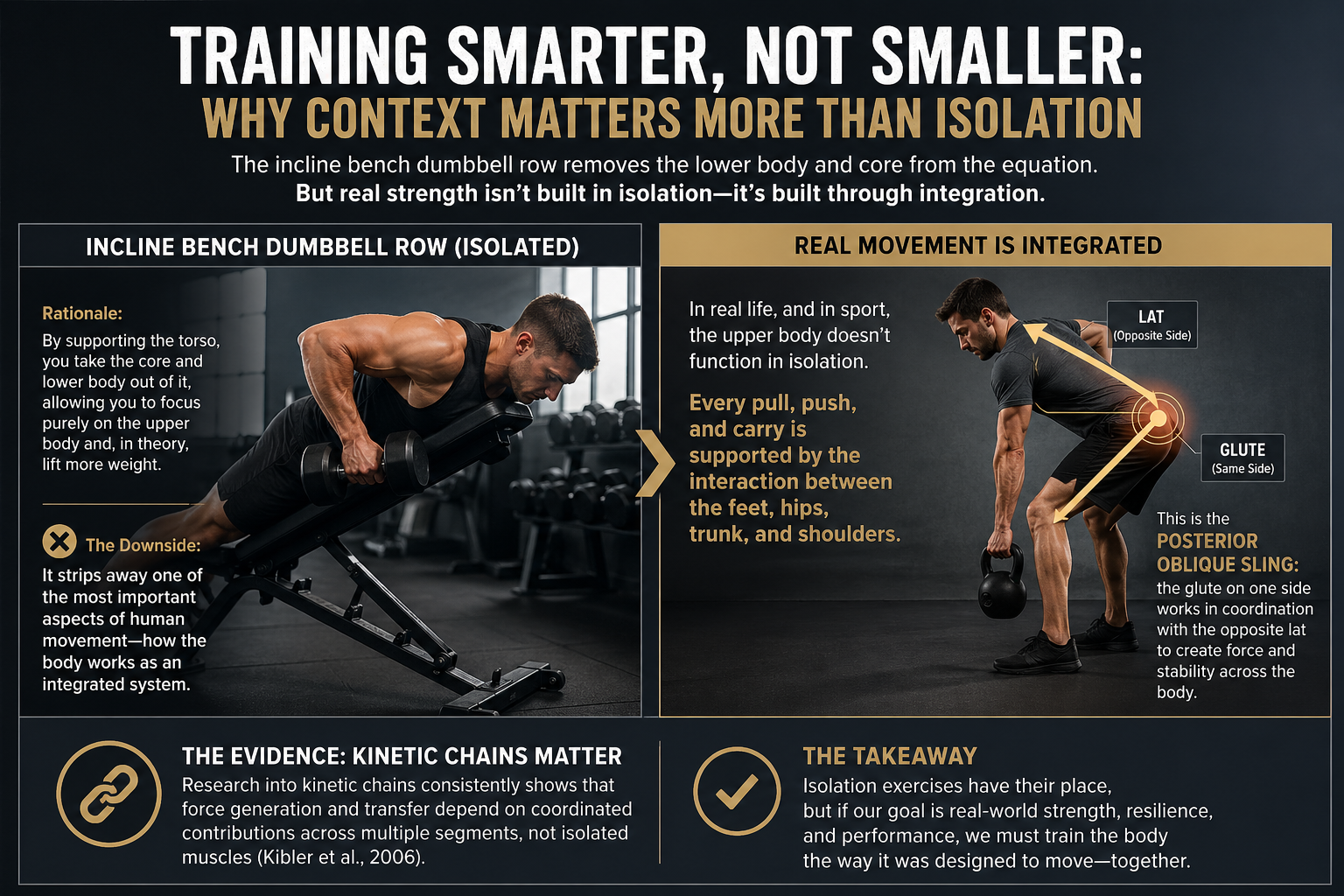
In real life, and in sport, the upper body doesn’t function in isolation. Every pull, push, and carry is supported by the interaction between the feet, hips, trunk, and shoulders. This is where concepts like the posterior oblique sling come into play, where the glute on one side works in coordination with the opposite lat to create force and stability across the body. Research into kinetic chains consistently shows that force generation and transfer depend on coordinated contributions across multiple segments, not isolated muscles (Kibler et al., 2006).
When you lie on a bench and row, you remove the need for your body to stabilize, transfer force, or coordinate across these chains. Yes, you may lift more weight locally, but you’re also teaching your body a pattern that doesn’t exist outside the gym. In contrast, standing or staggered-stance rows require the hips and core to contribute, reinforcing how strength is actually expressed in movement. Strength isn’t just about how much you can lift, it’s about how effectively your body can organize itself to produce and control that force.
View this post on Instagram
The second exercise is the landmine press. It’s often praised as a “shoulder-friendly” pressing option, and to be fair, it can feel good for people dealing with discomfort. But the reason it feels easier is also the reason it may fall short in developing true shoulder function. As you press a landmine, the resistance decreases the further you move through the range of motion. In other words, the hardest part is at the bottom, and it gets progressively easier as you press up.
That might sound harmless, but it changes how the shoulder and surrounding musculature are challenged. The shoulder is a joint that relies heavily on stability, particularly in the mid-to-end ranges of motion where the arm is elevated. Research on shoulder function highlights the importance of dynamic stability and coordinated muscle activation to maintain joint integrity during movement (Cools et al., 2014). If the load is decreasing as you reach those positions, the demand for stabilization is also reduced.
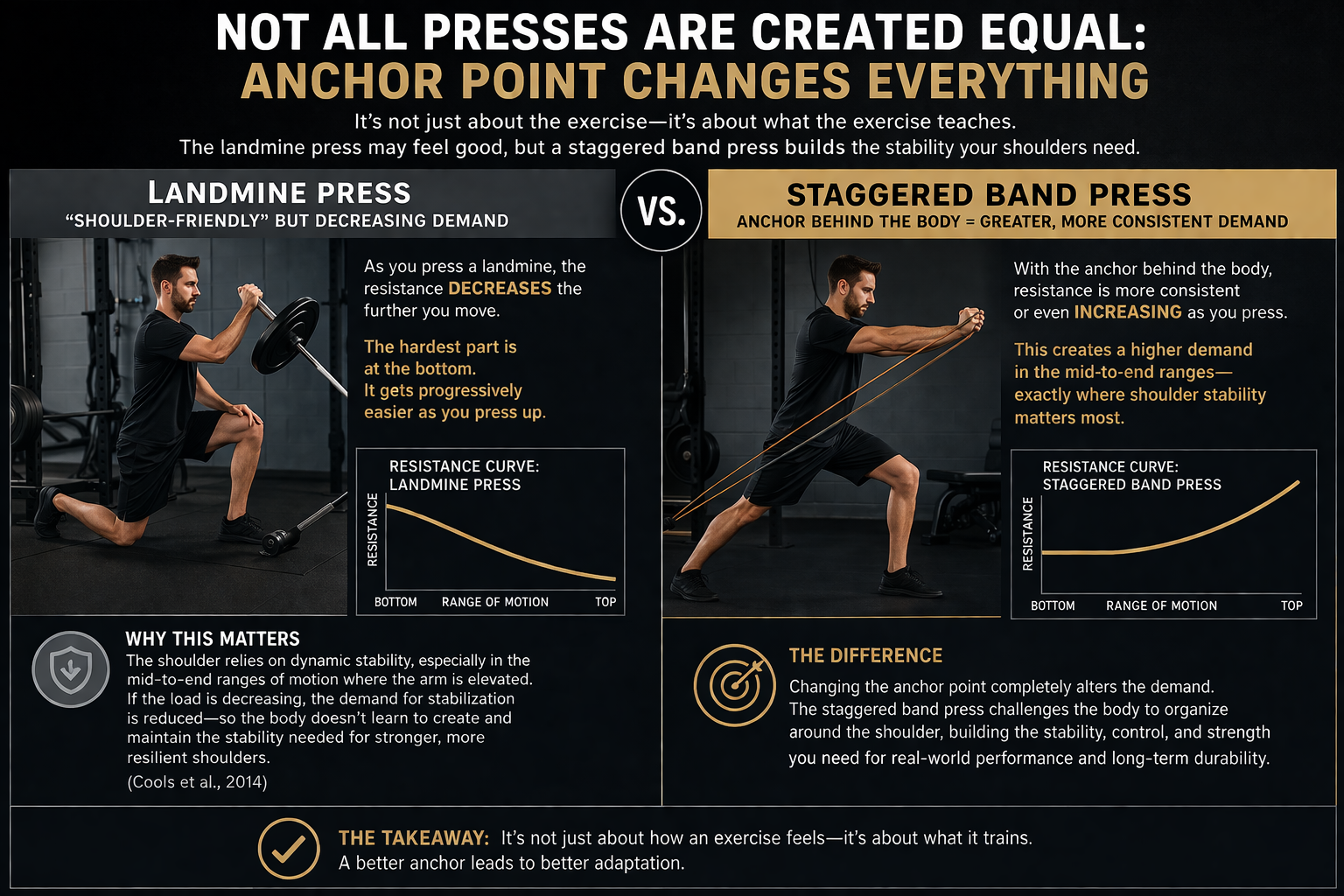
So while the landmine press doesn’t necessarily teach the body to create and maintain the kind of stability needed for stronger, more resilient shoulders. Interestingly, simply changing the anchor point, such as positioning resistance behind the body instead of in front, can completely alter these dynamics. This creates a more consistent or even increasing demand as you press, encouraging the body to organize around the shoulder rather than bypass its need for stability.
View this post on Instagram
The third example is the use of heel elevation in squats and lunges. This is often recommended for people with knee pain or limited ankle mobility, with the idea that it allows for deeper movement and reduces strain on the joints. While it may provide a temporary workaround, it can also reinforce the very issues that need to be addressed.
Elevating the heel shifts the body forward, increasing the load on the knee joint. In certain clinical contexts, such as decline squats used for patellar tendinopathy, this strategy has been studied and can be effective, but even then, it is often associated with high levels of discomfort during training. More importantly, research has shown that these specific protocols are not necessarily more effective than general strength training over time (Malliaras et al., 2013).
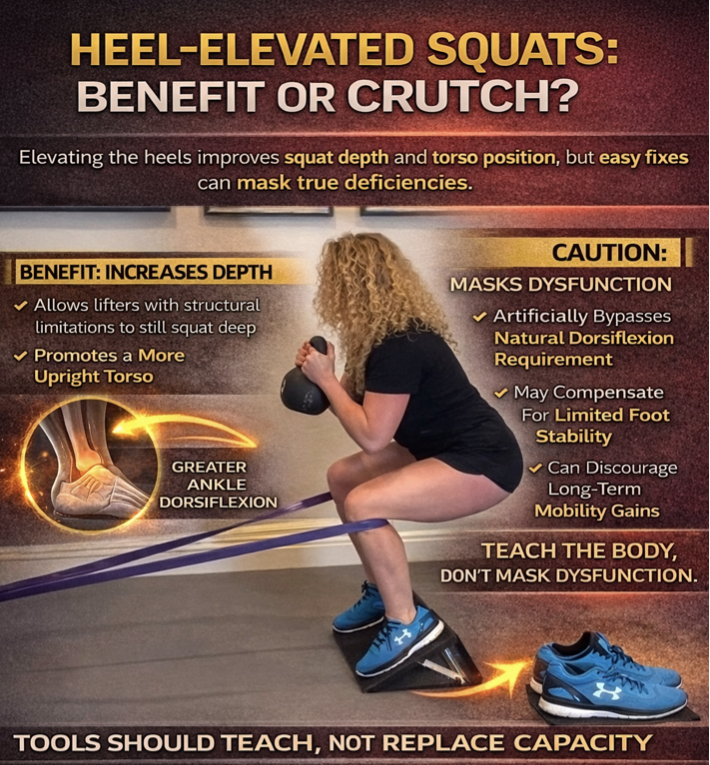
The bigger issue is that limited ankle mobility is strongly associated with altered movement patterns and increased stress on the knees, hips, and even the spine. When the ankle can’t dorsiflex effectively, the body has to find that motion elsewhere, often leading to compensations that place more strain on other joints. Rather than working around the ankle by elevating the heel, it makes more sense to address the mobility and control of the ankle itself while building strength through patterns that encourage better alignment.
Across all three of these examples, the common thread is this: the body is designed to work as an integrated system. When we remove or bypass key components whether it’s the core in a row, stability in a press, or mobility in a squat, we may make the exercise feel easier or more targeted, but we also reduce its carryover to real-world movement.
The goal of training shouldn’t be to isolate the body into artificial segments, but to improve how those segments work together. That’s what ultimately builds strength that lasts, reduces injury risk, and improves how we move in everyday life.
Learn more with our DVRT education and save 20% with code “save20” HERE
Featured in





© 2026 Ultimate Sandbag Training. Site by Jennifer Web Design.