
The Best Lower Body Exercises for People with Low Back Pain
2026-05-14
One of the biggest mistakes people make when training around low back pain is assuming they need to avoid challenging lower body exercises altogether. In reality, research consistently shows that improving lower body strength, stability, and movement coordination is one of the most effective ways to reduce stress on the spine and improve long-term function.
The key is choosing exercises that build strength without unnecessarily overloading the low back while also improving how the entire kinetic chain works together.
That’s where movements like front-loaded squats, step-ups, and integrated single-leg drills become so powerful.
Why Front-Loaded Squats Are So Effective for Low Back Pain
Traditional back squats can sometimes be problematic for people with low back pain because the load position often increases forward trunk lean and spinal compressive forces. Front-loaded squat variations create a very different stimulus.
One of the most important studies on this topic comes from Gullett et al. (2009), which compared front squats to back squats. The researchers found that front squats produced significantly lower compressive forces on the knee while also reducing lumbar spine stress due to a more upright torso position. Despite using lighter loads, front squats still generated similar muscular activation and training benefits.
That upright posture matters tremendously for people with low back pain because it decreases excessive shear stress on the lumbar spine while improving core engagement and thoracic mobility.
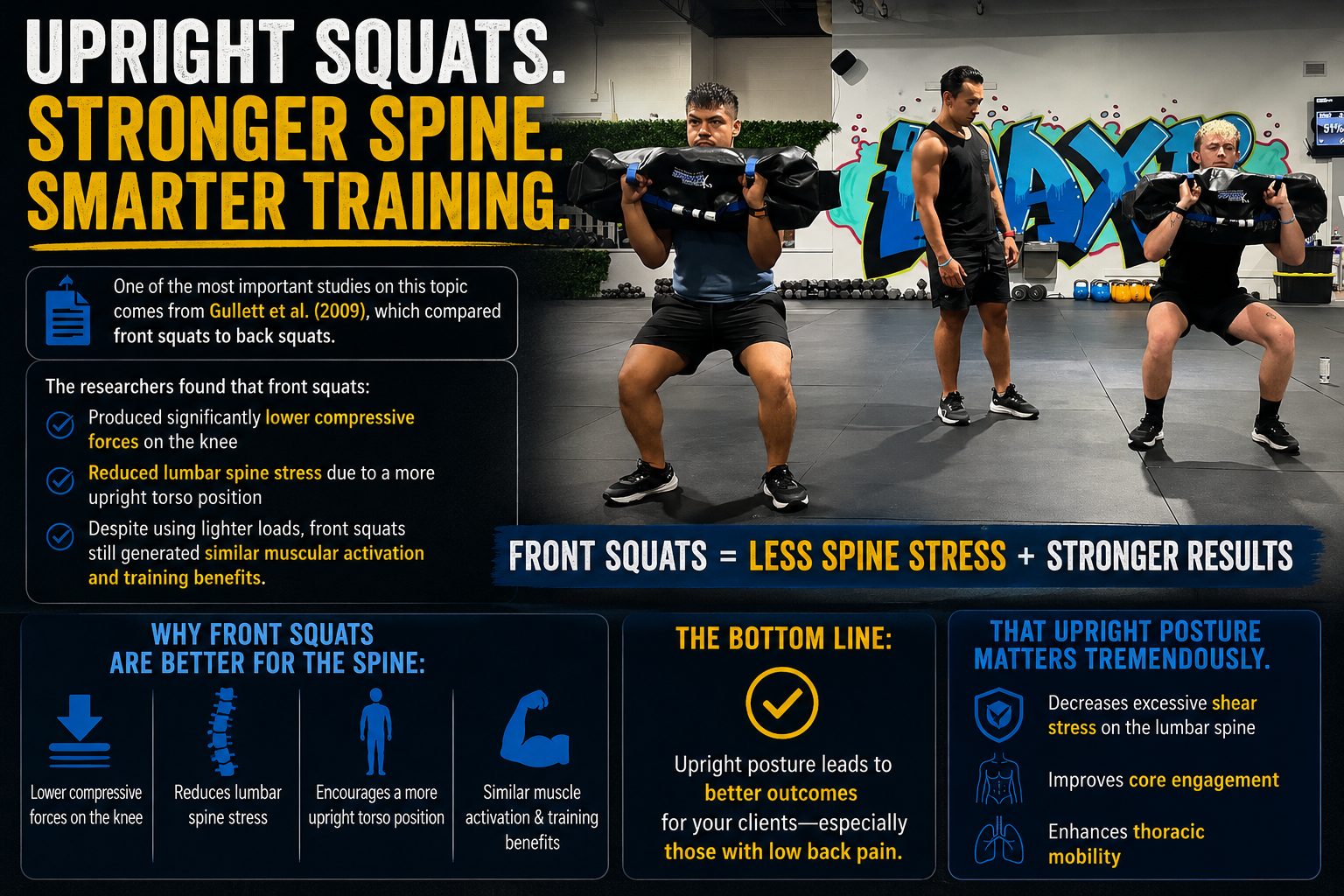
This is one reason Ultimate Sandbag front-loaded squat progressions are so effective.
Unlike rigid barbells, the Ultimate Sandbag gives the body continuous feedback through the anterior core and upper body. The front-loaded position naturally encourages:
- better trunk stiffness
- improved rib cage positioning
- enhanced diaphragmatic breathing
- and more efficient hip mobility
What makes the system especially powerful is the ability to progressively change how much “feedback” the body receives.
As Mimi Quinn demonstrates so well, holding the Ultimate Sandbag in different front-loaded positions allows us to either increase or decrease the core demand depending on the individual’s needs and tolerance.
For someone highly sensitive or fearful of loading, we can use more supportive holding positions that help create stability and confidence. As the person improves, we can gradually challenge reflexive core stability more dynamically without aggressively loading the spine.
This creates a progression system that develops mobility and strength simultaneously while sparing the low back.
The Overlooked Power of Step-Ups
Step-ups are one of the most underrated exercises for low back pain.
Many people think of step-ups as simply a leg exercise, but they actually train several qualities that are essential for reducing spinal stress.
First, step-ups are one of the best ways to build hip extensor strength. Strong glutes help absorb force and reduce the tendency for the lumbar spine to compensate during movement.
But what makes step-ups especially valuable is that they are truly single-leg exercises.
Walking, climbing stairs, running, and most real-life movement happen primarily from one leg at a time. When frontal plane stability is poor, the pelvis shifts excessively side-to-side, the knees collapse inward, and the low back often overworks trying to create stability the hips should be providing.
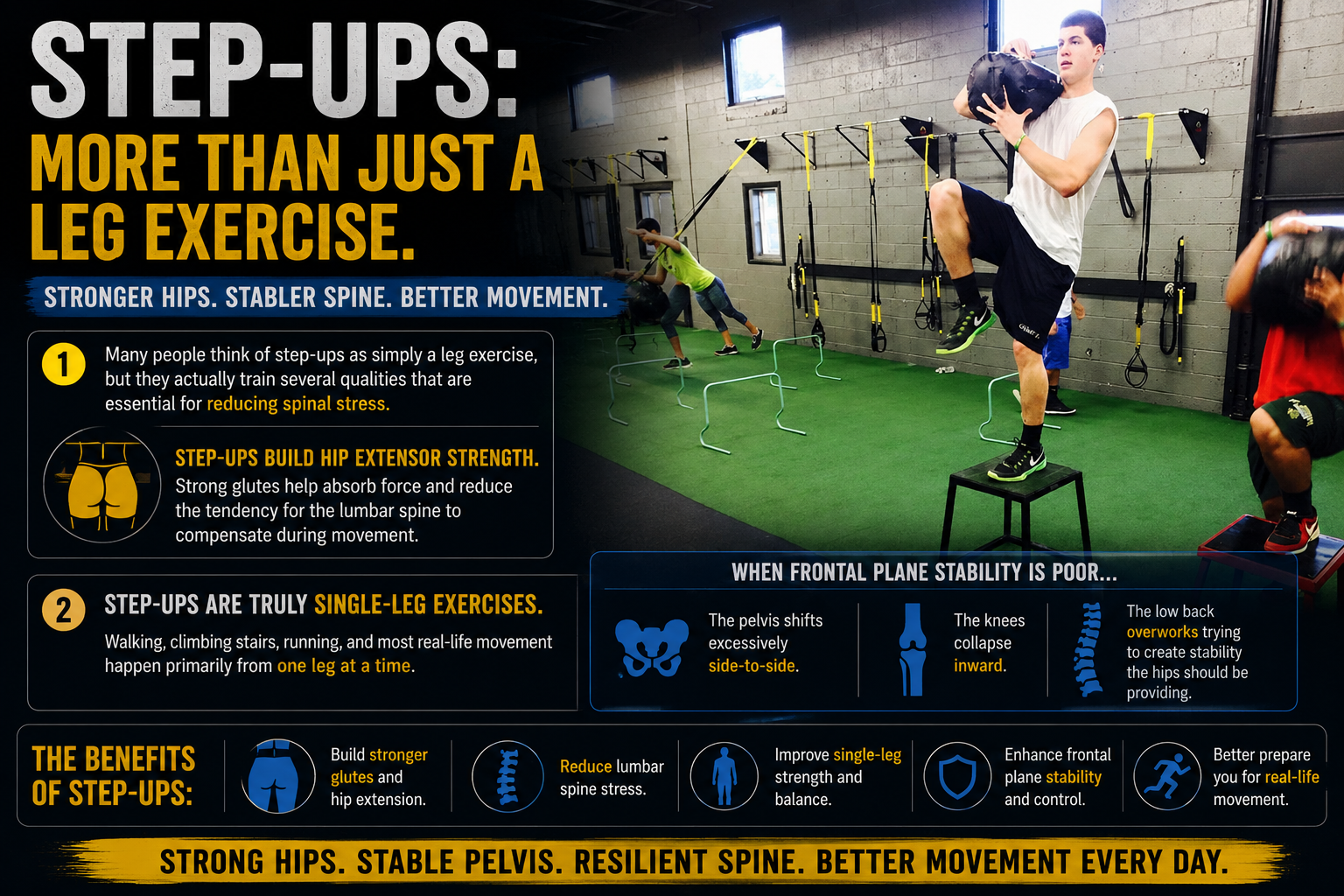
Research has repeatedly linked poor frontal plane control and weak lateral hip stability to low back pain.
Step-ups train the body to:
- stabilize the pelvis
- control lateral motion
- improve balance
- and transfer force more efficiently through the hips and trunk
Unlike bilateral exercises where compensation is easier to hide, single-leg work exposes weaknesses in the kinetic chain and helps restore more efficient movement patterns.
Even more importantly, step-ups can be progressed very gradually. Changes in height, load position, tempo, and direction allow people with low back pain to build confidence and strength without excessive spinal loading.
Why Integrated Single-Leg Training Changes Everything
Strength alone is not enough for many people with chronic low back pain.
Research increasingly shows that chronic pain changes how the nervous system processes movement, threat, and stability. Many people develop protective movement patterns, excessive muscular tension, and fear of motion long after tissues have healed.
This is where our Myofascial Integrated Movement single-leg drills become so valuable.
These drills go beyond isolated strengthening by integrating:
- breathing
- diagonal movement patterns
- balance
- rotational control
- and mindful movement awareness
Rather than “locking” the core down, these exercises teach the body how to create reflexive stability while still allowing efficient movement.
The combination of single-leg loading and cross-body integration helps reconnect the entire lower body kinetic chain. The hips, core, feet, and trunk learn to communicate more efficiently together instead of functioning as isolated parts.
At the same time, slower coordinated movement combined with intentional breathing helps down-regulate the nervous system.
Research on pain science increasingly shows that improving perceived safety during movement can reduce protective tension, decrease fear-avoidance behaviors, and help calm sensitized pain responses.
That’s why these drills are about more than just exercise.
They help restore trust in movement.
For many people with low back pain, that shift is just as important as building strength itself.
The best lower body exercises for low back pain are not necessarily the ones that create the most fatigue or use the heaviest weights.
They’re the exercises that improve how the body coordinates stability, mobility, breathing, and force transfer together.
Front-loaded squats, step-ups, and integrated single-leg drills do exactly that.
They help people become stronger, more resilient, and more confident movers while reducing unnecessary stress on the low back.
And ultimately, that’s what long-term success with low back pain is really about.
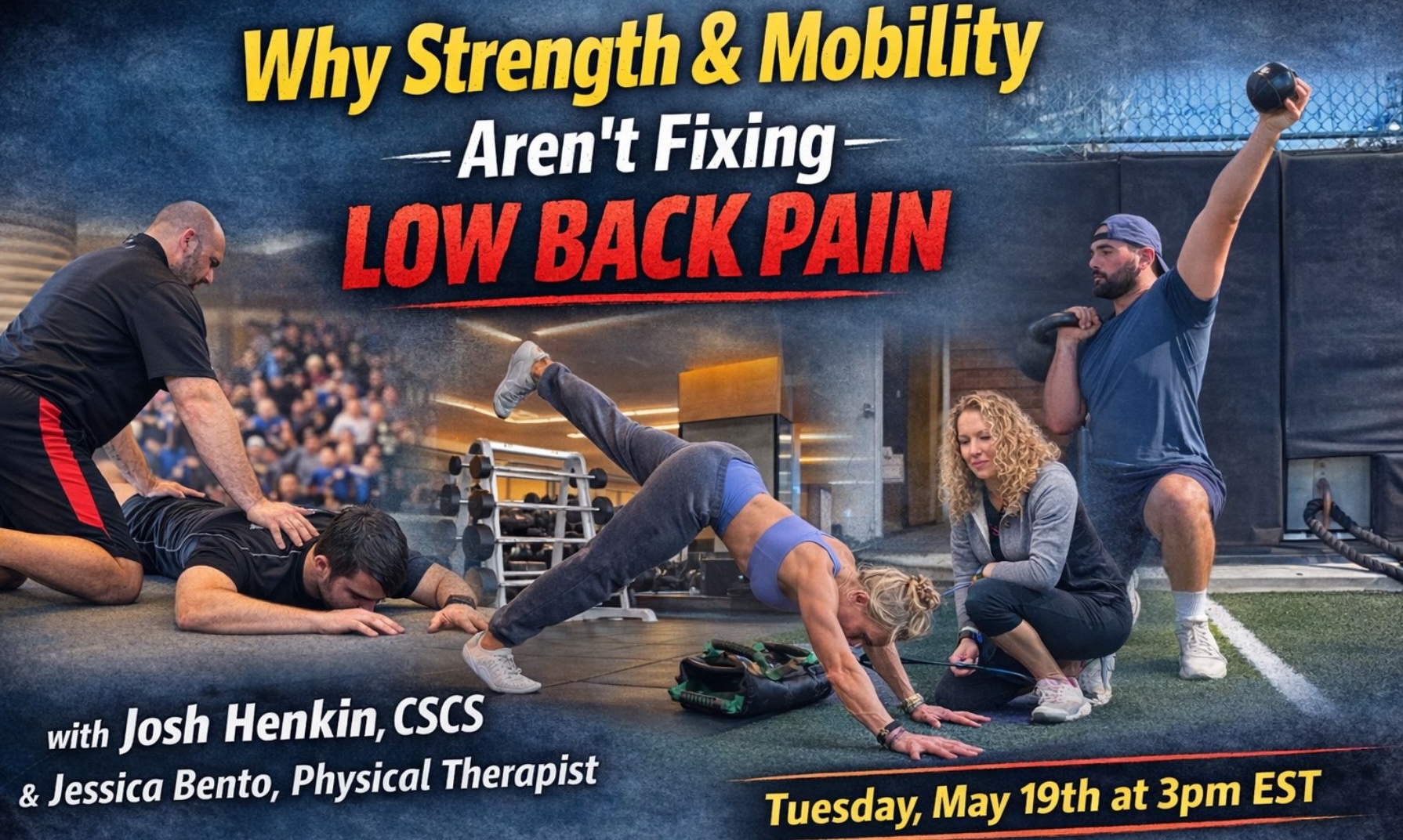
Find out SO much more at our FREE upcoming Low Back Pain Webinar this coming Tuesday May 19th at 3pm EST HERE
Featured in





© 2026 Ultimate Sandbag Training. Site by Jennifer Web Design.