
Fat Loss & Conditioning Workouts That Make You Resilient Not Just Leaner
2026-06-14

When most people hear the word “conditioning,” they immediately think about burning calories, sweating more, and losing fat.
While those outcomes can certainly happen, they often lead coaches and exercisers down the wrong path. Conditioning becomes about surviving workouts instead of improving movement. The result is often excessive fatigue, repetitive exercises, poor movement quality, and eventually plateaus, aches, and injuries.
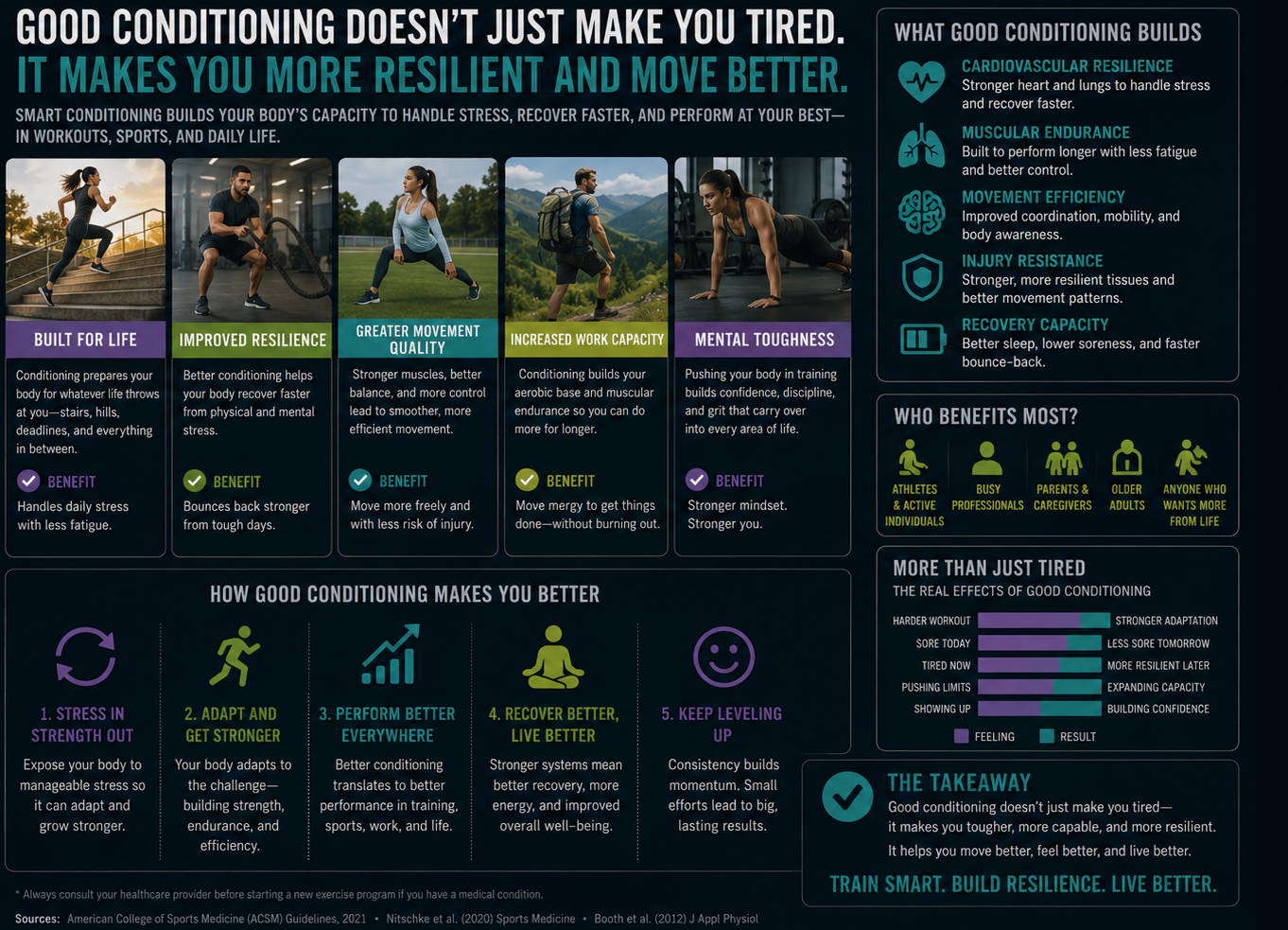
Great conditioning should do more than help people burn calories.
It should build resilience.
Resilience means creating a body that can move well, produce force, absorb force, recover efficiently, and adapt to life’s demands. When conditioning is programmed correctly, it becomes one of the most effective ways to simultaneously improve mobility, stability, power, and functional strength.
Start with the Foundational 7 Human Movements
One of the simplest ways to create more resilient conditioning programs is to build workouts around the seven foundational movement patterns:
- Squat
- Hinge
- Lunge
- Push
- Pull
- Rotation
- Locomotion (carries, crawling, gait-based patterns)
Instead of performing endless repetitions of the same movement pattern, conditioning sessions should expose the body to multiple movement demands.
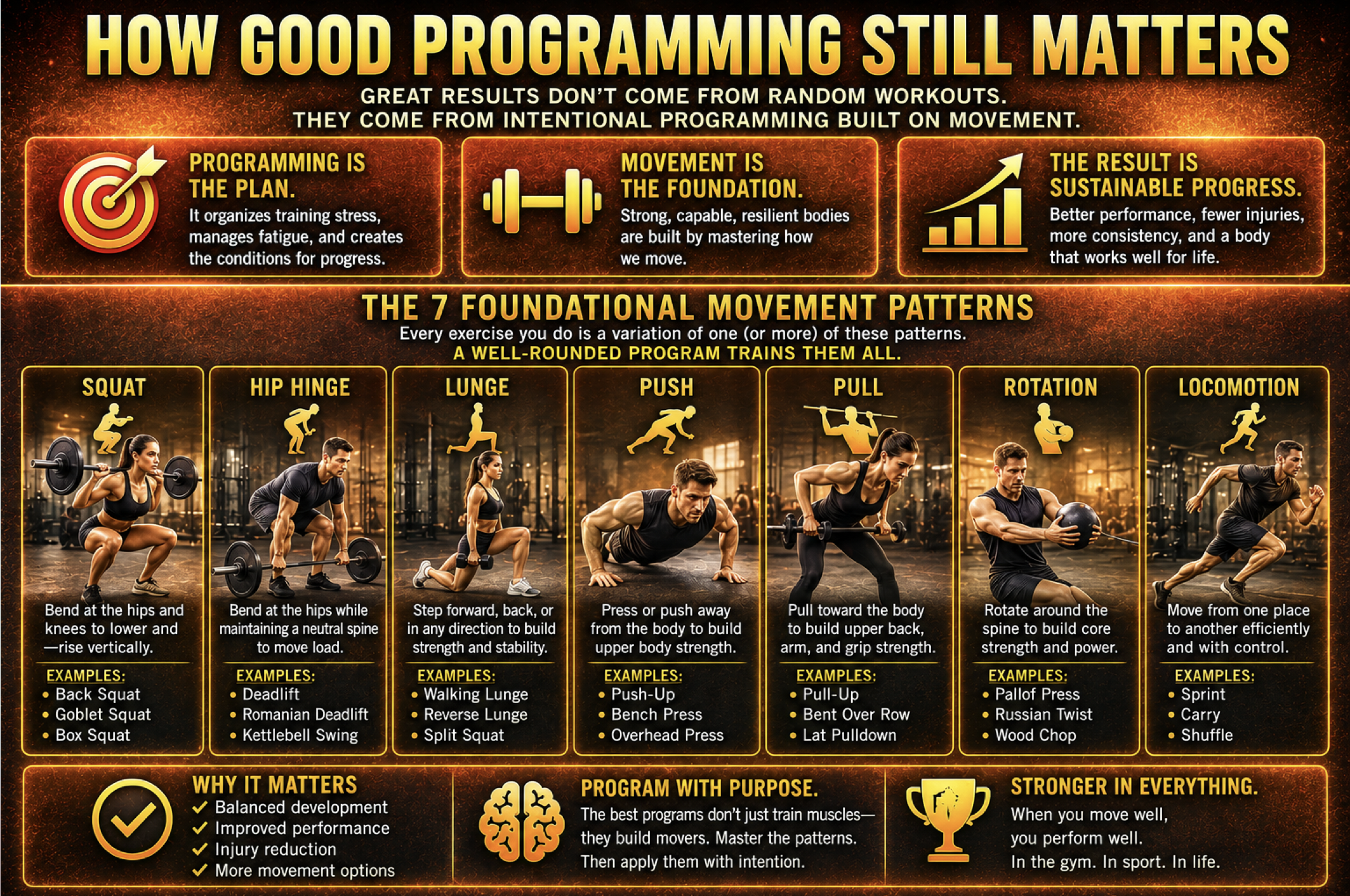
This creates a broader movement vocabulary while distributing stress throughout the body.
For example:
- Front Loaded Squat
- Tall Kneeling Arc Press
- MAX Lunge
- Sprinter Stance Row
- Shoulder Carry
Now the workout is developing movement competency while improving conditioning.
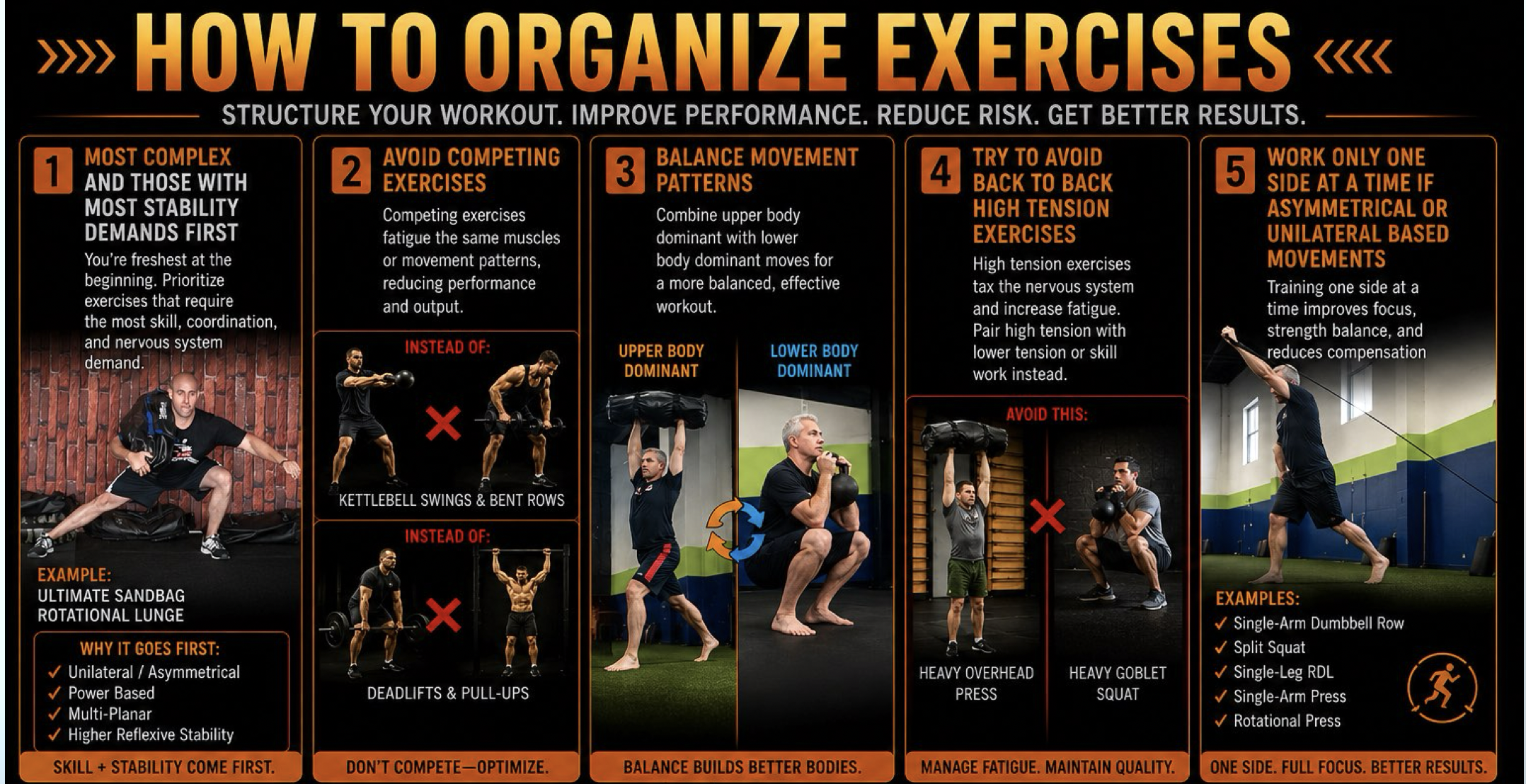
Alternate Upper and Lower Body Movements
One of the smartest programming strategies used in Coach Dos’s MRT (Metabolic Resistance Training) system is alternating upper and lower body dominant exercises.
Why?
Because alternating movement patterns allows local muscle groups to recover while maintaining a high overall work output.
Compare these two examples:
Less Efficient
- Squat
- Lunge
- Deadlift
- Step-Up
The lower body becomes the limiting factor.
More Efficient
- Squat
- Row
- Lunge
- Press
- Hinge
- Rotation
Now the cardiovascular system works harder while movement quality remains higher.
The result is greater total work with less breakdown.
This is one reason MRT programs often feel challenging without feeling destructive.
Progress Through the Planes of Motion
One of the most overlooked concepts in conditioning is movement progression.
Many programs stay trapped in the sagittal plane:
- Squats
- Deadlifts
- Lunges
- Push-ups
These are excellent exercises, but life doesn’t occur exclusively forward and backward.
Within our DVRT Ultimate Sandbag Movement System, we progressively develop movement through three planes:
Sagittal Plane
The foundation.
Focuses on:
- force production
- basic strength
- movement competency
Examples:
- Front Loaded Squat
- Deadlift
- Clean And Press
- Body Row
Frontal Plane
Adds lateral stability and deceleration.
Examples:
- Lunges
- Half Kneeling Drills
- Lateral Step-Ups
- Lateral Rows
Now the body must control side-to-side movement.
This develops mobility, balance, and stability simultaneously.
Transverse Plane
Introduces rotational force production and force absorption.
Examples:
- MAX Lunges
- Shoveling
- Around the Worlds
- Rotational Cleans
- Lateral Drags
The transverse plane challenges coordination, core integration, and real-world movement capacity.
As clients improve, conditioning becomes more dynamic while maintaining movement quality.
View this post on Instagram
Use Work-to-Rest Ratios Intelligently
One of Coach Dos’s greatest contributions through MRT is emphasizing strategic work-to-rest ratios.
Many people mistakenly believe conditioning means eliminating rest.
The opposite is true.
Rest determines which physiological qualities you’re training.
General Conditioning
Work = 1:1
Examples:
- 30 seconds work
- 30 seconds rest
Goal:
- Improve aerobic efficiency
- Increase work capacity
- Build movement endurance
Repetition Goals:
- 8-12
- Exceptions for drills more flowing (maybe kettlebell swing) or deliberately slow
Intermediate Resilience Phase
Work = 1:2
Examples:
- 20 seconds work
- 40 seconds rest
Goal:
- Learn movement
- Improve recovery
- Maintain quality
Repetition Goals:
- 6-8 (if you use one side at a time this is for one side then rest, then perform other side)
Advanced MRT Conditioning
Work = 1:3
Examples:
- 15 seconds work
- 45 seconds rest
Goal:
- Improve metabolic conditioning
- Increase fatigue resistance
- Maintain movement under stress
- Increased repeated power output
Repetition Goals:
- 4-6 (which means loads are going to be much higher)
The mistake many coaches make is starting here.
Instead, resilience is built through progression.
View this post on Instagram
Why This Approach Builds More Than Fat Loss
When conditioning is built around movement quality and intelligent progression, several physical qualities improve simultaneously.
Mobility
Multi-planar movement challenges joints to move through a variety of ranges while under control.
Mobility becomes something the body owns rather than something temporarily gained through stretching.
Stability
Alternating planes of motion and loading positions requires constant adjustment and control.
The nervous system learns to stabilize dynamically.
Power
Power is the ability to create force quickly and being able to decelerate quickly as well.
Rotational cleans, high pulls, lateral movement patterns, and dynamic lunges teach the body to generate and absorb force efficiently.
Functional Strength
Strength becomes usable because it is trained through integrated movement patterns rather than isolated muscles.
The body learns to connect the feet, hips, core, and upper body into one coordinated system.
The Real Goal of Conditioning
Conditioning should not leave people exhausted for the sake of being exhausted.
It should leave them more capable. The best programs don’t simply improve calorie expenditure.
They improve movement quality, recovery capacity, coordination, strength, and resilience.
When you build conditioning around the seven foundational movement patterns, alternate upper and lower body demands, progress through the planes of motion, and apply intelligent MRT work-to-rest ratios, something powerful happens.
You stop training fatigue, you actually start training adaptability. Developing adaptability is the foundation of true resilience.
Save 20% throughout DVRT including our conditioning programs with code “save20” HERE
View this post on Instagram
Featured in





© 2026 Ultimate Sandbag Training. Site by Jennifer Web Design.