
Myofascial Slings: What They Are, What They Aren’t, & Why They Change Everything About How You Train
2026-07-5

There is a conversation happening in the fitness and rehabilitation world that sounds more advanced than it actually is and that gap between perception and reality is costing people real results.
Myofascial slings. The moment most coaches hear that term, one of two things happens. Either their eyes glaze over because it sounds too academic to be practical, or they overcomplicate it into something that requires a PhD to program. Both responses miss the point entirely.
Here is what myofascial slings actually are, what they are not, and why understanding them even at a basic level will immediately make your programming more effective.
What Myofascial Slings Are Not
Let’s start by clearing the air.
Myofascial slings are not a complicated system reserved for elite athletes or clinical settings. They are not a reason to abandon the foundational movement patterns you already coach squats, hinging, presses, pulls, lunges, rotation, and locomotion. And they are absolutely not about isolating specific chains of the body and training them in a vacuum.
That last point is critical. One of the most common misapplications of sling system thinking is to treat each sling as a separate entity to be trained in isolation as if you can neatly target the posterior oblique sling on Monday and the lateral system on Wednesday and call it integrated training. That approach simply trades one form of isolation for another. The whole point of the sling concept is that these systems work together, continuously and simultaneously, to produce the coordinated movement your body actually relies on.
They are also not an excuse for unnecessary complexity. The K.I.S.S. principle, keep it simple…, is a genuinely valuable entry point for foundational strength training. The problem is when simplicity becomes a ceiling rather than a foundation. Exclusive adherence to oversimplification leads to what is called the S.I.S.S. method: stuck in stupid simplicity. Myofascial sling training is not complex for its own sake. It is specific for a very good reason.
What Myofascial Slings Actually Are
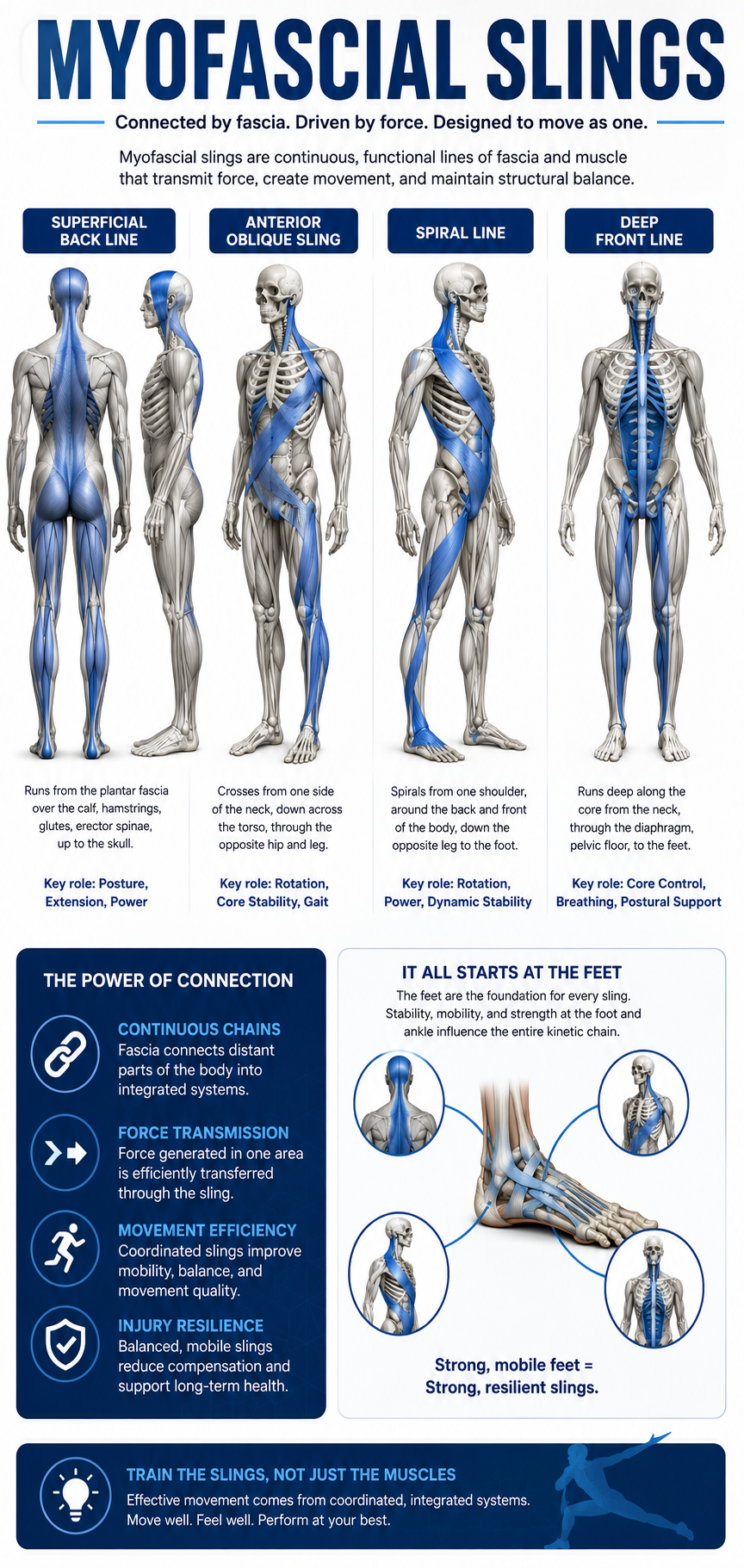
Physiotherapist Diane Lee’s foundational work on the pelvic girdle described four primary sling systems that work in and around the pelvis the anterior oblique system, the posterior oblique system, the deep longitudinal system, and the lateral system. Each represents a real, functional relationship between muscles and the connective tissue that links them across regions of the body.
The anterior oblique sling connects the obliques to the opposing leg’s adductors through the anterior abdominal fascia. This system is the reason your body can accelerate, decelerate, and change direction without falling apart. It stabilizes during the stance phase of gait and drives the leg through during the swing phase which is why athletes with poorly developed anterior oblique function struggle with cutting movements and groin injuries.
View this post on Instagram
The posterior oblique sling connects the latissimus dorsi of one side to the opposing gluteus maximus through the thoracolumbar fascia. Watch someone walking efficiently and this system is producing the cross-body tension that prevents your pelvis from rotating out of control with every step. It also stores and releases elastic energy which is precisely why it matters for both efficiency and performance.
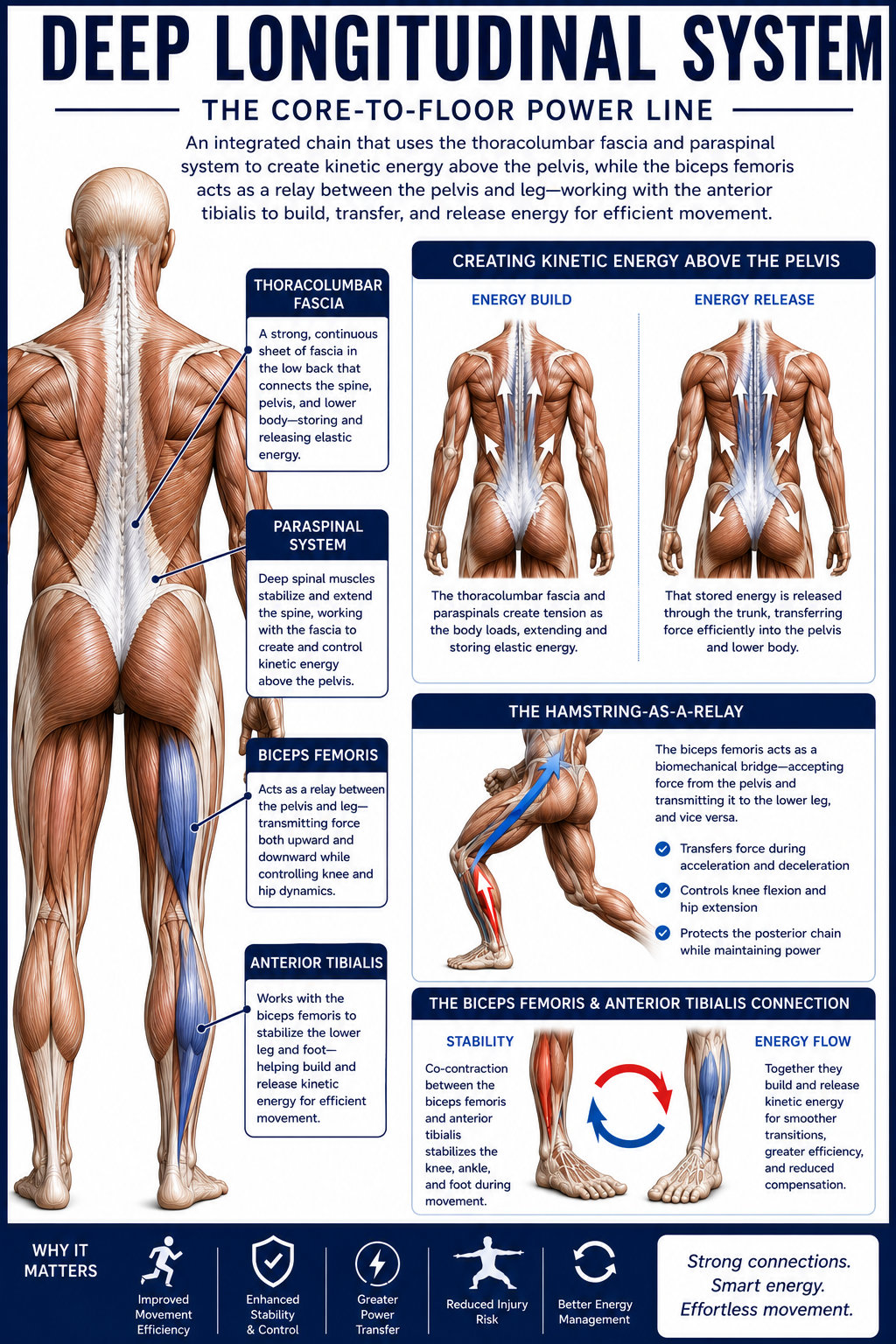
The deep longitudinal system links the erectors and paraspinal structures above the pelvis with the biceps femoris below it, using the thoracolumbar fascia as the relay. It is your body’s primary mechanism for transferring kinetic energy vertically from the ground through the pelvis and spine. Without it functioning well, force leaks at every transition.
The lateral system, glute medius and minimus working with the opposing adductors, provides the lateral pelvic stability that makes every single-leg movement safe and efficient. When it’s compromised, you see Trendelenburg gait, poor knee tracking, hip pain, and in female athletes, elevated ACL injury risk.
View this post on Instagram
What This Actually Means for Your Programming
Here is the practical insight that changes everything: most conventional training programs think in terms of the weight room. Myofascial sling training thinks in terms of life, sport, and the real demands the body faces outside the gym.
A rear-leg-loaded forward lunge with a Ultimate Sandbag trains the anterior oblique sling because it places load on the exact cross-body relationship that system is responsible for managing. A half-kneeling press with the load in the opposing hand challenges the posterior oblique sling by demanding the lat and opposing glute create tension together under load. A deceleration step deadlift trains the deep longitudinal system by forcing the body to manage eccentric energy through the chain rather than simply lifting and lowering in a controlled environment.
View this post on Instagram
These are not exotic movements. They are familiar patterns made more specific by understanding the system they’re developing. The exercises don’t change dramatically, the intention behind them does.
That intention is what separates a program that builds real-world strength, resilience, and performance from one that simply builds a body that performs well in the weight room.
The body is a chain. Train it that way.
Learn more in our DVRT training programs and courses, ALL which are 25% off along with our Ultimate Sandbags HERE with code “dvrt25”
View this post on Instagram
Featured in





© 2026 Ultimate Sandbag Training. Site by Jennifer Web Design.