
The Knee Is Not the Problem. Here’s What Is.
2026-07-8

Knee pain is one of the most common complaints in both fitness and clinical settings. And it is also one of the most commonly mismanaged.
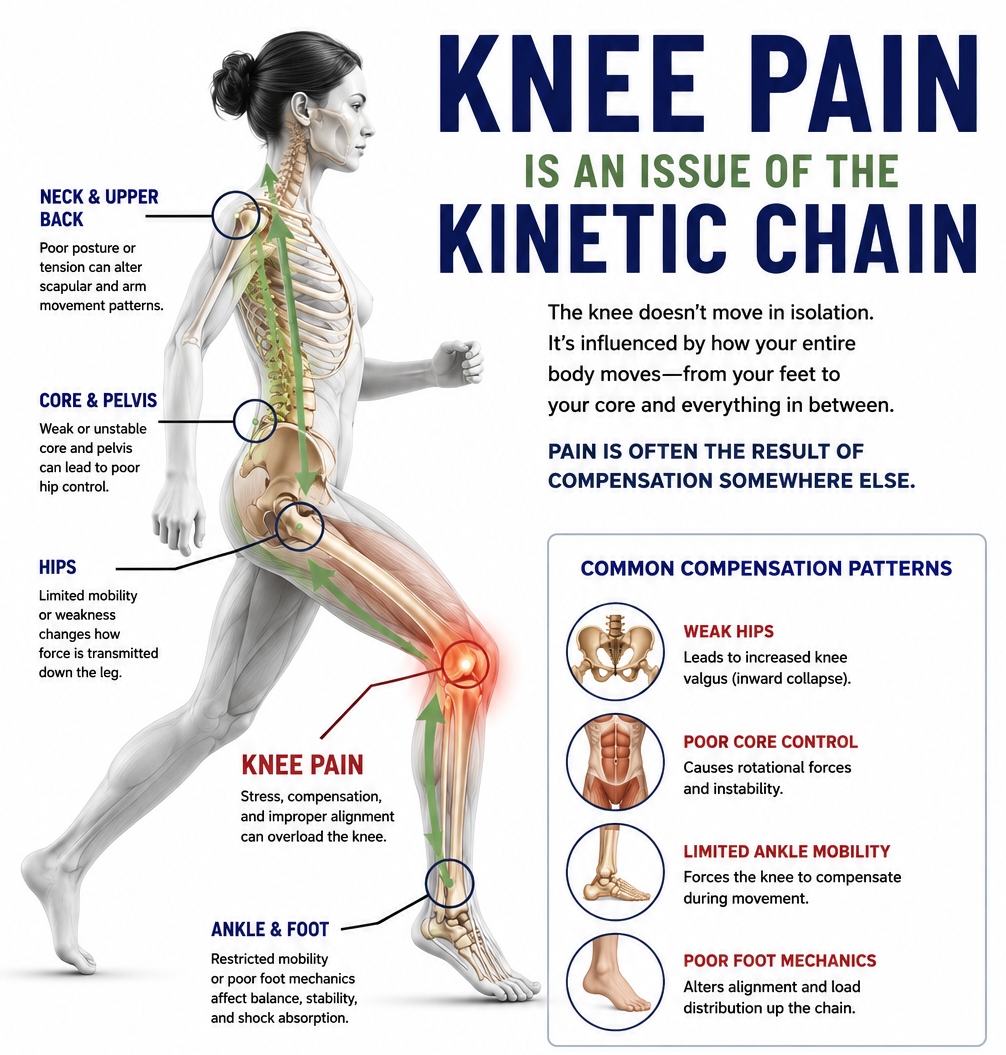
The default response to knee pain is maybe do some quad sets and terminal knee extensions, is based on a model that treats the knee as the origin of the problem. Most of the time it isn’t. The knee is the victim. The rest of the kinetic chain is the perpetrator. And until that distinction becomes the foundation of how we assess and train around knee pain, the same people will keep coming back with the same complaints no matter how diligently they follow their protocols.
Here is what the research actually tells us about why knees hurt and what to do about it.
The Knee Does Not Live in Isolation
The knee joint itself has a relatively limited mechanical job. It primarily flexes and extends in the sagittal plane. It does not generate its own stability in the frontal or transverse planes in any meaningful way, it depends entirely on what is happening above and below it to maintain its integrity under load.
This is the fundamental insight that most knee pain management misses. When the structures above the knee, the hip and pelvis, fail to control frontal plane forces, and when the structures below it, the ankle and foot , fail to provide adequate mobility and stability, the knee absorbs the consequences of both failures simultaneously.
Research published in the Journal of Orthopaedic and Sports Physical Therapy has consistently demonstrated that frontal plane knee motion, the inward collapse known as dynamic valgus, is one of the strongest biomechanical predictors of knee pain, patellofemoral syndrome, and ACL injury risk. And that frontal plane collapse rarely originates at the knee. It is driven from above by insufficient hip abductor and external rotator strength, and from below by restricted ankle dorsiflexion and poor foot stability.
The knee is caught in the middle of a chain that is failing at both ends.
View this post on Instagram
The Frontal Plane Problem Nobody Talks About Enough
Frontal plane stability — the body’s ability to control lateral forces during single leg loading — is one of the most undertrained qualities in conventional strength programming. Most programs live in the sagittal plane. Squats. Deadlifts. Lunges moving straight forward. These are valuable movements, but they do not adequately challenge the lateral stabilizing system that the knee depends on during real-world activity.
Research by Hewett and colleagues, whose work on ACL injury biomechanics has been foundational in sports medicine, identified that excessive frontal plane knee motion during landing and cutting tasks was a primary predictor of non-contact ACL tears — particularly in female athletes, who experience ACL injuries at significantly higher rates than their male counterparts.
The solution is not knee-specific. It is hip-specific. Research has consistently shown that strengthening the hip abductors, external rotators, and the lateral stabilizing system — what physiotherapist Diane Lee describes as the lateral sling connecting the glute medius and minimus to the opposing adductors — directly reduces dynamic valgus and improves knee mechanics under load.
You fix the frontal plane problem at the hip and foot. The knee follows.
Ankle Mobility: The Variable Everyone Underestimates
Restricted ankle dorsiflexion is one of the most consistent findings in people with chronic knee pain and one of the least frequently addressed variables in knee rehabilitation programs.
The relationship is mechanical and direct. When the ankle cannot dorsiflex adequately during a squat, step, or landing, the body compensates by collapsing the arch of the foot and driving the knee inward to find the range of motion it needs. That compensation is the frontal plane collapse discussed above generated not by hip weakness alone but by the ankle’s inability to move through its required range.
Research published in the Journal of Strength and Conditioning Research found that restricted ankle dorsiflexion significantly increased frontal plane knee motion during squatting tasks, and that improving ankle mobility produced measurable reductions in dynamic valgus without any direct knee intervention. The ankle was the input. The knee was the output.
View this post on Instagram
This is why assessing and addressing ankle mobility belongs at the beginning of any knee pain management program not as an afterthought.
Triplanar Hip Strength and Why It Matters More Than You Think
The hip is designed to move in all three planes simultaneously. It flexes and extends in the sagittal plane. It abducts and adducts in the frontal plane. It internally and externally rotates in the transverse plane. During any complex movement walking, running, cutting, squatting, landing, all three planes are being managed at once.
Most hip strengthening programs address one plane at a time. Clamshells for the frontal plane. Hip thrusts for the sagittal plane. Maybe some banded rotation work for the transverse plane. Performed in isolation, these exercises build strength in controlled, stable positions that don’t translate well to the dynamic, multi-planar demands of real movement.
Research on triplanar hip training has shown that exercises demanding simultaneous control across all three planes MAX lunges, lateral step-ups with rotation, single leg patterns in varied stances produce significantly greater improvements in functional knee mechanics than single-plane isolation exercises. The hip doesn’t get to choose which plane to work in during sport or daily life. Training it across all three planes simultaneously builds the kind of strength and coordination that actually transfers.
View this post on Instagram
The Kinetic Chain Answer
Effective knee pain management and knee injury prevention both require the same thing: an honest assessment of the entire lower body kinetic chain rather than a narrow focus on the symptomatic joint.
That means assessing ankle dorsiflexion and foot stability before loading movement patterns. It means evaluating frontal plane hip strength and identifying where lateral sling function is compromised. It means training hip strength triplananrly rather than in isolated planes. And it means progressing single leg work systematically , because single leg training is where the kinetic chain’s weak links reveal themselves most clearly and where the most meaningful improvements in knee mechanics are built.
The knee is not the problem. It is the messenger. And the message it is sending almost always points somewhere else.
Train the chain. The knee will follow.
Learn more in Jessica’s corrective exercise programs like her outstanding knee programs HERE and you still can get 25% off for two more days with code “dvrt25”
View this post on Instagram
Featured in





© 2026 Ultimate Sandbag Training. Site by Jennifer Web Design.