
The Unlikely Exercise That Builds a Stronger, More Stable You
2026-07-18

Some of the most powerful training progressions don’t look impressive at first glance. No heavy load. No dramatic range of motion. Just a controlled step forward at a 45-degree angle, followed by a controlled return to start.
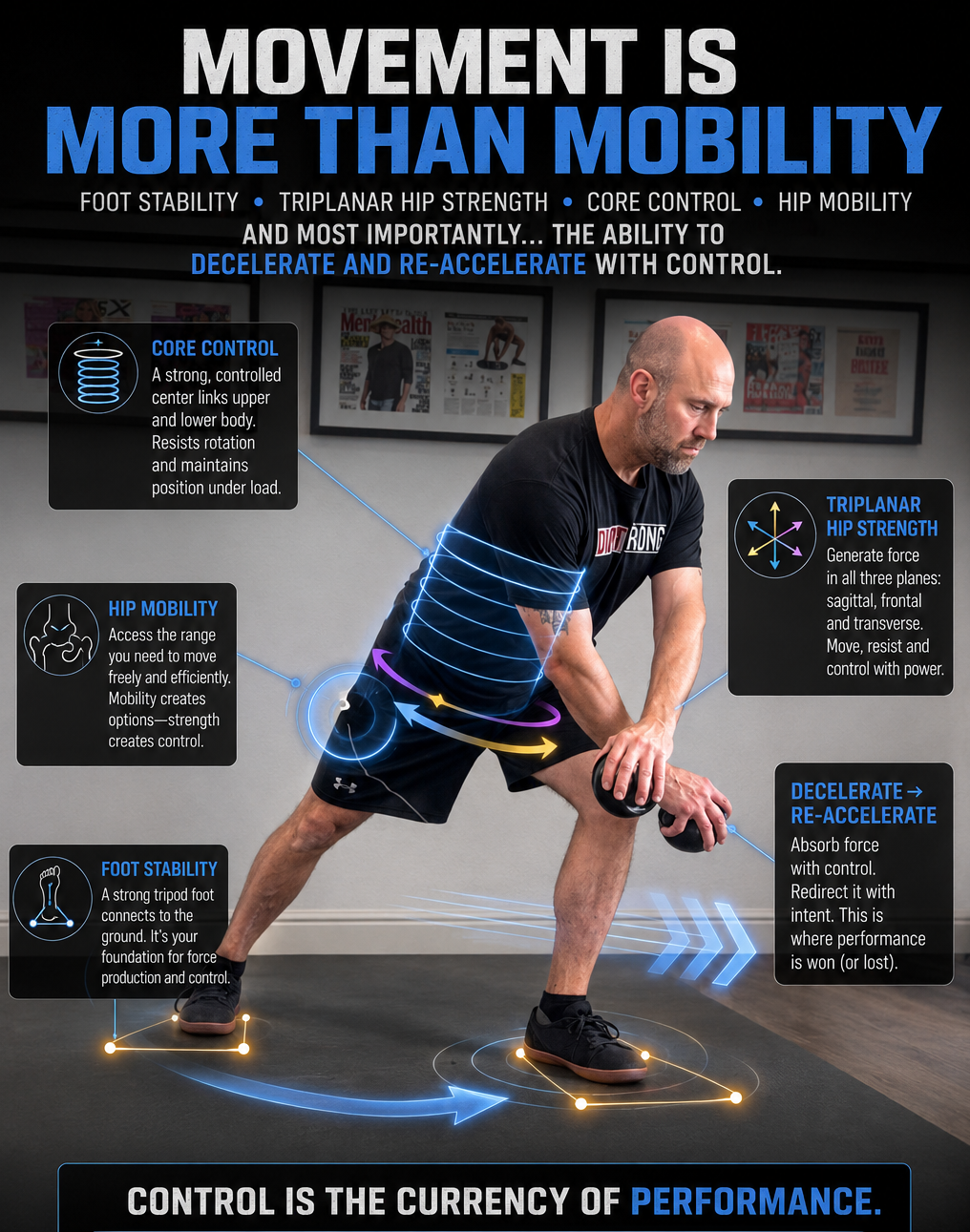
But watch closely, and you’ll see this simple pattern is doing more work than almost any single exercise in a typical training program. It’s teaching foot stability, triplanar hip strength, core control, hip mobility, and maybe most importantly the ability to decelerate and re-accelerate with control. That last piece is where most training programs quietly fall short.
Why the 45-Degree Angle Changes Everything
Most step patterns move straight forward or straight back sagittal plane only. That’s useful, but it’s incomplete. Real movement, in sport and in life, rarely happens in a single plane.
Stepping at a 45-degree angle forces the body to manage rotation and diagonal loading simultaneously with forward and backward motion. That diagonal step demands tri-planar hip strength meaning your hip has to control flexion/extension, abduction/adduction, and rotation all at once, rather than just moving through one clean plane. This is exactly the kind of demand your hips face in real athletic movement: cutting, pivoting, changing direction, absorbing force from an angle you didn’t fully anticipate.
Foot Stability Starts the Whole Chain
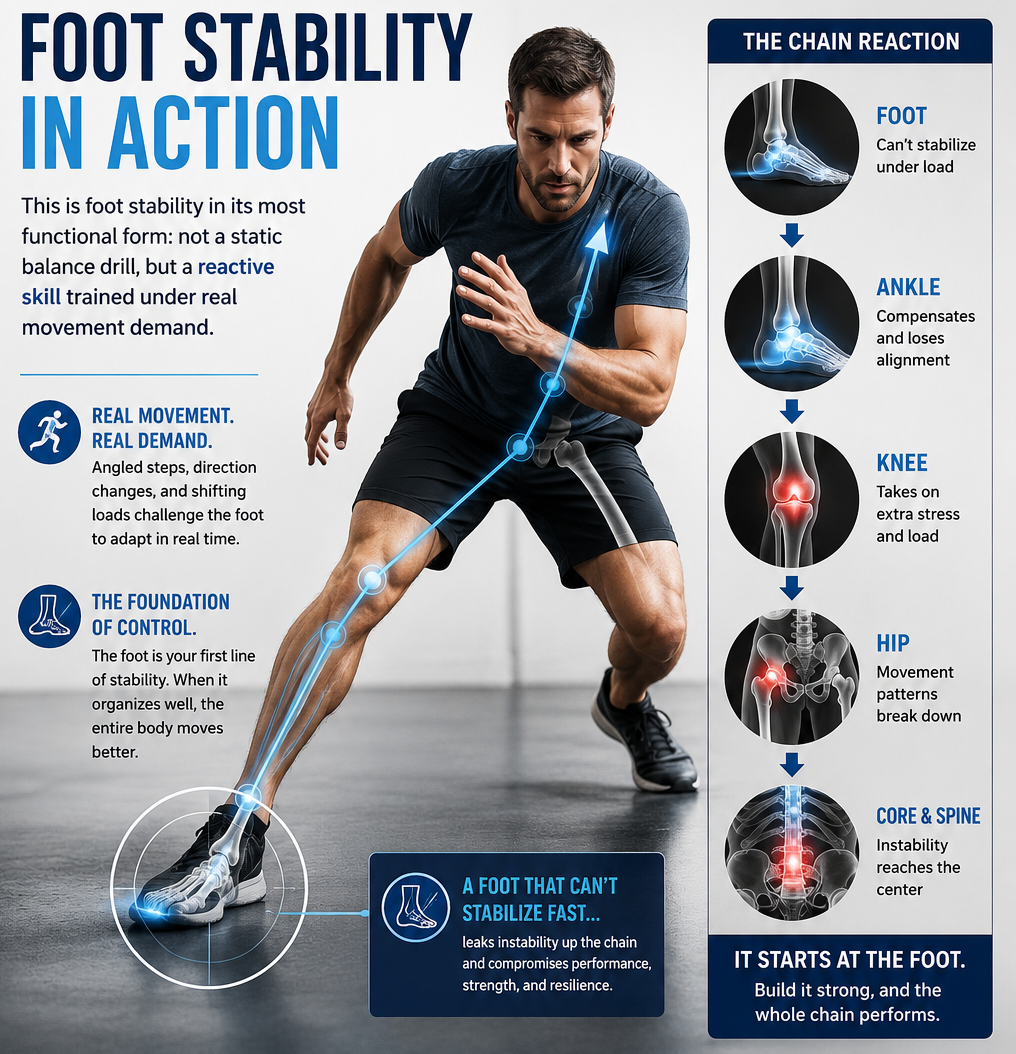
Before the hip or core can do anything productive, the foot has to establish a stable base. As you step into that 45-degree angle, your foot has to actively find and control the ground adjusting instantly to the angle, the surface, and the load coming through it.
This is foot stability in its most functional form: not a static balance drill, but a reactive skill trained under real movement demand. A foot that can’t stabilize quickly under an angled step sends instability up the entire chain into the ankle, knee, hip, and eventually the core and spine. Training this pattern repeatedly teaches the foot to organize itself instantly, which pays off far beyond the exercise itself.
Core Stability Through Controlled Rotation
As the body steps and returns through this diagonal pattern, the core isn’t just holding a static brace it’s managing rotational and anti-rotational forces in real time. Every step out creates a rotational demand at the trunk; every return back requires the core to control that motion and bring the body back to center without collapsing or over-rotating.
This builds a different kind of core stability than a plank or crunch ever could. It’s reflexive, load-responsive stability the core learning to organize itself automatically in response to movement, rather than relying on conscious bracing. That reflexive quality is exactly what transfers into real-world strength and athletic performance.
Hip Mobility, Earned Through Movement
One of the most overlooked benefits of this pattern is how it builds hip mobility without ever relying on passive stretching. As you step into the 45-degree angle and shift your weight, the hip is taken through a controlled range of flexion, rotation, and lateral movement actively, under load, with full muscular control the entire way.
This is mobility you can actually use, because it was built the same way you’ll need to access it: while moving, loading, and controlling your own bodyweight. Add intentional breath work into the pattern inhaling as you prepare, exhaling as you step and control the return and you create an additional layer of nervous system regulation. That breath pattern helps manage intra-abdominal pressure, supports core engagement through the movement, and keeps the nervous system calm enough to allow full mobility rather than guarding against it.
Where This Really Pays Off: Deceleration and Acceleration
Here’s the piece that separates this progression from simple mobility or stability work: it directly trains your ability to decelerate and re-accelerate under control.
Stepping out into the 45-degree angle requires you to decelerate your own bodyweight and momentum smoothly, without collapsing or losing structure. Returning back to start requires you to re-accelerate out of that position with control and stability. This eccentric-to-concentric transition absorbing force, then producing it again is exactly what athletes need for cutting, changing direction, and reacting to unpredictable demands in sport.
Most training programs build acceleration and deceleration separately, if they train deceleration at all. This pattern trains both, together, in a single controlled movement building the kind of functional strength and stability that holds up under real, dynamic conditions, not just in a controlled gym environment.
Small Movement, Complete Training Effect
It’s easy to underestimate a pattern like this because it doesn’t involve heavy loads or dramatic movement. But foot stability, triplanar hip strength, core control, hip mobility, and deceleration-acceleration capacity rarely get trained together this efficiently.
That’s exactly why this simple step-and-return pattern deserves a place in serious training programs not as a warm-up throwaway, but as a foundational piece building the kind of complete, connected strength that actually transfers to real performance.
Learn MUCH more at our upcoming 4-week Myofascial Integrated Movement live online classes (yes, recordings will be provided) starting July 28th. Save 25% this week with code “mim25” HERE
Featured in





© 2026 Ultimate Sandbag Training. Site by Jennifer Web Design.