
Does Age Impact How We Should Workout?
2026-02-26

Talking about strength training as we get older usually falls into the, “no, age is just a number” category. It is true, you shouldn’t be terrified to exercise because you are getting older, but there are things you may want to consider MORE that you might be reaching that over time in your life.
We know from research lots of things start to more dramatically change as we get over the age of 35. There is a lot of evidence that we start to see more muscle loss, power drops (which impacts our ability to walk efficiently and balance ourselves, not just be an athlete), our connective tissue loses some elasticity so we can fell like our mobility drops.
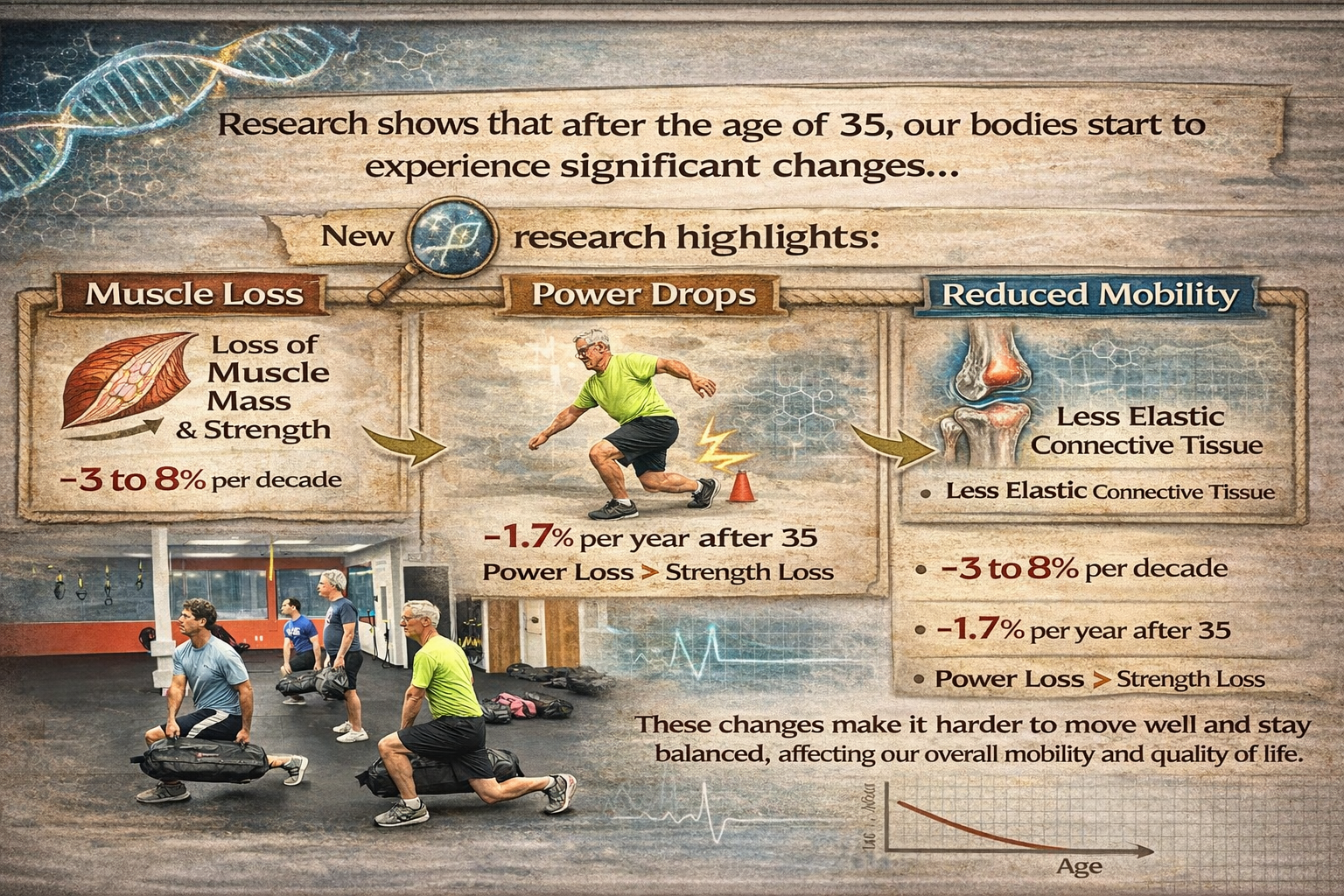
This isn’t to scare you and it is where the “age is just a number” crowd has a point. We know that the more physically active you are the LESS these changes become impactful till much later. However, this is where I think a lot of people make a mistake about aging as well.
The biggest is that our lives change quite a bit as we age. Research shows that the most stressful time in most people’s lives occurs around ages 44-47 (it could be a bit earlier or later this is just an average). Why?
People often feel the biggest demands from work, family life, financial burdens, and people start to think about their own mortality more which makes them re-evaluate many aspects of their life. This in turn can lead to more dramatic hormonal changes, issues with sleep, mental health considerations and the like.
So, what does this have to do with fitness?
Stop Comparing Yourself To Yourself!
It is bad enough social media is full of unrealistic and at this point potentially AI generated versions of what you SHOULD look like and do, but many fall into the trap of comparing themselves to their younger self. Research in sport psychology and behavioral science suggests that comparing oneself to a younger version of oneself can undermine long-term physical activity by shifting motivation from adaptive mastery goals to ego-driven performance standards. Studies on self-discrepancy theory show that when people focus on the gap between their current abilities and past peak performance, it increases feelings of loss, frustration, and perceived failure, which are associated with lower exercise adherence.
Research on aging and identity further indicates that clinging to a “former athletic self” can create unrealistic training expectations, leading to overreaching, injury risk, or abandonment of exercise when performance no longer matches memory. In contrast, self-compassion and process-oriented goal frameworks are consistently linked to better persistence, improved recovery behaviors, and more sustainable training outcomes.
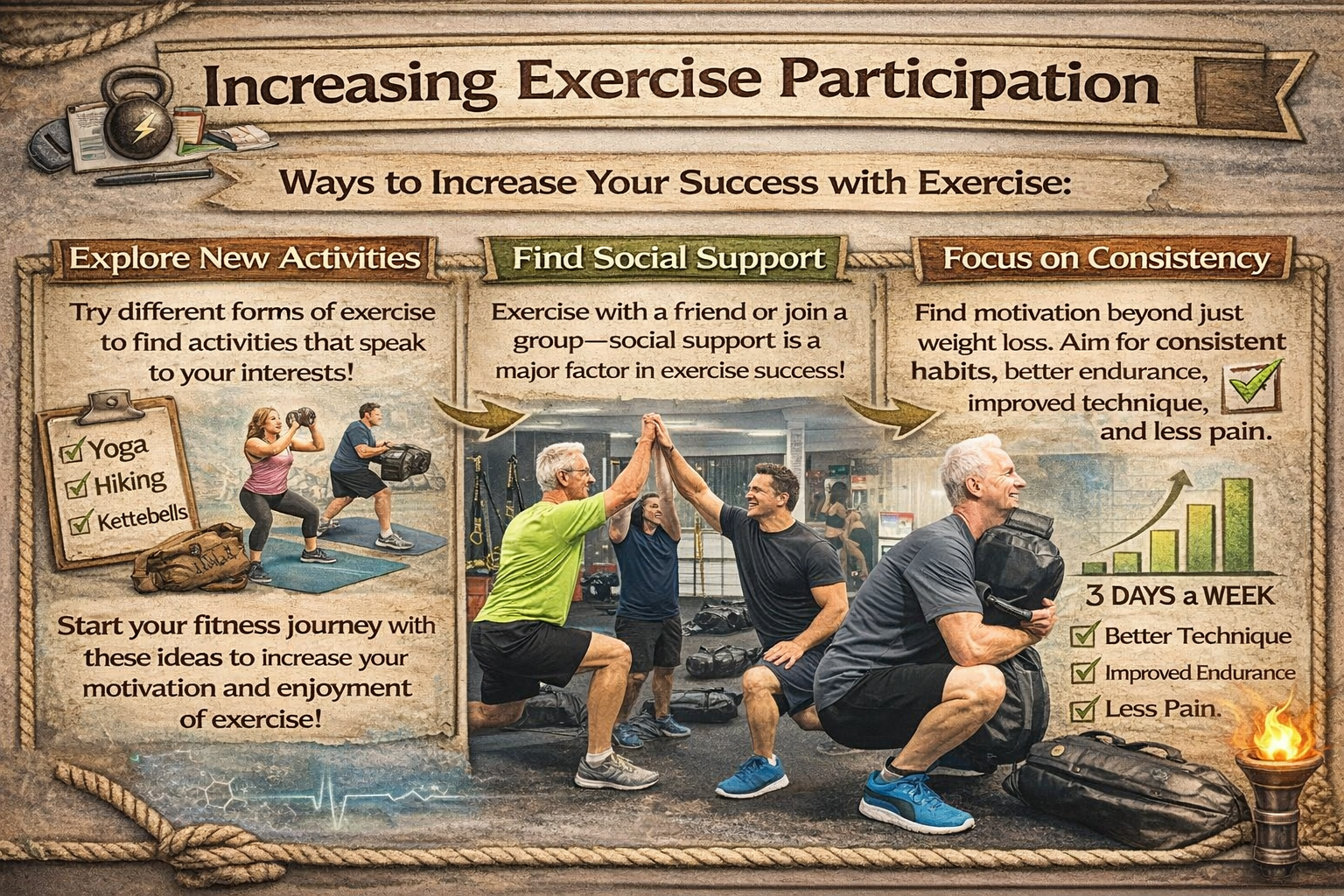
One of the most well researched ideas on being successful in exercising is finding things you ENJOY doing!!! So, if you are just doing what you did when you played high school sports or when you were 20 something because that is what you THINK you should do but you hate it, then you won’t be successful. How can we make exercise more enjoyable?
-Explore different forms of exercise, things you may have never tried and see if any of them speak to your interests.
-Try something we a friend or join a social group as social support is a big factor in exercise success.
-Don’t become so focused on extrinsic goals such as JUST weight loss. See if you can find motivation in being consistent 3 days a week with an activity. Look for opportunities to see increase progress maybe in technique, better endurance, less aches/pains, progress in a specific exercise you enjoy.
These ideas are practical for anyone, but when you are over 40 and feel overwhelmed it makes seeing yourself making exercise and health a part of your life much easier!
Train Smarter!
Of course training in ways that are effective and efficient are also part of the equation. If you are constantly hurting, your training takes too long, or you don’t feel like you are making any progress anywhere, you won’t be able to reach those goals.
How can we train smarter? Below are some simple ideas that accomplish the goals of making your training better and also less likely to cause the aches/pains that sink so many well-meaning programs.
Instead of barbell bench press: many people end up with upper body mobility issues that lead to shoulder issues if they do a lot of barbell bench pressing. There is no research that using barbells instead of dumbbells yield a big difference in the strength or muscle you build in the upper body. In fact, electromyography (EMG) studies often show greater activation of stabilizing muscles (like the serratus anterior and rotator cuff muscles) during dumbbell bench presses because each arm moves independently. This can contribute to more balanced muscle development and control.
I find even better than just dumbbell pressing is stability ball (you need a stability ball calibrated to use weights upon not just any old stability ball) and standing cable pressing. Using more of the body allows us to train the whole system and teach the upper body to work with the core and lower body which is essential.
Instead of barbell back squats: I can hear it now…I can barbell back squat!!! That is great and if you enjoy it and it doesn’t cause any issues keep doing them. However, for many of my clients, lower body mobility is was an issue, core stability, and a history of back, hip, and knee issues often made back squatting impractical. Plus, again, there is no research to say that barbell back squatting increases strength or muscle in the lower body more than other forms of squatting.
In using drills like our wide array of Ultimate Sandbag squats, kettlebell squats, and moving to more unilateral versions of the squat, I am able to accomplish more! I can reduce many of the issues in the low back, I can build better lower body mobility that allows more strength and muscle, while also helping their hips, knees, and back. Plus, by moving to more unilateral versions I can can use important elements of stability.
Instead of lunges: whoa whoa…I LOVE lunges and think they are so important in achieving many fitness goals at once. So, why would I EVER tell you to do something instead of them? For many people over 40 starting a fitness program, lunges pose a lot of issues.
People often may not have the mobility, stability, or strength/power to do them well. Others have fear of pain from poor past experiences that makes their body tighten up just thinking about them. So, while I don’t want to not try to progress to lunges, I don’t have to do lunges right off the bat.
I can use split stance, half keeling positions, bow stances, all to train qualities that will both help build up their ability to lunge, but also confidence it doesn’t have to kill them. We can use all these strategies or the ones that make people feel the best (remember, the importance of enjoyment?).
These principles can help anyone, but especially as we age we tend to need to be more mindful of these concepts. When we see that only 25% of American adults achieve the minimum standards of strength and aerobic training, we know we aren’t giving people what they REALLY need. Using some of these solutions can help greatly!
Find out more in our upcoming Training Over 40 online masterclass and save 25% and get 3 FREE resources for ONE more day HERE with code “masterclass25”
Featured in





© 2026 Ultimate Sandbag Training. Site by Jennifer Web Design.