
Strong Feet, Healthier Knees, Hips, and Low Backs
2026-02-3

Foot strength and stability are often overlooked in traditional fitness and rehabilitation programs, yet research consistently shows that the feet play a critical role in the health of the entire kinetic chain. The way we load, stabilize, and interact with the ground directly influences how forces travel through the ankles, knees, hips, pelvis, and spine. When the feet are weak, poorly coordinated, or disconnected from the rest of the body, compensations occur higher up often showing up as knee pain, hip discomfort, or low back issues.
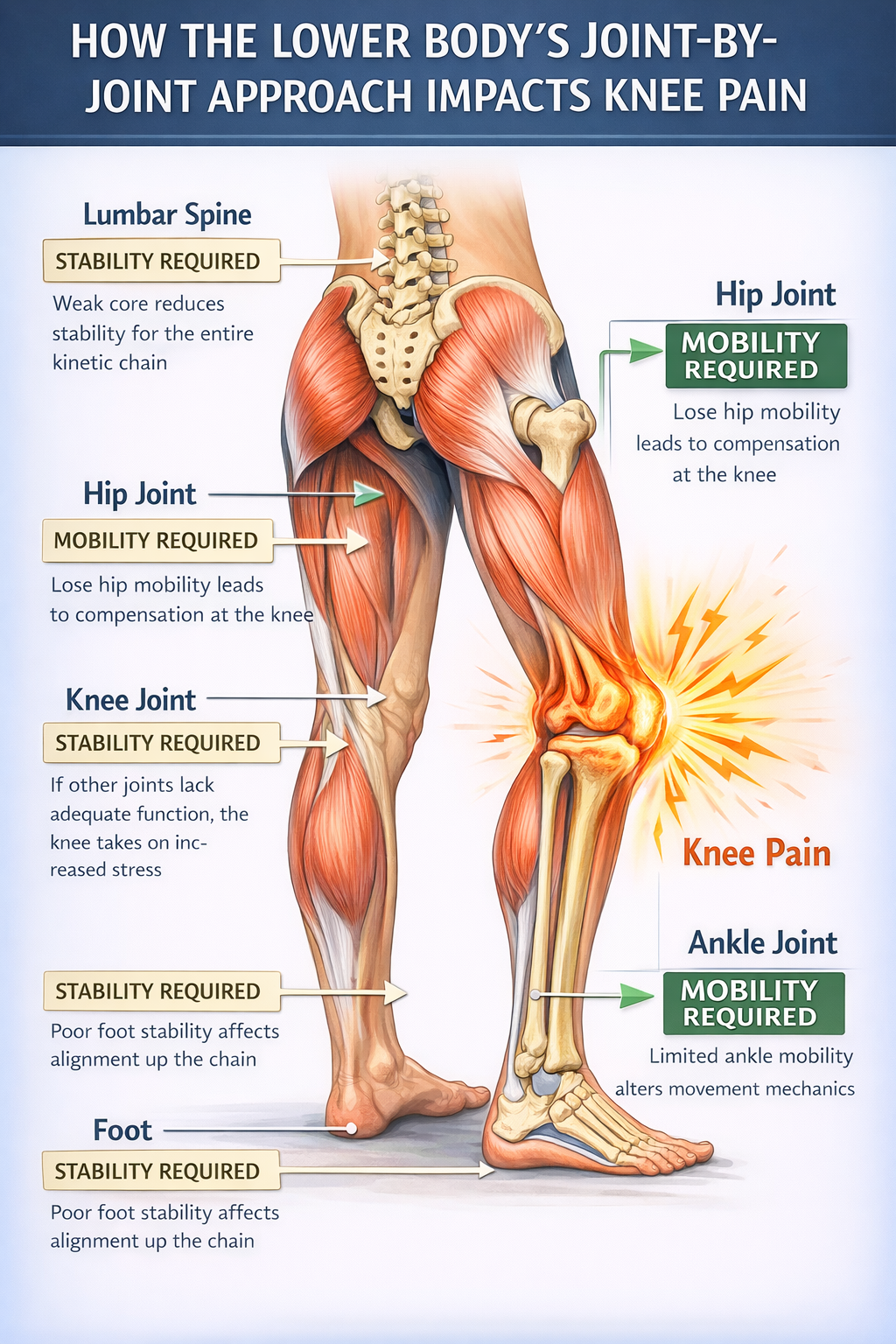
The foot is not just a passive structure. It is a dynamic, sensory-rich system designed to adapt to load, provide feedback to the nervous system, and create a stable foundation for movement. Studies show that reduced foot strength and impaired foot mechanics are associated with increased knee valgus, altered hip activation patterns, and greater stress on the lumbar spine (Levinger et al., 2010; McKeon & Hertel, 2009). In other words, what happens at the foot does not stay at the foot.
Why Foot Stability Matters for Joint Health
The feet serve as the body’s primary interface with the ground. Every step, squat, hinge, or lunge begins with how force is accepted and managed through the foot. When the foot collapses excessively or lacks the ability to stabilize under load, the body compensates by seeking stability elsewhere often through increased knee motion, hip stiffness, or spinal rigidity.
Research demonstrates that poor foot control can alter lower-extremity alignment, increasing stress at the knee and hip joints (Tiberio, 1987). Additionally, impaired foot proprioception the ability to sense position and pressure has been linked to reduced balance and greater injury risk (McKeon et al., 2015). These findings highlight that strong, responsive feet are essential not only for performance, but also for long-term joint health and resilience.

Why Being Barefoot Isn’t Enough
While barefoot training has gained popularity, simply removing shoes does not automatically teach the feet how to function well. In fact, without guidance, many people continue to use the same compensatory patterns they developed while wearing supportive footwear. The feet may still collapse, grip excessively with the toes, or fail to distribute pressure evenly.
Physical therapist Jessica Bento emphasizes that the feet must be actively trained, not just exposed. This means teaching people how to load the tripod of the foot, sense pressure through the heel and forefoot, and coordinate foot movement with the rest of the body. Research supports this approach, showing that targeted foot exercises improve arch control, balance, and lower-limb mechanics more effectively than passive exposure alone (McKeon et al., 2015).
View this post on Instagram
Teaching the Feet to Work Through Integrated Movement
The exercises Jessica Bento uses focus on reinforcing proper foot engagement within whole-body movement patterns. Rather than isolating the foot in non-functional positions, these drills integrate foot stability with hip, trunk, and shoulder control. This reflects how the body actually moves in daily life.
Integrated training improves neuromuscular coordination by linking sensory input from the feet with muscular responses throughout the kinetic chain. When the feet learn to stabilize dynamically, the knees and hips no longer need to compensate. Studies have shown that improving distal stability can enhance proximal control, reducing joint stress and improving movement efficiency (Kibler et al., 2006).
View this post on Instagram
Why Dynamic Tools Matter
Dynamic tools such as Ultimate Sandbags and kettlebells play a key role in this process. Unlike machines or overly rigid implements, these tools introduce controlled instability and shifting loads that challenge the feet to adapt in real time. The changing center of mass requires continuous feedback from the feet, ankles, and lower legs, reinforcing stability without excessive joint compression.
Research supports the value of variable loading for improving balance and motor control. Training with unstable or asymmetrical loads has been shown to increase muscle activation, improve proprioception, and enhance postural control compared to fixed-load exercises (Behm & Colado, 2012). Importantly, this type of training teaches the nervous system how to manage force safely, rather than relying on rigid bracing strategies.
View this post on Instagram
How Strong Feet Protect the Knees, Hips, and Low Back
When the feet are stable and responsive, force is distributed more evenly throughout the body. The knees experience less valgus stress, the hips can generate and absorb force more efficiently, and the spine no longer needs to stiffen excessively to create stability. This is particularly important for adults over 40, as age-related changes in proprioception and tissue quality can increase reliance on compensatory patterns.
Strong feet also support better balance and gait mechanics. Improved foot strength has been associated with enhanced postural control and reduced fall risk, which is critical for long-term independence and confidence in movement (Menz et al., 2006). For people dealing with chronic knee, hip, or low back discomfort, addressing foot stability often provides relief where isolated strengthening has failed.
Training the System, Not Just the Symptoms
The key takeaway is that foot strength is not about isolated toe exercises or standing barefoot alone. It is about teaching the feet how to function as part of an integrated system. By combining intentional coaching, dynamic tools, and whole-body movement, Jessica Bento’s approach helps retrain how force is managed from the ground up.
This method does not chase pain or symptoms. Instead, it restores the foundation that allows healthier movement patterns to emerge naturally. When the feet know how to stabilize, the rest of the body can move with greater confidence, efficiency, and resilience.
Strong feet create a stable base for everything above them. When we train them intentionally, we don’t just build better feet we build healthier knees, hips, and low backs that support lifelong movement and performance.
For a limited time, save 25% on everything and upgrade your training. With any Ultimate Sandbag Package, you’ll also receive the complete DVRT Workout Bundle (Beginner, Intermediate, Advanced)—a $60 value included with your purchase. Use code “save25” HERE
View this post on Instagram
Featured in





© 2026 Ultimate Sandbag Training. Site by Jennifer Web Design.