
Why Breath Work & Stress Management Is Making You Feel Worse!
2026-01-12

The title of today’s post may sound like clickbait, but I promise you it isn’t! You may be asking how things that are suppose to be good for you and rooted in science actually make you feel worse? Well, it is something that took me my own experience and a deeper dive into the behavioral and neuroscience to really appreciate.
Let’s not make this difficult because it doesn’t need to be. Who isn’t stressed out to some degree right now? Even if EVERYTHING in your life is daisies and puppies (can I move in with you if it is btw?), the world itself has enough going on to make one feel a more than a bit on edge. Looking for ways to feel calmer and not feel like you are going to lose it from one moment to another are good goals to have.
This is where people turn to solutions like breath work and a LONG list of things that are suppose to make us feel more regulated. Now, I am not going to tell you that none of these things work, but you may notice a few things. For some of you, strategies like breath work and all the biohacking in the world aren’t making you feel better and others may find the strategies only work for a very short period of time and then the freak out or heaviness of life comes back on.
What gives? Is this just the way things are?
Fortunately no! There are several key mistakes I found myself doing and when I started doing the ideas below not only did I start to feel better, but so did other coaches I was working with as well.
Stop Trying To Make Yourself Calm or Stress Free
Isn’t the whole point of doing things like breath work to make you feel calmer? Actually the answer is no! What?! Let me explain…
Have you ever had a good friend, family member, or romantic partner be REALLY upset? They are just losing themselves and you make the mistake we ALL make. In your effort to help you tell them, “why don’t you just calm down!” I’m going to put money on the fact that such advice not only didn’t help but made things MUCH worse.
Trying to force yourself to feel calm often increases stress because it turns calmness into a performance goal. From a neuroscience perspective, this creates self-monitoring and evaluation (“Am I calm yet?”), which activates the prefrontal cortex and keeps the nervous system in a problem-solving, threat-detection mode.
Research on ironic process theory shows that efforts to suppress or control internal states (like anxiety) actually make them more salient, increasing physiological arousal. Additionally, when calm is treated as something to achieve, the nervous system interprets the current state as “wrong,” reinforcing sympathetic activation.
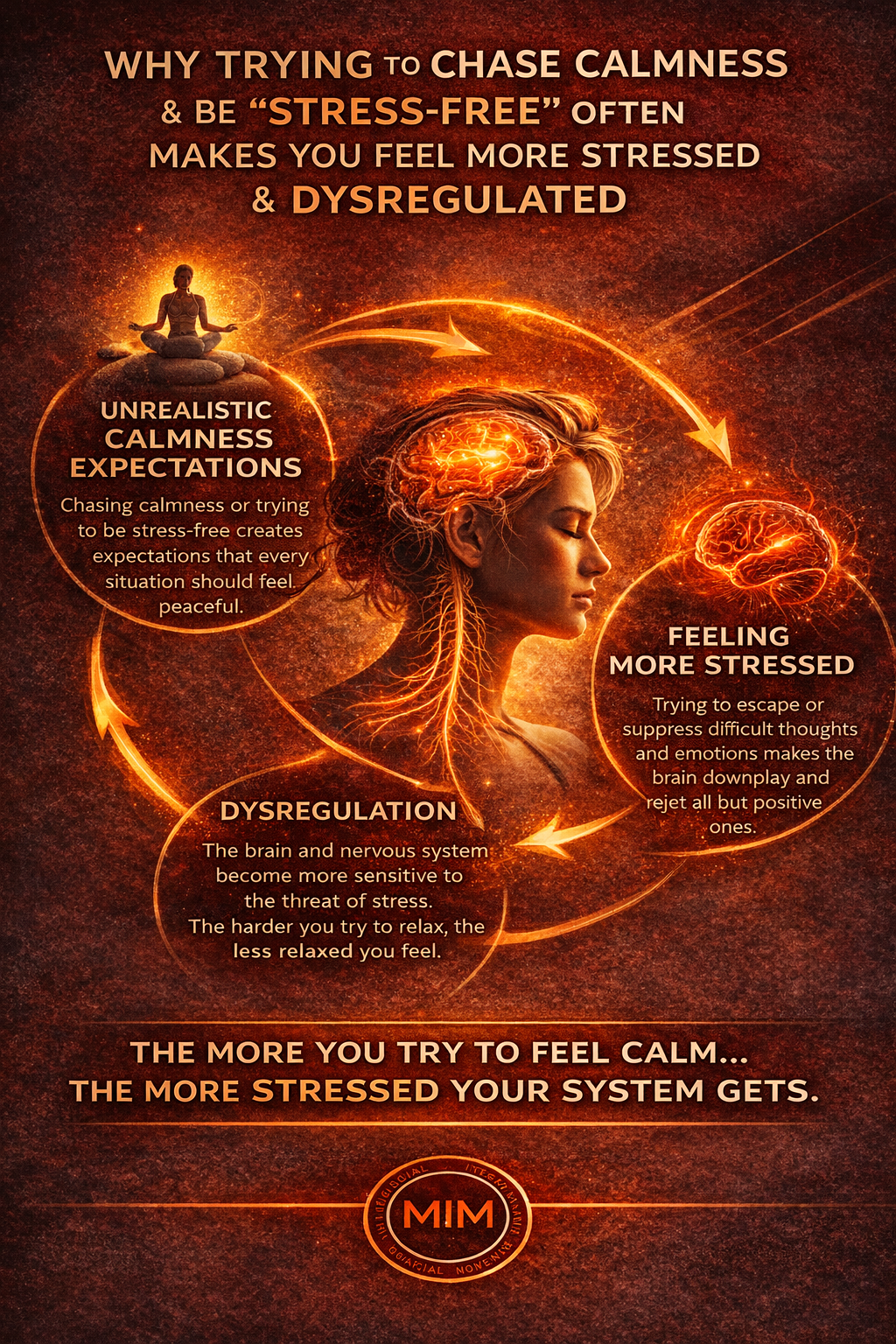
Actually reaching regulation emerges not from chasing calm, but from allowing sensations to be present without resistance this reduces prediction error in the brain and allows parasympathetic activity to increase naturally. Calm is a byproduct of safety, not a command the nervous system can obey on demand.
If that sounded too sciency, I’m simply trying to explain the more you chase the outcome of “feeling better” the less likely you are going to be able to actually achieve that goal. The more you learn to be with thoughts and sensations the more effective your efforts will be at the end.
Don’t Sit Still!
The above is the first key because if we do anything with that pressure and thought to achieve a certain state the less likely we are to achieve it with whatever we do. I know, doesn’t seem fair right? This is what we know from neuroscience though, so it sets the foundation.
Okay, we the right attitude but what action do we take? Most try to sit and do some breathing exercises, or they might even try to sit and meditate. These are good things right? Well, they are good in the right context, but when you feel really stressed, agitated, or overwhelmed they can feel absolutely impossible to do. When you are feeling this way and something feels really difficult it can cause more agitation to arise.
That is why I love to use actually very dynamic shaking or power based movements to help. No, I’m not saying necessarily go do box jumps or kettlebell swings, but let me break it down.
Ever seen an animal, like your dog, shake itself? Maybe they just got up or actually were a bit mentally stressed? Shaking one’s body is actually a very typical action in the animal kingdom.
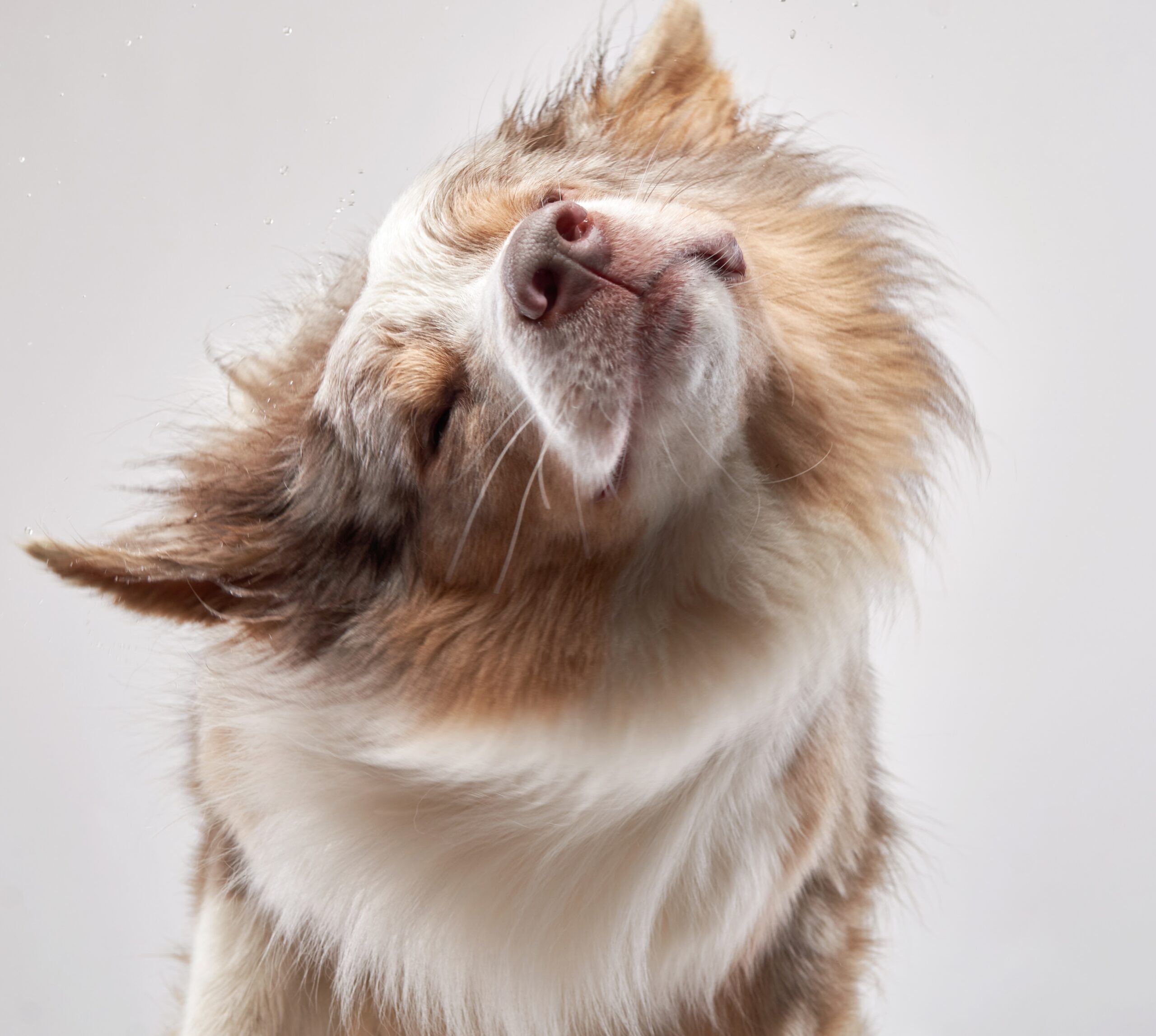
Animals shake their bodies when stressed as a natural, instinctive way to release built-up tension and adrenaline from the fight-or-flight response, essentially “resetting” their nervous system after a threatening situation, allowing them to return to a calm state. This physical release helps discharge energy that the body prepared for action but didn’t use, preventing stress hormones and tension from getting “stuck” in the body, a process also seen in humans but often suppressed.
Therapies like tension and trauma release exercises (TRE) use controlled shaking to help people release deep-held tension, allowing the body to process and let go of fear and trauma. Essentially, the body can do what it does naturally after a stressful event, shake it off.
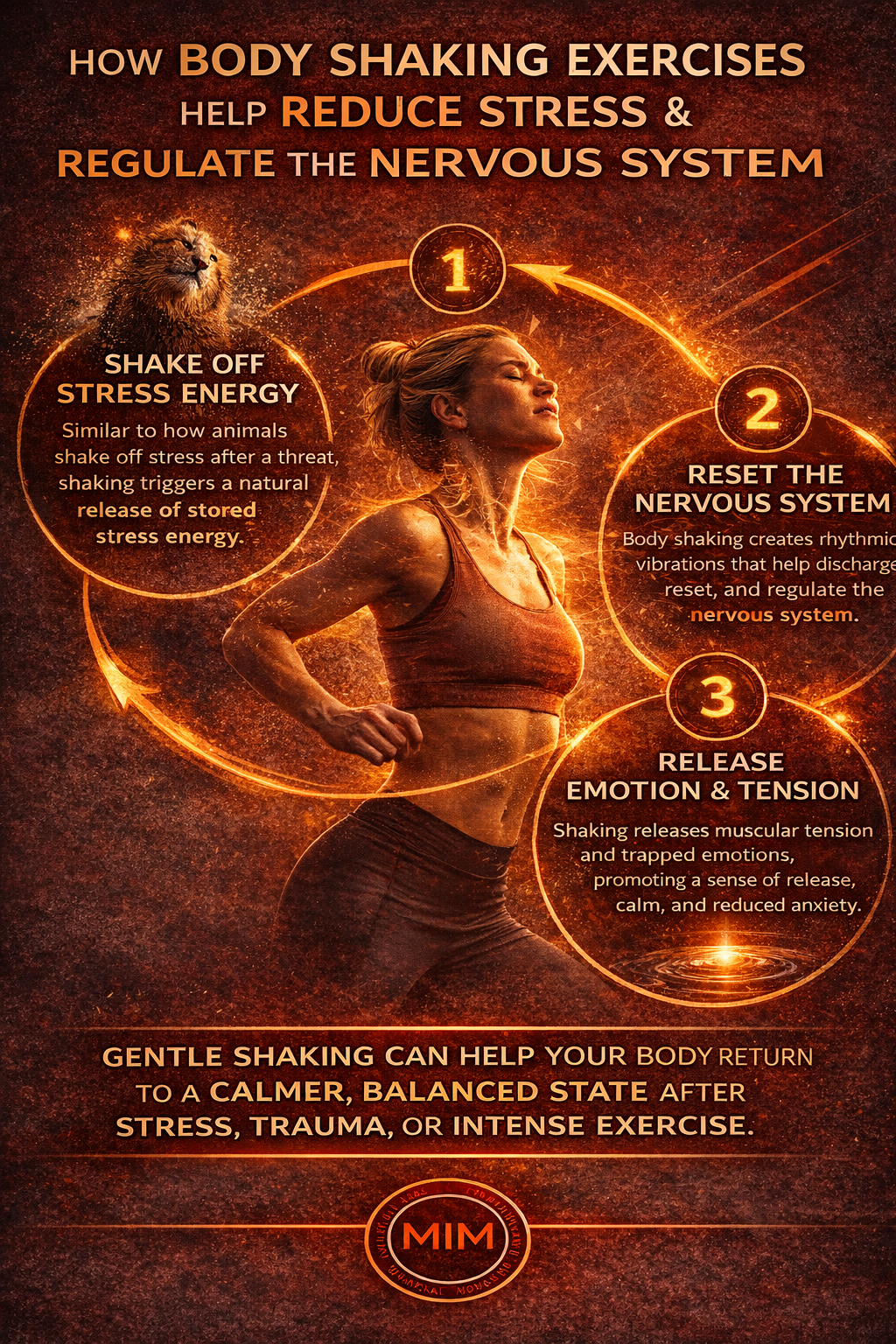
Shaking can be done in many ways and have to fit what a person feels comfortable with performing them. I’ve recommended this in the past to coaches and they sometimes report that a client feels too embarrassed or silly. I get it, it is hard to release that tension when you feel like it is a bit too goofy.
That is why I break down a series of different movements you can use to teach anyone these methods. They are invaluable because you don’t have to be at the gym to use them. You can use any form of them when you are in the office, in a public place where there are many other people, to in the gym especially before a workout or even during a workout when you are trying to recover faster. The goal isn’t to achieve any special state, but to really be aware of the feeling of your body as you are performing them.
Find the one that works for you and see how you can find yourself in a better position to not only move better, but make better decisions, see things more clearly, and find some sanity during times that feel like they are too much. I’ll continue these posts and let us know if you like strategies like this.
Learn MUCH more in our Myofascial Integrated Movement Intensive Course. Over 9 hours of coaching video and FREE follow along program. Don’t miss saving over $50 THIS week only HERE
Featured in





© 2026 Ultimate Sandbag Training. Site by Jennifer Web Design.