Why Front-Loaded Squats Aren’t Just Safer—They’re More Effective
Squats are often called the king of all exercises and for good reason. They build strength, improve mobility, and enhance total-body coordination. But not all squats are created equal. While back squats have long been the traditional choice in strength training, growing evidence and practical experience suggest that front-loaded squat variations may not only be safer, but actually more effective for most people.
Instead of making it sound like your body will fall apart instantly if you do a barbell squat, I’d rather focus on why front loading in the squat actually provides you MORE benefits.
The Safety Advantage: Why Load Placement Matters
Okay, I am a little bit of liar, I do want to explain how we probably DO have less risks when performing front loaded squats. Not because I am running around the gym screaming at people who back squat that their spine is going to burst, but because as a coach, I have a responsibility to provide people the least risk and the highest benefits.
The biggest difference between front-loaded and back-loaded squats is simple: where the load sits.
- Back squat → load is positioned on the spine (posterior)
- Front-loaded squat → load is positioned in front of the body (anterior)
This difference dramatically changes how the body organizes movement.
Reduced Spinal Stress
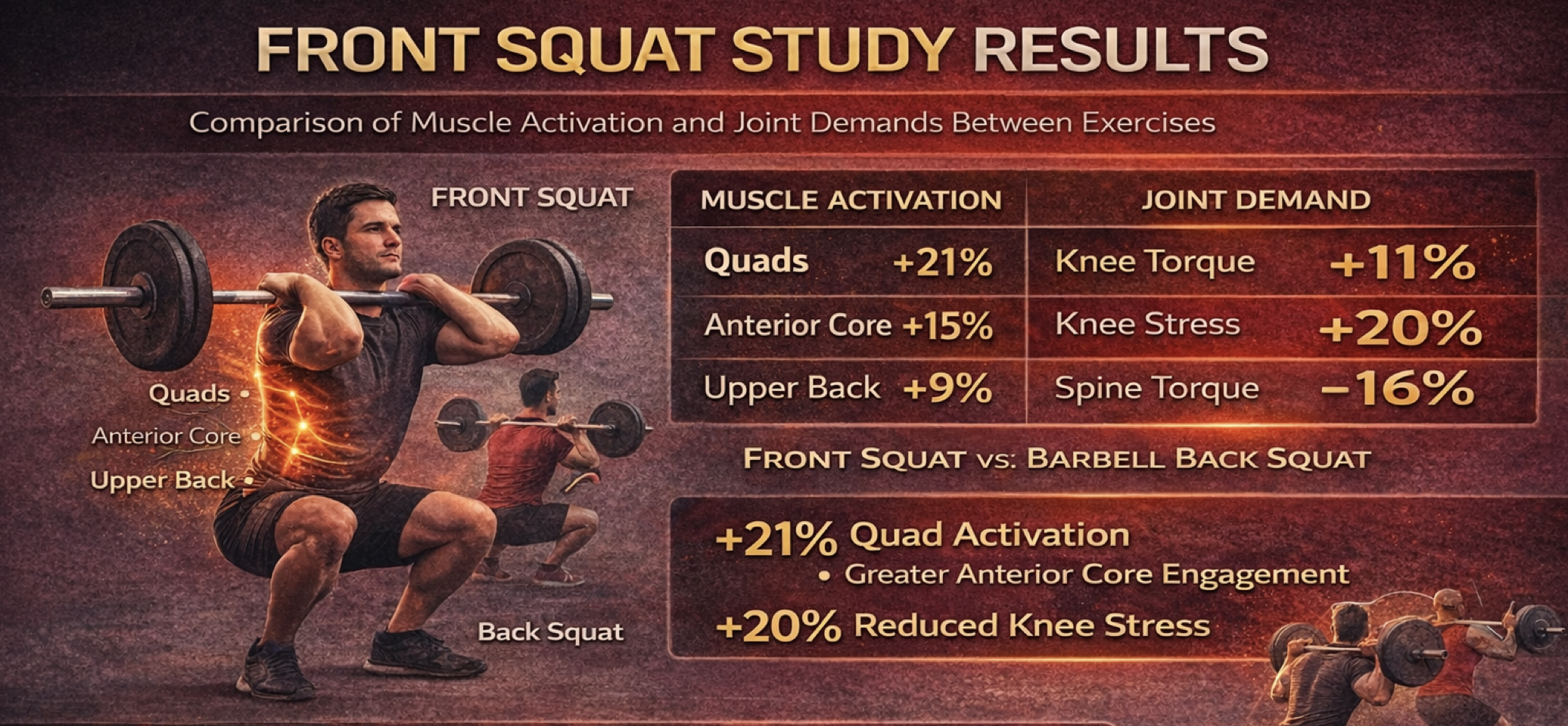
Front-loaded squats encourage a more upright torso position. Research comparing front and back squats has shown that front squats result in:
- Lower compressive forces on the lumbar spine
- Similar muscle activation in key lower-body muscles
(Gullett et al., Journal of Strength & Conditioning Research)
Because the load is in front, the body must stay upright to maintain balance. This reduces excessive forward lean a common issue in back squats that increases shear stress on the lower back.
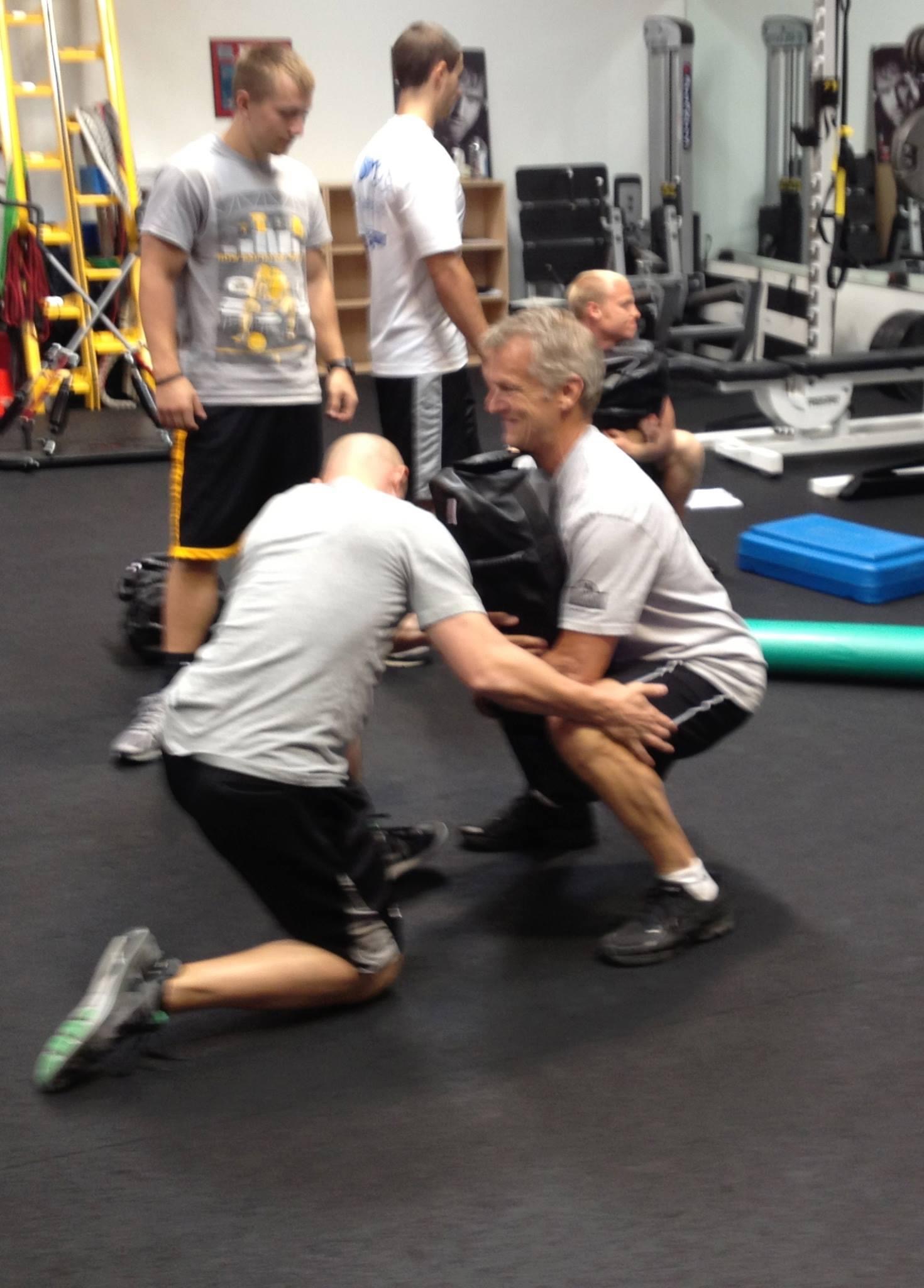
Front-loaded squats naturally reinforce safer spinal mechanics without needing as many coaching cues.
Built-In Movement Correction
Front-loaded positions act as a self-limiting system.
If a client:
- Loses core tension
- Shifts weight forward
- Collapses posture
…the load will immediately pull them out of position.
This provides instant feedback and helps prevent:
- Spinal flexion
- Excessive forward lean
- Poor bracing strategies
Back squats, in contrast, don’t provide that feedback on how to be in a safe and stronger position.

The Effectiveness Advantage: More Than Just Legs
While safety is critical, effectiveness is what drives results. Front-loaded squats shine here as well.
Greater Core Activation
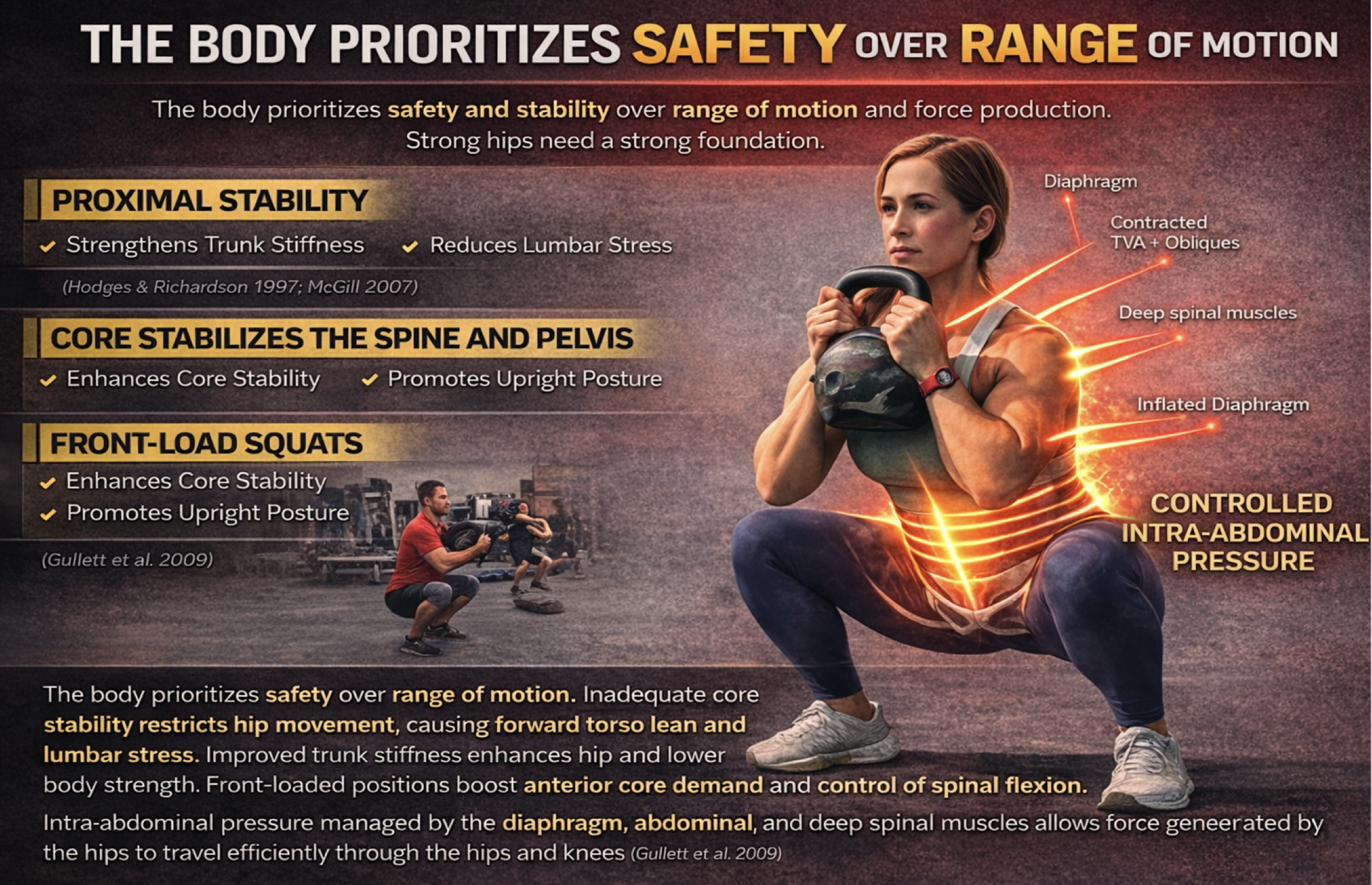
Front-loaded squats demand significantly more from the anterior core.
Research shows:
- Increased activation of rectus abdominis and obliques in front squat variations
- Higher demand on trunk stabilizers to resist forward collapse
This turns the squat into a true total-body exercise, not just a lower-body lift. Instead of just training legs, you are training:
- Core stability
- Force transfer
- Postural control
Better Movement Transfer
In real life and most sports load is rarely placed on your back.
We carry:
- Groceries
- Kids
- Equipment
…in front of our bodies.
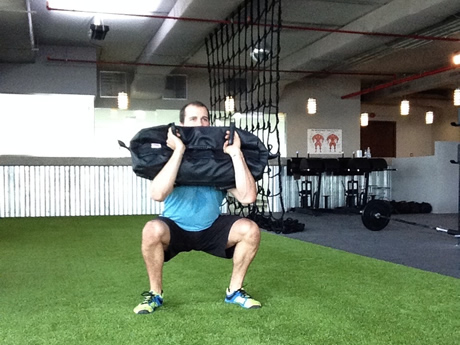
Front-loaded squats more closely mimic these real-world demands, improving:
- Functional strength
- Movement efficiency
- Carryover to daily life and sport
This aligns with principles of specificity and transfer of training, making front-loaded squats more practical for general population clients.
Improved Mobility Through Positioning
Many people struggle with:
- Limited ankle mobility
- Hip restrictions
- Thoracic stiffness
Back squats often expose these limitations in a way that leads to compensation.
Front-loaded squats, however:
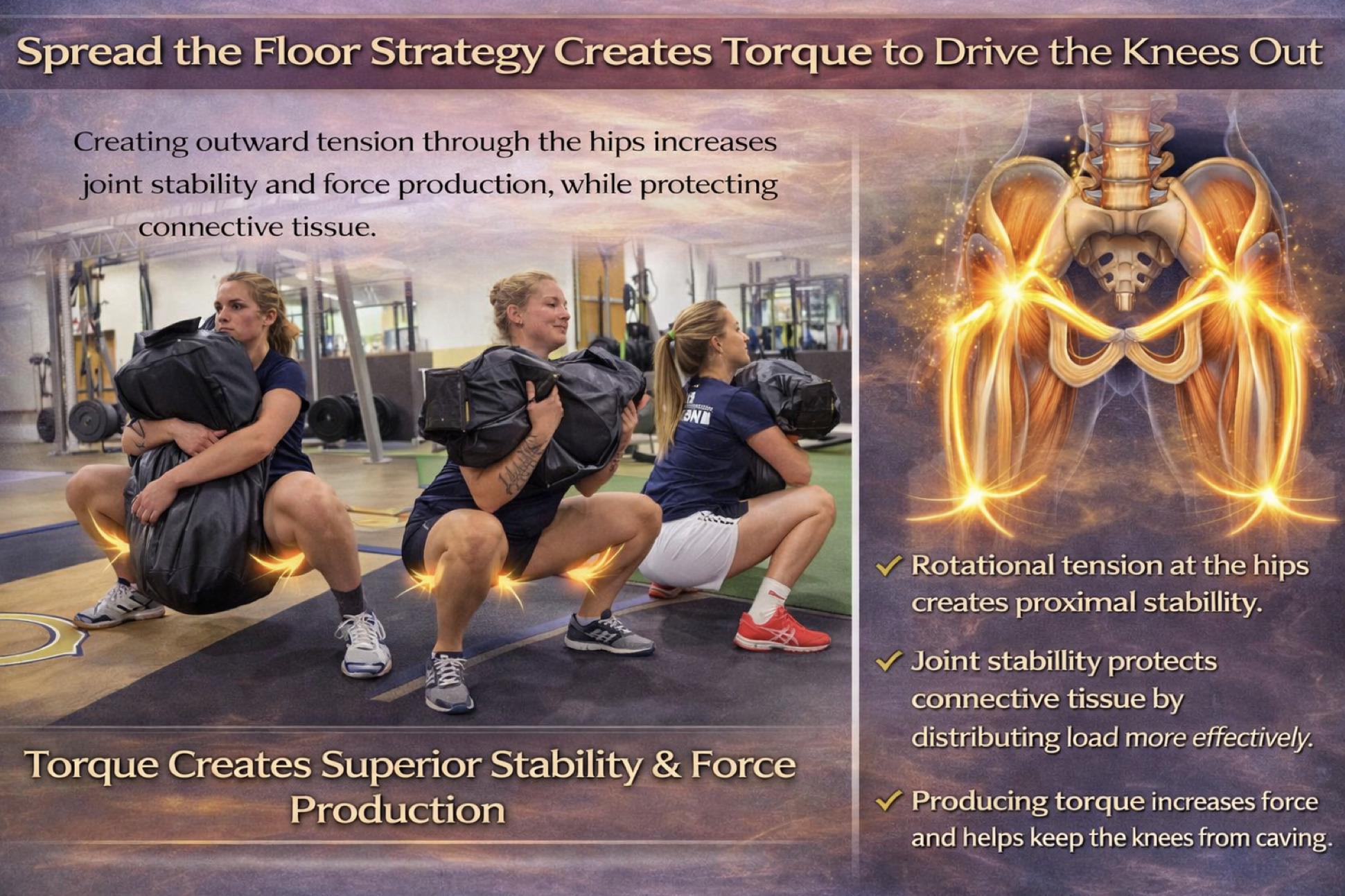
- Encourage deeper squat positions
- Promote better hip and ankle mechanics
- Reinforce thoracic extension
Because the load pulls the body forward, the lifter must sit “between the hips” rather than hinging excessively. The result: Better movement quality while building strength.
Similar (or Better) Strength Development
A common argument against front-loaded squats is that you can’t lift as much weight.
That’s true, but it misses the point.
Research shows that despite lower absolute loads:
- Muscle activation in the quadriceps is similar between front and back squats
- Front squats can produce comparable strength adaptations
(Gullett et al.)
Additionally:
- Time under tension
- Stability demands
- Neuromuscular control
…are often higher in front-loaded variations. Strength is not just about load, it’s about stimulus.
Why Front-Loaded Squats Work Better for Most Clients
For general population clients—not competitive powerlifters—training goals usually include:
- Moving better
- Reducing pain
- Building usable strength
- Staying consistent
Front-loaded squats align better with these goals because they:
- Reinforce proper mechanics
- Reduce injury risk
- Improve total-body coordination
- Build strength that transfers to real life
From a coaching perspective, front-loaded squats are easier to teach and scale.
They:
- Provide immediate feedback
- Require less external cueing
- Encourage better positions automatically
This leads to:
- Faster skill acquisition
- Higher confidence
- Better adherence
In contrast, back squats often require extensive coaching to correct:
- Torso angle
- Bracing
- Depth mechanics
When you combine great level of strength, muscle activation, and mobility, why NOT prioritize front loaded squats and you can feel MORE confident you are building a better feeling body.
Discover many MORE solutions, progressions, and ways to optimize the squat in our NEW Squat Blueprint program 30% off with code “stronger” HERE