Why Single Leg Squats May Be BEST!
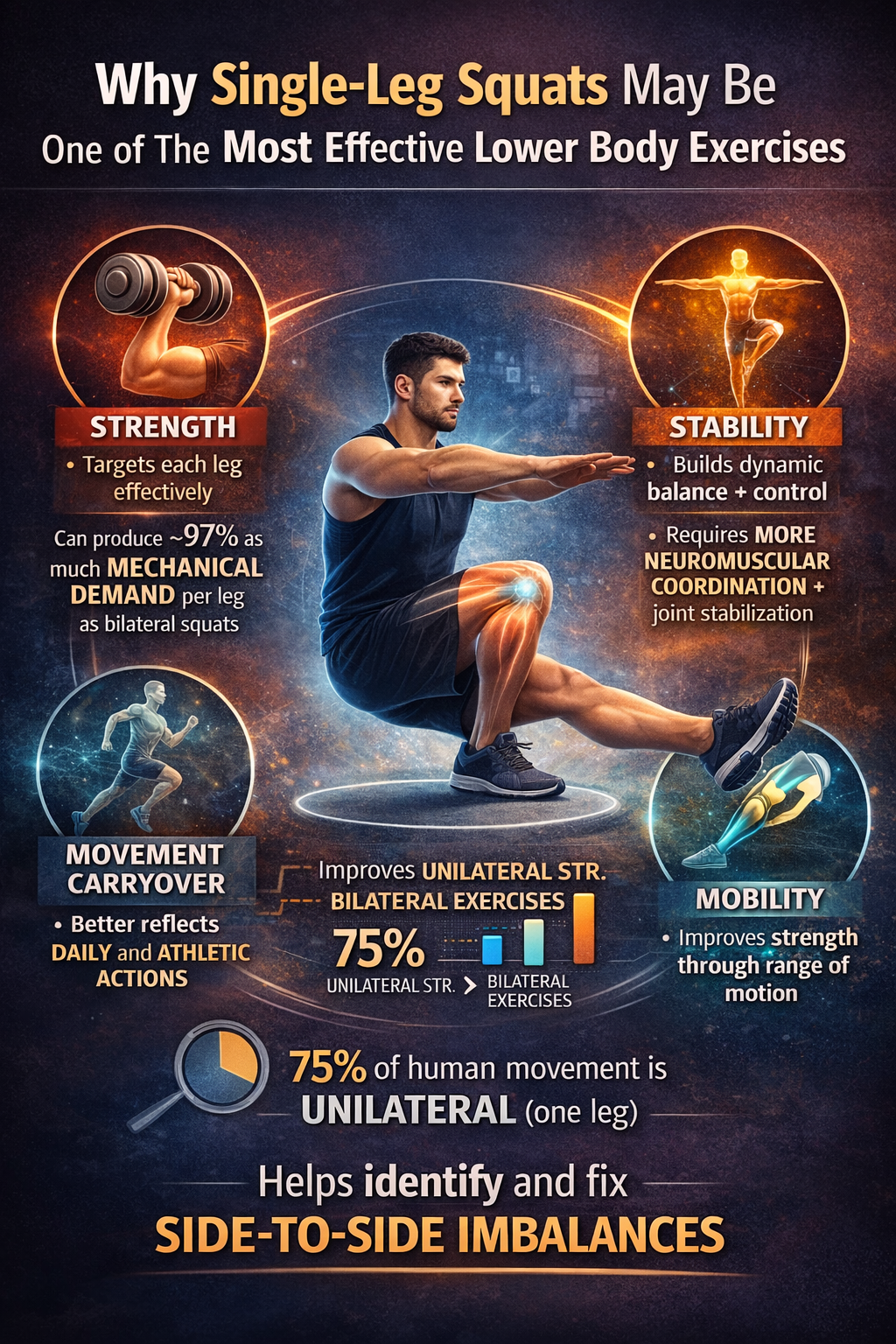
Single-leg squats are often viewed as a progression, a balance drill, or just an accessory movement. But research comparing unilateral (single-leg) and bilateral (two-leg) training suggests something deeper:
Training one leg at a time may offer unique advantages for strength, stability, and movement quality that bilateral exercises alone can’t fully replicate.
When we look at the science, the value of single-leg squats becomes much clearer.
Strength: It’s not just about lifting more weight
A common argument against single-leg squats is simple: you can’t load them as heavily as bilateral squats.
That’s true, but it misses a key point.
A study comparing unilateral and bilateral squats examined muscle activity, force production, and movement mechanics when the load per leg was the same . What researchers found was important:
- When each leg is loaded equally, single-leg variations can produce similar mechanical demands
- The body doesn’t just rely on total weight, it responds to relative load per limb and neuromuscular demand
In other words, even with lighter total weight, single-leg squats can challenge each leg just as much, or more, than bilateral squats.
And since many real-world and athletic movements happen one leg at a time, single-leg strength matters more than most people realize.
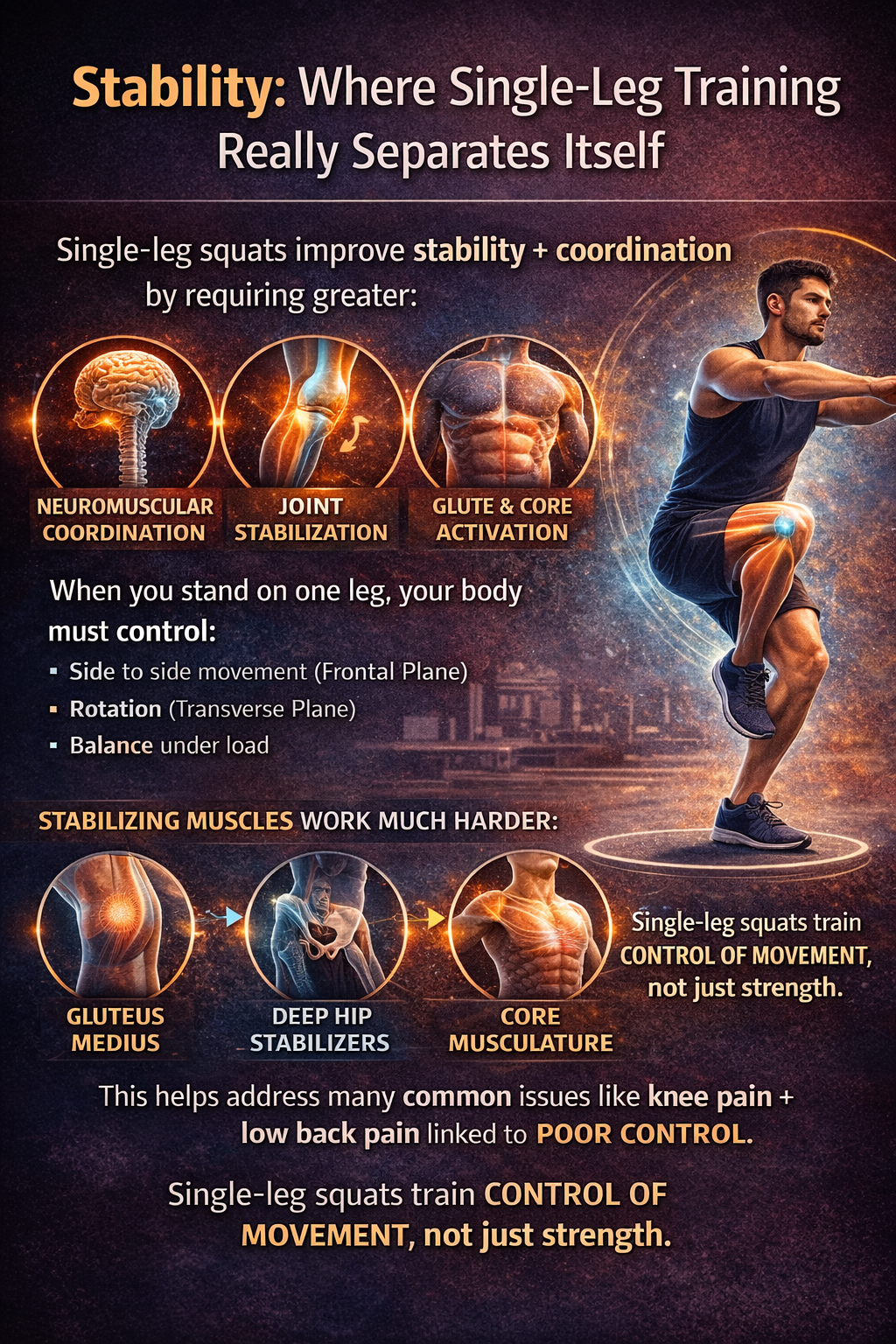
Stability: Where single-leg training really separates itself
One of the clearest advantages of single-leg squats is their impact on stability and coordination.
The same research comparing unilateral and bilateral training highlights that unilateral movements:
- Require greater neuromuscular coordination
- Demand more joint stabilization
- Increase reliance on muscles like the glutes and core
Why?
Because when you stand on one leg, your body must control:
- Side-to-side movement (frontal plane)
- Rotation (transverse plane)
- Balance under load
View this post on Instagram
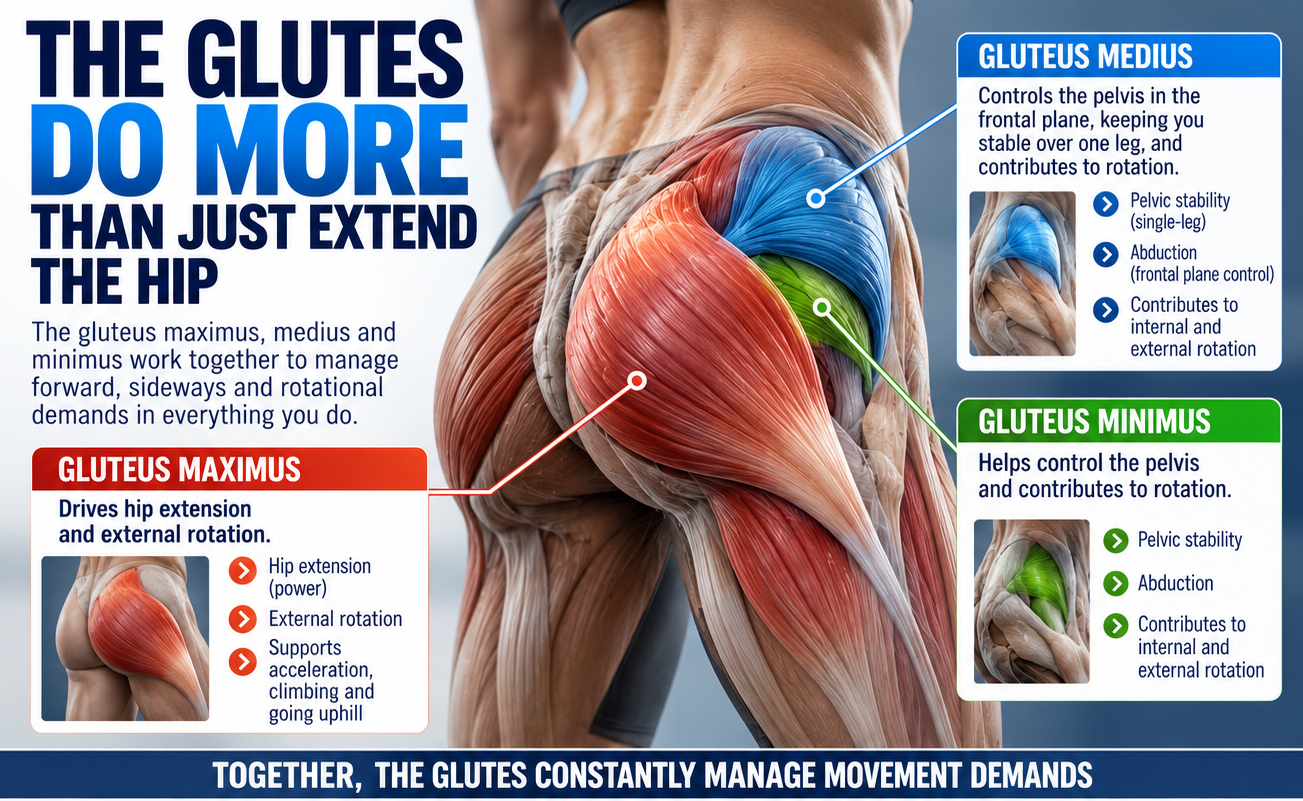
This creates a much higher demand on stabilizing muscles, particularly:
- Gluteus medius
- Deep hip stabilizers
- Core musculature
This is critical because many common issues like knee pain or low back pain are linked not just to weakness, but to poor control of movement.
Single-leg squats don’t just build strength, they train your body to manage force and control motion, which is what stability actually means.
Mobility: Strength through range, not just flexibility
One of the most overlooked benefits of single-leg squats is their impact on mobility.
Mobility isn’t just about stretching, it’s about:
Having control through a range of motion under load
Single-leg squats require:
- Hip flexion and extension
- Ankle dorsiflexion
- Controlled knee movement
All while stabilizing the body.
This combination:
- Improves active range of motion
- Enhances joint control
- Increases tolerance to movement under load
Research on resistance training suggests that moving through full ranges of motion, especially under load, can improve mobility similarly to traditional stretching, but with better transfer to real movement.
Single-leg squats act as both:
- A strength exercise
- A mobility intervention
Addressing imbalances: A major hidden benefit
One of the most important reasons to include single-leg squats is their ability to expose and correct asymmetries.
With bilateral squats:
- The stronger side can compensate
- Imbalances often go unnoticed
With single-leg squats:
- Each leg must do its own work
- Weaknesses and limitations become obvious
Research shows that unilateral training:
- Helps correct side-to-side strength differences
- Improves overall movement symmetry
- Can enhance coordination and reduce injury risk
There’s even evidence of a cross-education effect, where training one limb can improve strength in the other, highlighting the strong role of the nervous system in unilateral training.
View this post on Instagram
It’s important to be clear, This isn’t about replacing bilateral squats.
Bilateral training is still valuable for:
- Maximizing total load
- Building global strength
But the research suggests that relying only on bilateral movements leaves gaps in:
- Stability
- Coordination
- Movement-specific strength
Single-leg squats help fill those gaps. If your goal is to build stronger, more resilient clients, or improve your own performance, single-leg squats shouldn’t be an afterthought.
They offer:
- Strength that transfers to real movement
- Stability that protects joints
- Mobility that’s actually usable
And most importantly, they train the body the way it actually functions one leg at a time.
Find out MORE in our NEW Squat Blueprint program and our 2 other new programs 30% off HERE with code “stronger”