
When a Doctor Says “Don’t Lift Weights”: A Smarter Approach to Low Back Pain
2026-05-27
One of the most common questions we received during our recent Low Back Pain webinar was, “What do you do when a client says their doctor told them not to lift weights?” It’s an important question because many fitness professionals immediately feel pulled into deciding whether the doctor was “right” or “wrong.” However, that approach often misses the bigger issue entirely.
Our first action is not to have the client start lifting weights. In fact, we don’t immediately jump into proving that lifting is safe. Why? Because we usually don’t actually know why the doctor gave that recommendation in the first place. Even if we ask the client, we are often hearing a secondhand interpretation rather than the exact medical concern. Sometimes the doctor may have very valid reasons based on acute symptoms, recent surgery, specific pathology, or other factors. Other times, the recommendation may have become distorted through what many call the “telephone game,” where the client unintentionally simplifies or changes the message.
The important point is that our role is not to debate the doctor. Our goal is to help the client feel better, move better, and regain confidence safely and progressively.
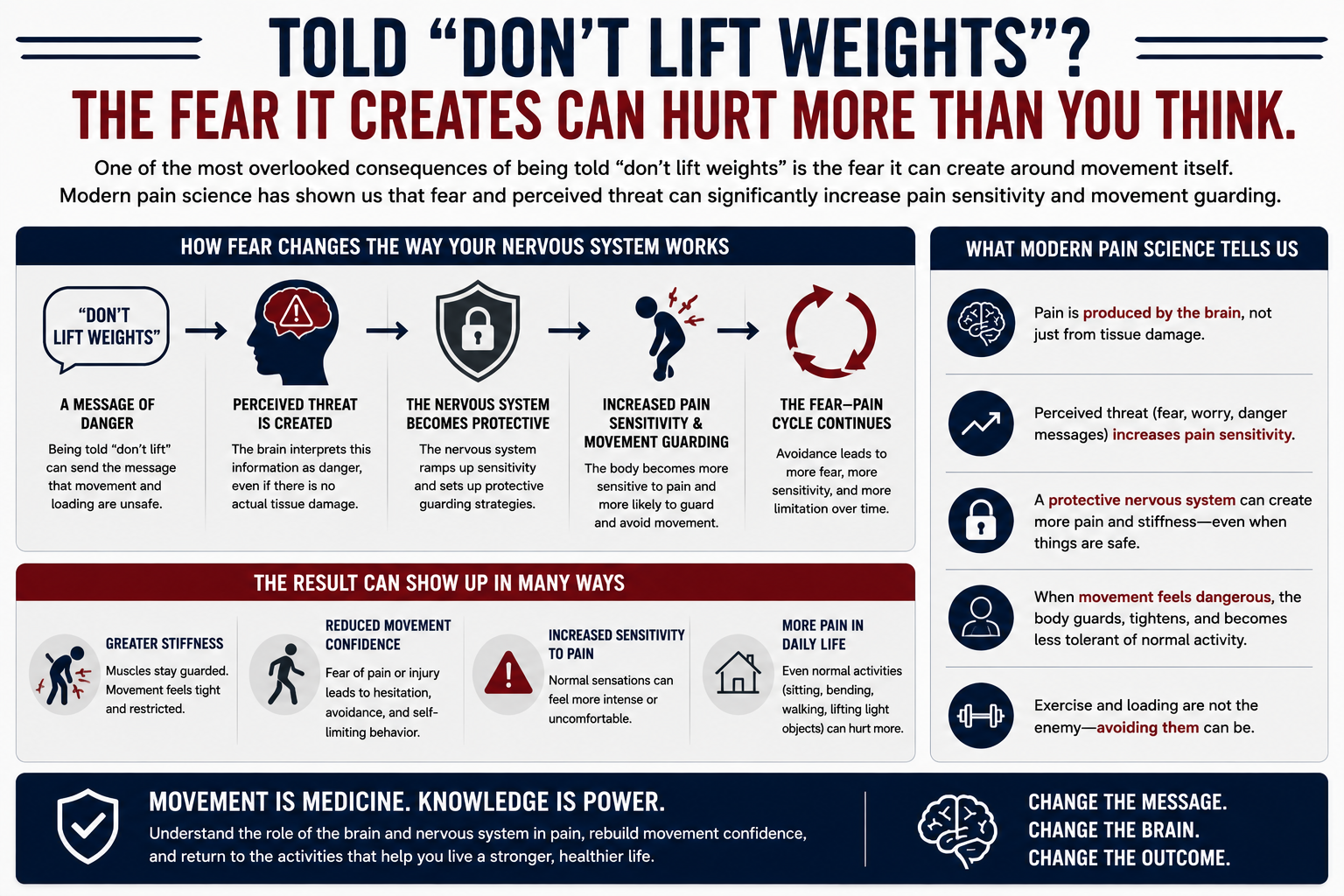
One of the most overlooked consequences of being told “don’t lift weights” is the fear it can create around movement itself. Modern pain science has shown us that fear and perceived threat can significantly increase pain sensitivity and movement guarding. If someone begins to associate exercise, loading, or movement with danger, the nervous system often becomes more protective. The result can be greater stiffness, reduced movement confidence, and increased sensitivity to pain even during normal daily activities.
This is why we focus first on building safety, trust, and confidence.
Instead of asking, “How quickly can we get them back to lifting weights?” we ask, “How can we help this person feel safe and successful moving again?”
One helpful strategy is asking more specific questions. Did the doctor mean all forms of resistance training? Or were they more concerned about specific tools or exercises? Sometimes the recommendation is aimed more at heavy spinal compression, high-load barbell training, or poorly controlled lifting strategies rather than movement itself.
That distinction matters.
There are many ways to improve strength, stability, and function without immediately using traditional heavy weights. Tools such as medicine balls, suspension trainers, resistance bands, and Mobility Balls can allow clients to develop coordination, balance, stability, and confidence without the psychological stress that “lifting weights” may create. Often these methods don’t even register in the client’s mind as the type of “strength training” they were warned against.
This is where our Myofascial Integrated Movement (MIM) system becomes especially valuable. Rather than focusing only on isolated muscles or simply adding load, MIM helps restore how the body organizes movement as an integrated system. Through carefully designed progressions, we can improve how the feet, hips, trunk, and shoulders work together to create stability and efficient force transfer.
What makes this approach so powerful is that it addresses several key factors simultaneously. We can help reduce pain sensitivity by creating positive movement experiences. We can improve fascial mobility and joint mobility without aggressive stretching. We can build stability and balance through integrated movement rather than rigid bracing. We can improve nervous system regulation by helping clients move with less fear and tension. Most importantly, we can help clients regain trust in their bodies.
This process also builds credibility with healthcare providers. Instead of trying to “prove” the doctor wrong, we demonstrate through the client’s progress that movement can become safe, tolerable, and beneficial again. Reduced pain, improved function, and greater movement confidence create trust not only with the client but potentially with the doctor as well.
Over time, many clients become far more capable than they originally believed possible. But the path there often doesn’t begin with heavy lifting. It begins with restoring safety, confidence, coordination, and movement options.
That’s an important lesson in modern low back pain care. The issue usually isn’t whether someone can eventually become stronger or more resilient. The issue is how we help them get there in a way that respects both the physical and psychological aspects of pain and movement.
When we focus on creating better movement experiences instead of forcing exercises, we often discover that the body becomes far more adaptable, resilient, and capable than fear originally allowed.
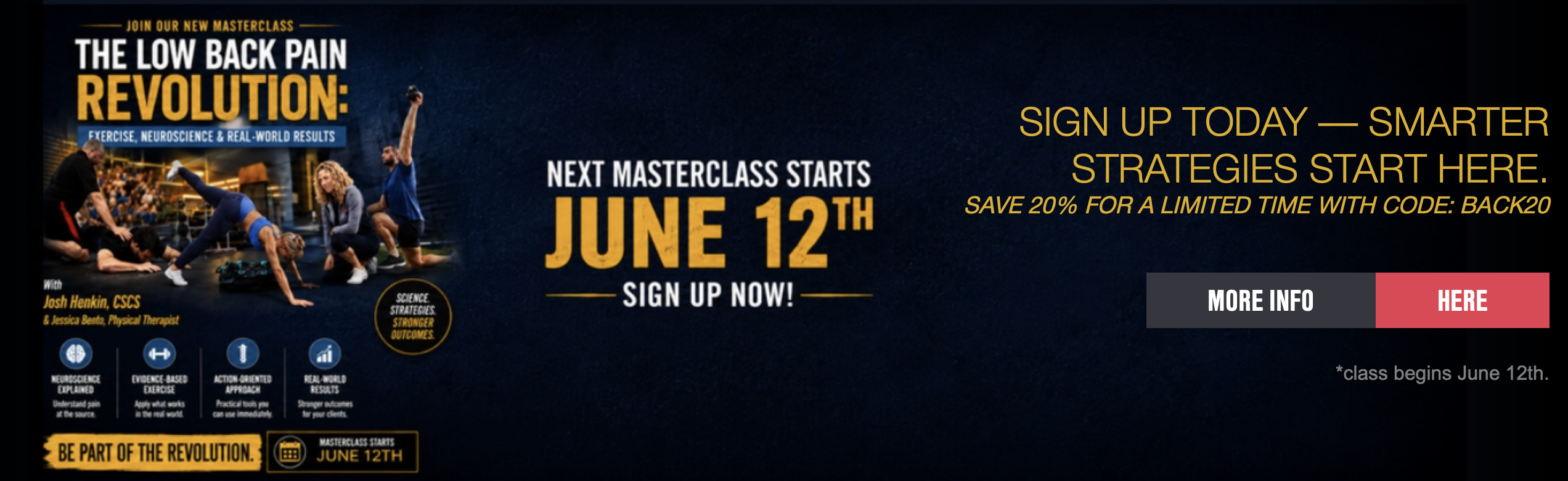
Find out much more in our comprehensive NEW Low Back Pain Masterclass and get CEUs while also saving 20% for a VERY limited time. Just use code “back20” HERE
Featured in





© 2026 Ultimate Sandbag Training. Site by Jennifer Web Design.