
Should You Do THIS For Your Core?
2026-06-7

When discussing what makes a good core training program, planks ultimately come up. I like to ask people though, “why do you teach planks?” The question usually confuses people because “that’s just what you do”, right? Commonly I’ll hear, because it teaches “stability”, however, when I hear people say this I often think of the great Will Ferrell “Blades Of Glory” line….”no-one knows what it means, but it is provocative.”
It is true that the plank teaches a specific concept of stability, but what is it? It is about abdominal bracing. For years, abdominal bracing has been a focused concept of core stability and it does absolutely have its place.
The logic seemed straightforward. If the spine needs stability, then tightening the abdominal muscles should help protect the back and reduce pain.
The reality is more nuanced.
Current research suggests that abdominal bracing can be very helpful for some people with low back pain. However, other individuals may actually benefit from learning how to reduce excessive trunk tension and relax overactive core muscles. The challenge is determining which person is standing in front of you.
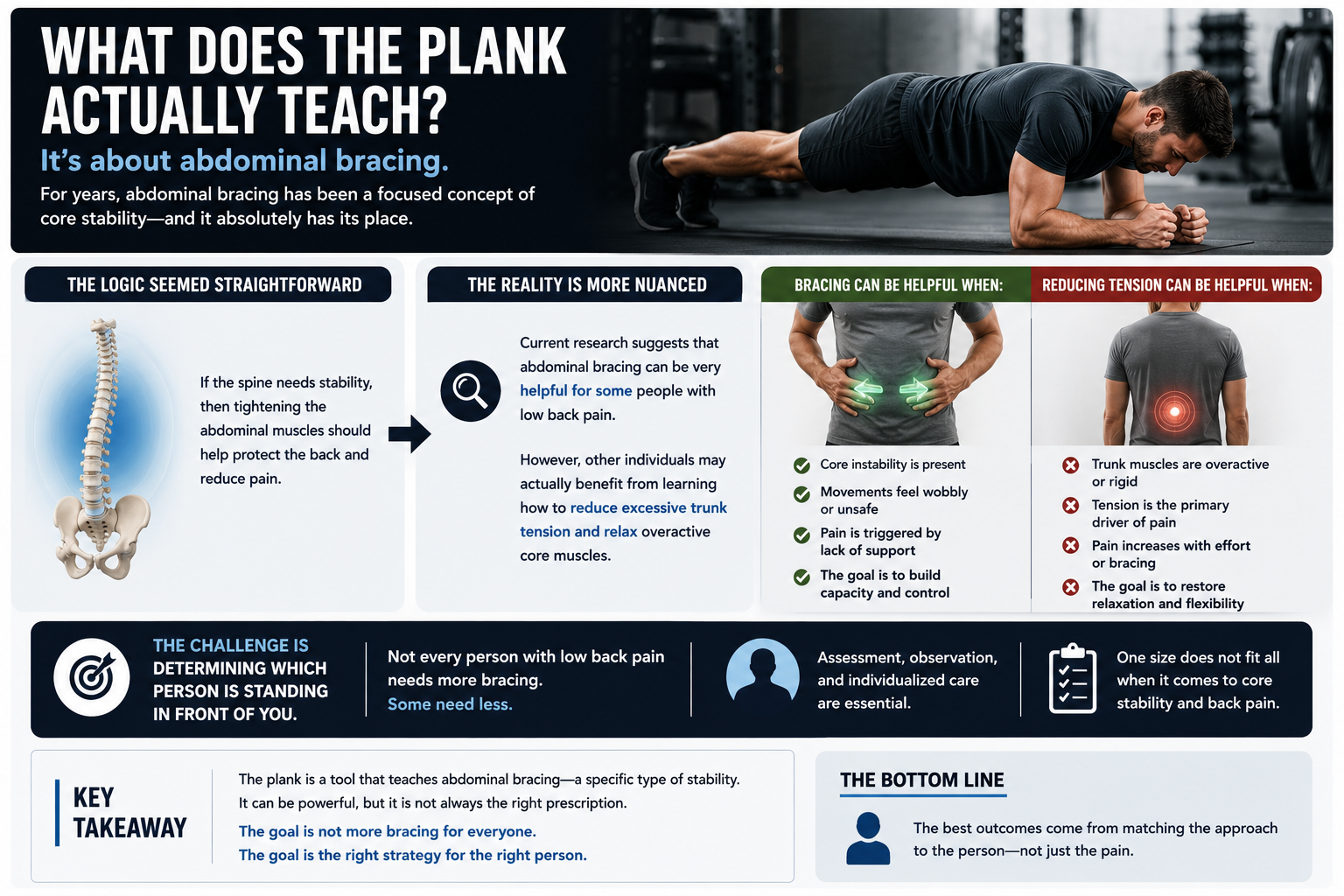
When Abdominal Bracing Can Help
Abdominal bracing involves co-contracting the muscles of the trunk, including the abdominals, obliques, and spinal stabilizers. Unlike abdominal hollowing, which focuses on drawing the belly inward, bracing creates a more global stiffness around the torso.
A 2024 scoping review examining 22 randomized controlled trials found that abdominal bracing can improve trunk stability, muscle activation, balance, and functional outcomes in individuals with low back pain. The review concluded that bracing is a valuable rehabilitation strategy, although it is not clearly superior to other stabilization methods.
This makes sense biomechanically.
When lifting, carrying, changing direction, or dealing with unexpected forces, the body often benefits from temporary increases in trunk stiffness. Bracing can improve force transfer throughout the kinetic chain and create a more stable foundation for movement.
For individuals who demonstrate poor trunk control, instability, deconditioning, or difficulty producing sufficient trunk stiffness during loading tasks, learning to brace appropriately may reduce pain and improve confidence during movement.
In these cases, bracing is not necessarily reducing pain directly. Instead, it may improve movement efficiency and allow people to tolerate activities that previously felt threatening.
Physical therapist, Dan Swinscoe explains how the Press Out is a great option for people to teach bracing that have a difficult time doing a good plank.
The Problem With Universal Bracing Advice
The mistake occurs when we assume every person with low back pain lacks stability.
Research increasingly shows that many people with chronic low back pain do not present with insufficient muscle activity. Instead, they often display excessive muscle guarding and increased co-contraction of trunk muscles.
In fact, studies examining trunk muscle activity have found that people with chronic low back pain frequently adopt protective movement strategies characterized by increased muscular tension and stiffness.
A systematic review investigating trunk muscle stiffness reported that individuals with low back pain often demonstrate altered neuromuscular control and increased trunk stiffness compared to pain-free individuals.
This creates an important clinical question:
If someone is already excessively braced all day long, is teaching them to brace harder really the answer?
Not necessarily.
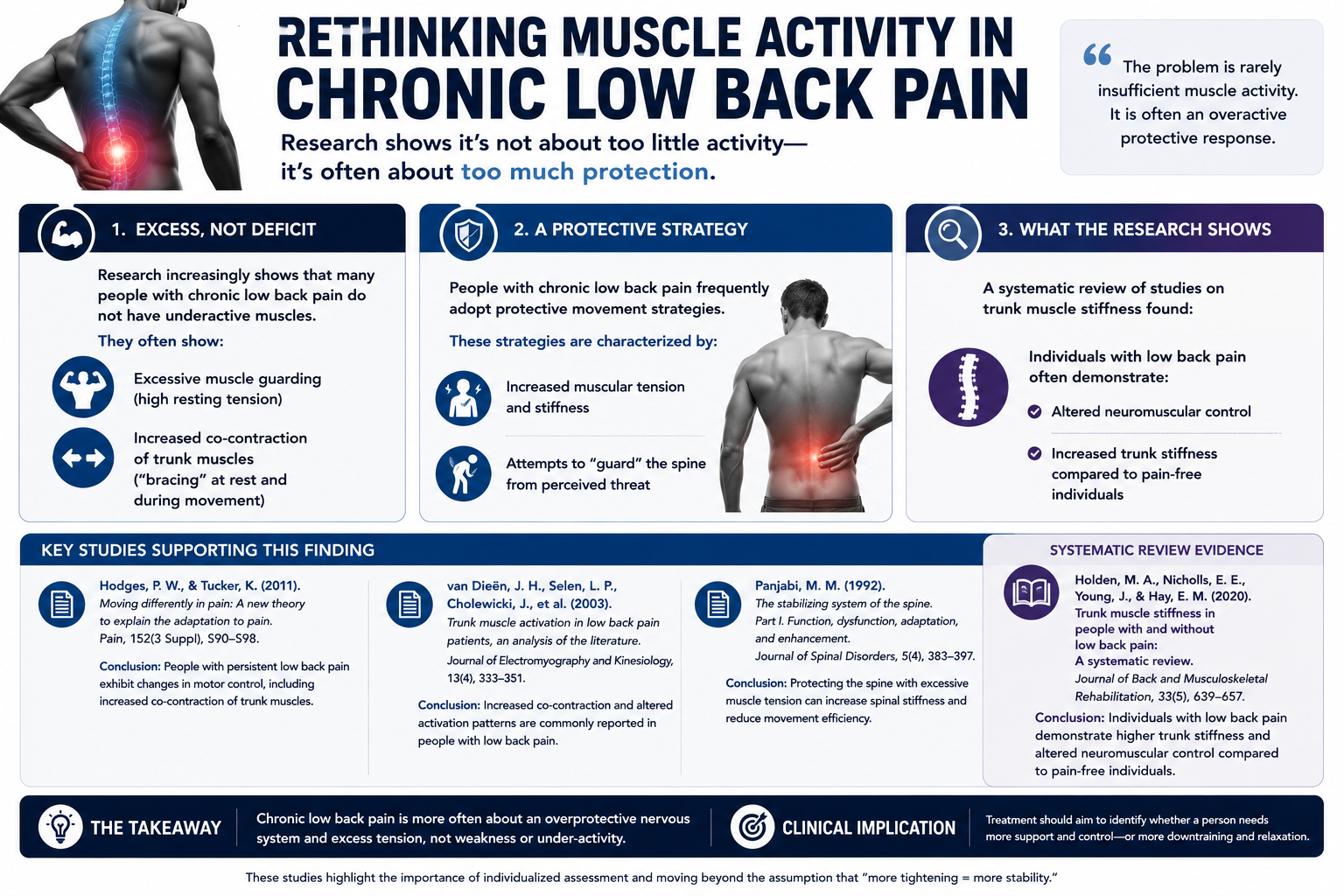
When Core Relaxation May Be More Important
Many people with persistent low back pain develop what researchers often call a “protective strategy.”
The nervous system interprets movement as threatening and responds by increasing muscle tension around the spine. Initially, this may be a useful protective response. Over time, however, excessive guarding can become habitual.
Think of someone who:
- Constantly holds their stomach in
- Tightens their abs while sitting
- Braces while walking
- Feels unable to relax their back muscles
- Moves rigidly and cautiously
These individuals may already be creating more trunk stiffness than they need.
Research examining muscle coactivation patterns has shown that people with low back pain often demonstrate higher levels of trunk muscle co-contraction than healthy controls. While this strategy may temporarily increase perceived protection, it is also associated with greater fatigue and less efficient movement.
For these individuals, learning diaphragmatic breathing, relaxation strategies, movement variability, and graded exposure to movement may be just as important as strengthening exercises.
The goal becomes helping the nervous system recognize that not every movement requires maximum protection.
View this post on Instagram
Coach Cory Cripe shows why sometimes Myofascial Integrated Movement drills like these are a better solution for those with back pain.
Stability Versus Adaptability
One of the most important shifts in modern rehabilitation is moving away from the idea that the spine needs to be rigidly protected at all times.
The healthiest movement systems demonstrate both stability and adaptability.
A person should be able to:
- Create stiffness when lifting a heavy object
- Relax when sitting comfortably
- Stabilize during a carry
- Breathe normally during walking
- Transition smoothly between tension and relaxation
The problem is rarely a lack of one quality alone.
Instead, chronic pain often reflects a reduced ability to adjust muscle activity appropriately to changing demands.
What This Means in Practice
The research does not support a one-size-fits-all approach.
For some people, abdominal bracing can be an effective tool that improves stability, confidence, and function. For others, chronic pain may be associated with excessive guarding, making relaxation and movement variability equally important components of recovery.
Perhaps the better question is not:
“Should everyone brace their core?”
Instead, ask:
“Does this person need more stability or less protection?”
The answer may determine whether abdominal bracing becomes part of the solution, or part of the problem.
The best rehabilitation programs don’t teach people to brace all the time. They teach people to use the right amount of tension at the right time.
That ability to move fluidly between stability and relaxation may be one of the most important characteristics of a healthy spine. Cory shows a good mixture of these concepts below…
Find out more about understanding Low Back Pain and creating better solutions at our NEW Low Back Pain Masterclass that starts FRIDAY! You can still save 10% with code “back10” HERE
View this post on Instagram
Featured in





© 2026 Ultimate Sandbag Training. Site by Jennifer Web Design.