
2 VERY Different & Powerful Squats For Stability & Strength
2026-08-22
Ask most people what makes a squat variation “different,” and they’ll point to depth, tempo, or how much weight is on the bar. Change where the load sits on your body, though, and you’re not just adding variety you’re fundamentally changing what the squat is actually training. Two of our favorite examples of this with the Ultimate Sandbag are the Bear Hug squat and the Shoulder squat. Both are squats. Both use the same tool. And both accomplish genuinely different things.
The Bear Hug Squat: Building the Foundation
Holding the Ultimate Sandbag in a Bear Hug position, pulled tight against the chest, arms wrapped around it , is one of the most underrated ways to build a genuinely strong, well-organized squat pattern, especially for anyone still developing confidence and control in the movement.
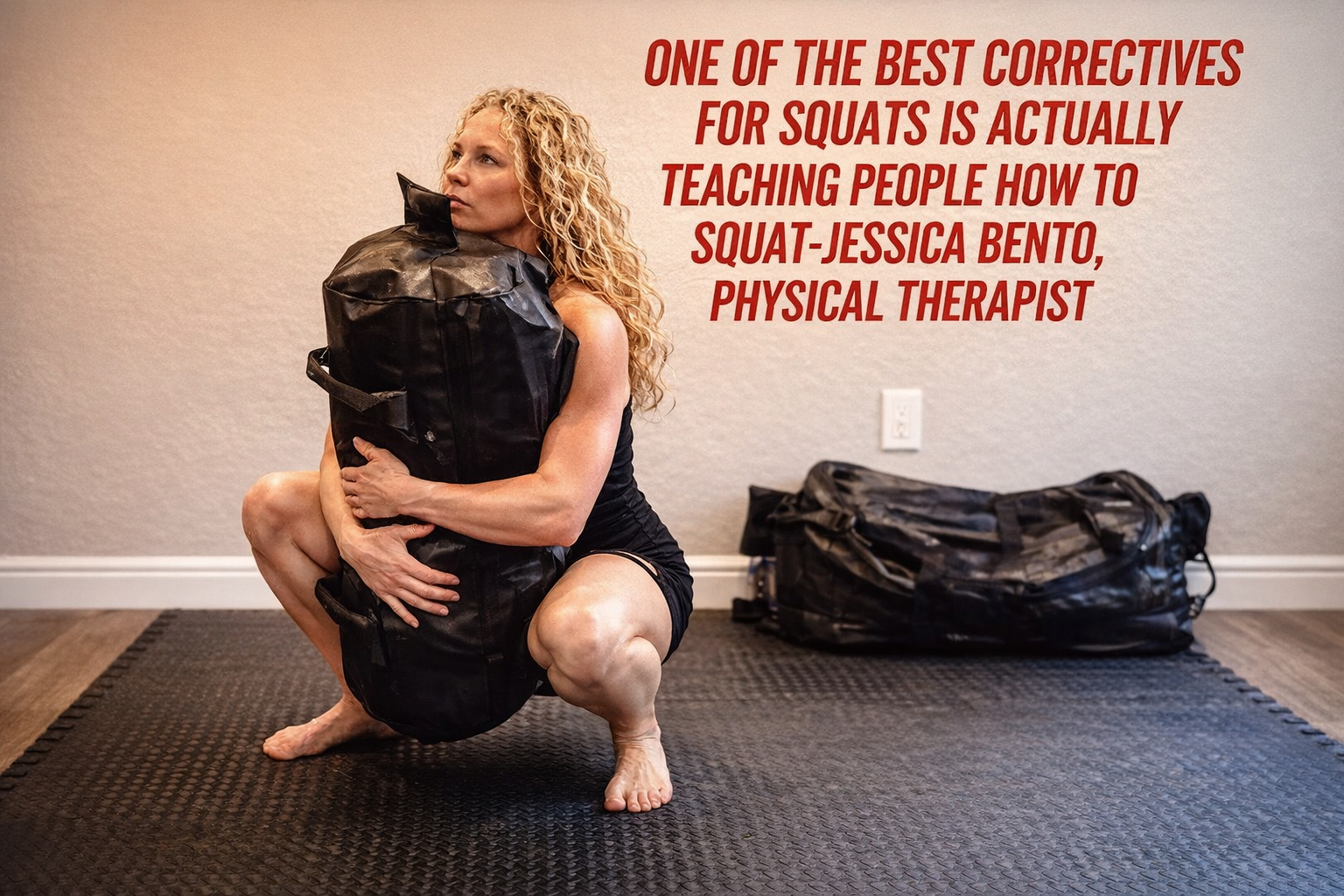
Why the front-loaded position matters. Holding load against the chest shifts your center of mass forward, which immediately demands a more upright torso to stay balanced. This isn’t a limitation, it’s exactly why the Bear Hug squat is so effective at teaching people to squat with better thoracic position and less forward lean than they might default to with other loading styles. The load itself becomes a built-in feedback tool: round through the upper back or let your chest collapse, and you’ll feel the Ultimate Sandbag pulling you out of position immediately.
The core demand most people don’t expect. Because the load is held anteriorly, the core has to work hard to resist unwanted trunk flexion and keep the ribcage stacked over the pelvis throughout the entire squat. This is genuine anti-flexion core training happening inside a squat pattern, not a separate ab exercise tacked onto the end of a workout, but a core demand built directly into the strength movement itself.
Why it’s often where we start. Because the Ultimate Sandbag is symmetrically loaded, held close to the body, and provides that immediate postural feedback, the Bear Hug squat is one of the safest, most teachable entry points into loaded squatting we use. It builds genuine strength and confidence in the pattern before introducing the more complex demands of asymmetrical loading.
The Shoulder Squat: Teaching the Body to Resist What It Doesn’t Expect
Once someone has a genuinely solid squat pattern, the Shoulder squat, the Ultimate Sandbag racked on a single shoulder, introduces a completely different kind of challenge. This isn’t a “harder” version of the Bear Hug squat. It’s a different training goal entirely.
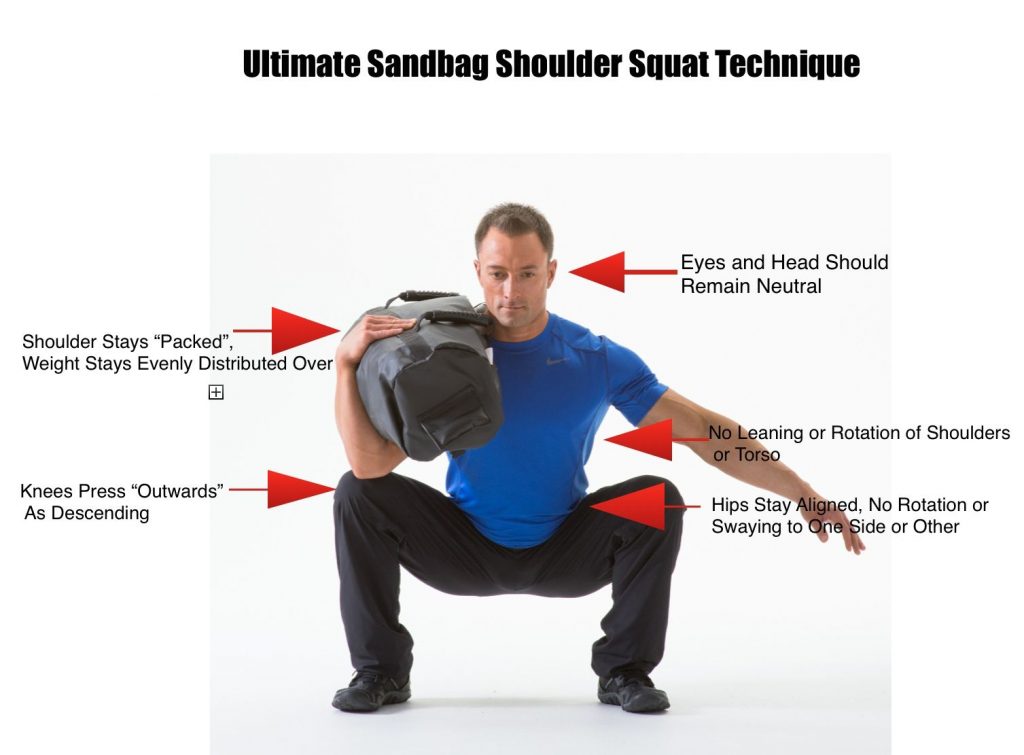
Asymmetrical loading changes everything. With the load sitting on one shoulder instead of centered against the chest, your body has to actively resist lateral flexion and rotation throughout the entire squat, the trunk wants to lean and twist toward the loaded side, and your core, obliques, and stabilizing musculature have to work continuously to prevent that from happening. This is frontal and transverse plane core training happening inside a squat, addressing exactly the kind of lateral and rotational stability that symmetrical, bilateral training never touches.
Real-world carryover. Very little of what we lift in daily life is perfectly balanced and symmetrical a bag of groceries, a child on one hip, a heavy object picked up and shifted to one side. The Shoulder squat trains the body to produce real strength and stability under exactly this kind of asymmetrical, unbalanced demand, building genuine resilience for the way load actually shows up outside the gym.
A different kind of leg and hip demand too. Because the body has to make subtle postural adjustments to manage the off-center load, the hips and legs are working through a slightly different stability challenge than a symmetrically loaded squat often revealing side-to-side imbalances that a Bear Hug squat, by its symmetrical nature, simply can’t expose.
View this post on Instagram
Why You Need Both, Not Just One
The mistake would be treating one of these as the “beginner” version and the other as the “real” or “advanced” one. They’re not on the same continuum, they’re training different qualities entirely. The Bear Hug squat builds foundational squat mechanics, anti-flexion core control, and postural awareness. The Shoulder squat builds lateral and rotational stability, asymmetrical strength, and the kind of real-world resilience that comes from managing load your body doesn’t expect. Building a good and strong Bear Hug squat will help your efforts into progressing to the Shoulder squat
Used together, they give you a genuinely complete picture of squat training, one that builds a strong, well-organized pattern and then challenges that pattern under the unpredictable, asymmetrical demands real life actually presents. That’s the difference between training a movement and training a body that can actually use it.
Find out more in our DVRT Courses 25% off along with ALL DVRT educational programs, workouts programs, and Ultimate Sandbags with code “dvrt25” HERE

Featured in





© 2026 Ultimate Sandbag Training. Site by Jennifer Web Design.