
Side Planks Are Not An Oblique Exercise, But Rather….
2026-08-31

Ask most people what a side plank is for, and you’ll hear the same answer: it works the obliques. Look at how it gets programmed almost everywhere a static hold, tacked onto the end of a core circuit, treated as a slightly harder cousin of the regular plank.
That framing sells the exercise dramatically short. Done well, and progressed intentionally, the side plank isn’t an oblique exercise at all. It’s one of the most direct ways to train the Lateral Line, a foundational system running the entire length of your body and understanding that changes both how you should perform it and why it matters so much for real fitness goals.
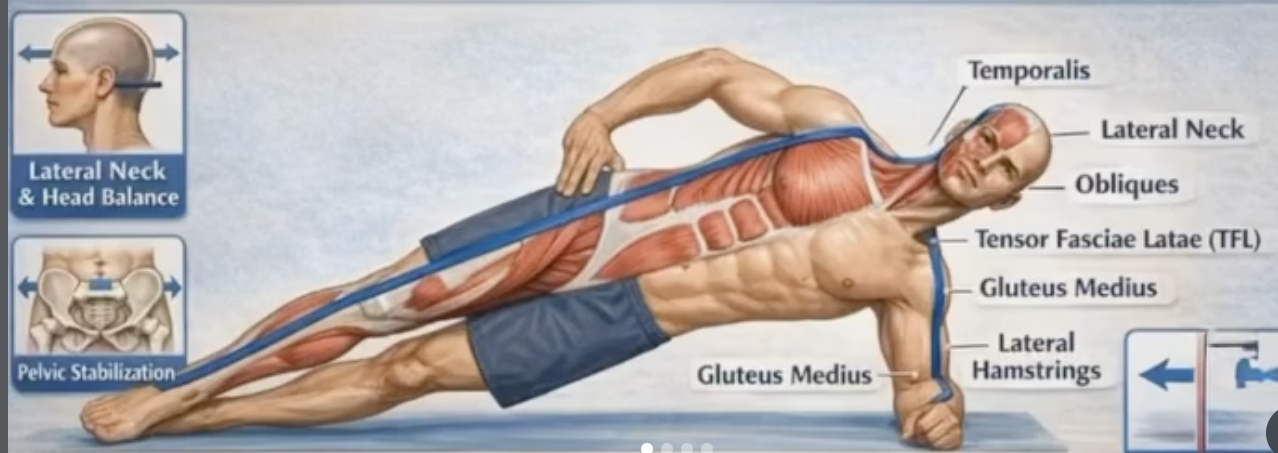
The muscles of the side plank run down lateral side of the body from head to foot!
What the Lateral Line Actually Is
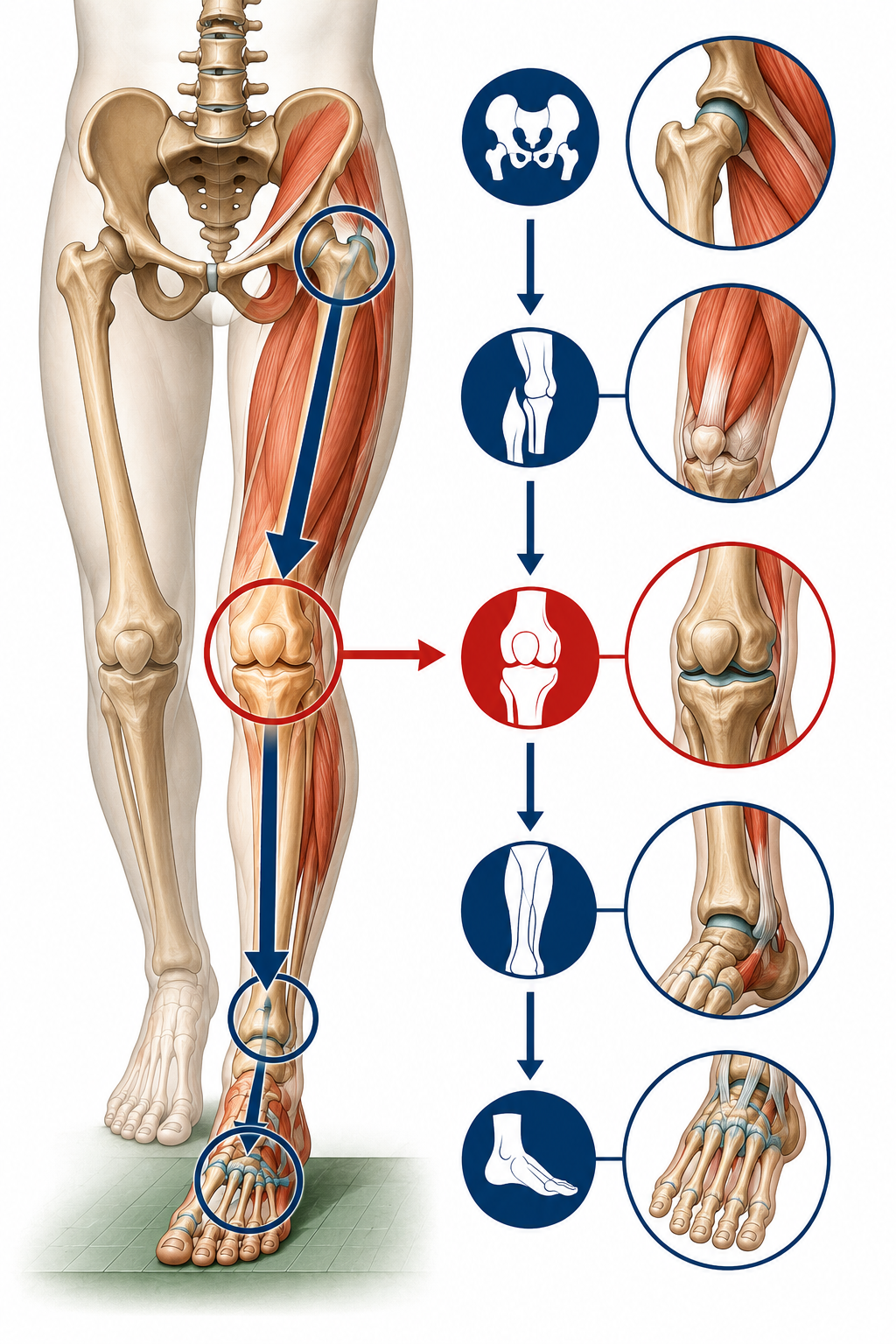
The Lateral Line is a continuous chain running along the side of your body starting at the outer foot, traveling up through the peroneal muscles of the lower leg, crossing the outside of the knee, continuing up through the iliotibial band and hip, and continuing through the obliques, intercostals, and up into the side of the neck. It’s not a metaphor for “everything is connected.” It’s a real, anatomically continuous system, and its job is remarkably specific: controlling side-to-side stability.
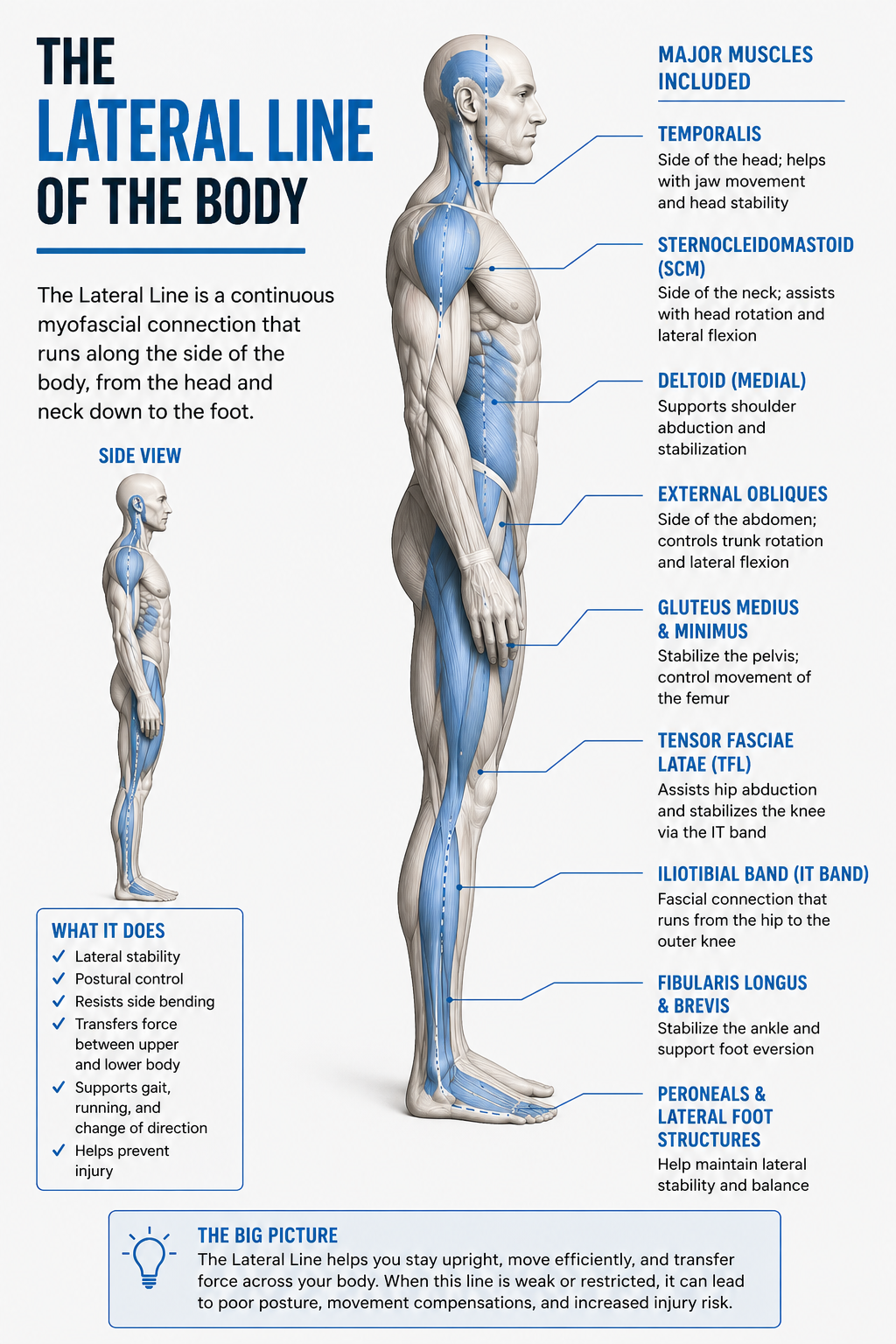
This matters because most training squats, presses, lunges forward and back lives almost entirely in the sagittal plane, moving forward and backward. The Lateral Line’s job, frontal-plane control, is exactly the direction most programs neglect. And yet frontal-plane stability is what keeps your knee from caving inward during a single-leg movement, what stabilizes your pelvis while you walk or run, and what keeps you upright when you step onto uneven ground or catch yourself from stumbling sideways.
Why This Matters for Real Fitness Goals
If your goals involve anything beyond moving weight in a straight line staying injury-resilient, aging well, playing a sport, simply walking confidently on uneven terrain the Lateral Line is directly relevant, whether or not you’ve ever heard the term before.
Weak or poorly trained frontal-plane stability shows up as recurring IT band pain, knees that drift inward under load, a hip that can’t hold position during single-leg work, or a general sense of instability moving side to side. These aren’t separate, unrelated issues. They’re often the same underlying gap: a Lateral Line that was never trained as the connected, whole-body system it actually is.
The side plank, positioned correctly, is one of the most direct tools available for training this exact system which is why it deserves far more intention than the “hold for 30 seconds” treatment it usually gets.
From Proximal Stability to Reflexive Stability
Here’s where progression becomes essential, and where most people’s side plank training stalls out permanently at the same basic level.
The first job of the side plank is building proximal stability teaching the trunk, hip, and shoulder to hold a stable, aligned position against gravity. This is foundational, and it’s exactly where most people start and, unfortunately, stay. A basic side plank hold is genuinely useful early on, but it’s teaching a fairly limited skill: static control under a fixed, predictable demand.
Real function requires something more advanced: reflexive stability the ability to maintain control automatically, in response to changing, sometimes unpredictable demands, without consciously thinking through the correction. This is the stability you actually rely on when you step awkwardly off a curb, get bumped while carrying something, or plant your foot on uneven ground during a hike. Nobody has time to consciously brace in that half-second. The nervous system has to already know how to respond.
Building that bridge from proximal to reflexive stability requires deliberate progression, layered through both the lower and upper body.
Lower body progressions might move from a basic side plank with both feet stacked, to lifting the top leg for a reduced base of support, to eventually adding movement a top-leg raise and lower, a controlled hip drop and lift, or a single-leg stance variation that challenges the hip and ankle to make constant, small corrections rather than holding one fixed position.
Upper body progressions might move from a basic forearm or hand support, to adding a reaching or rotating arm movement, to introducing an external load or resistance band that pulls the body out of position and forces a reactive correction. Each of these variations asks the Lateral Line to do something it never had to do in the static hold: respond to a changing, less predictable demand in real time.
The goal of this progression isn’t simply “harder side planks.” It’s a genuine shift in what the nervous system is being asked to do from holding a known position to organizing itself automatically under uncertainty, which is the actual skill that transfers into daily life, sport, and long-term injury resilience.
View this post on Instagram
A side plank held perfectly still for a minute is a reasonable starting point. It is not the ceiling of what this position can teach your body. Understood as a tool for training the Lateral Line specifically, and progressed deliberately from proximal control toward genuine reflexive stability, the side plank becomes something far more valuable than an oblique exercise a direct, evidence-informed way of building the frontal-plane resilience most training programs never touch at all.
Learn so much more with our DVRT online education 30% off as well as our workout programs and Ultimate Sandbags with code “laborday” HERE
View this post on Instagram
Featured in





© 2026 Ultimate Sandbag Training. Site by Jennifer Web Design.