
Why Are We Still Separating Stretching, Breathing, Core Training, and Movement?
2026-06-17

Walk into most gyms, rehabilitation clinics, or fitness facilities and you’ll often see the same approach. First comes stretching, then breathing drills, after that, some core stability exercises. Finally, people move into their strength or movement training.
At first glance, this seems logical. If flexibility, breathing, stability, and movement are all important, shouldn’t we train them all?
The better question may be: why train them separately?
Modern research increasingly suggests that the human body doesn’t operate in isolated systems. Movement is the result of multiple systems working together simultaneously. When we separate mobility from stability, breathing from movement, or core training from strength training, we may unintentionally move away from how the body actually functions.
This is one reason why mind-body fitness approaches such as yoga, Tai Chi, qigong, and newer integrated movement systems continue to show impressive benefits across a wide range of outcomes. Don’t worry, you don’t have to become a Tai Chi master or yoga guru to find the benefits!
The Research on Integration
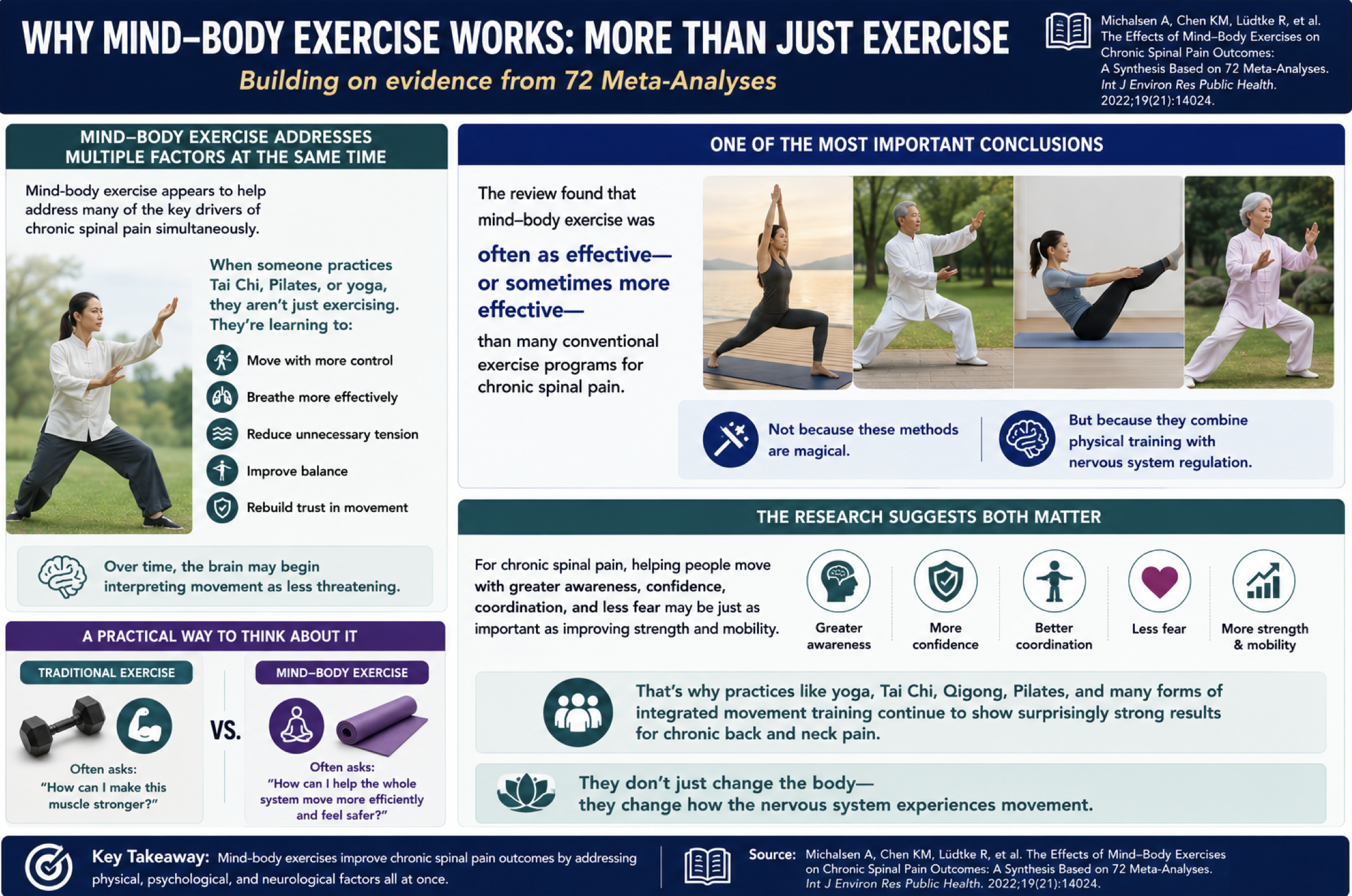
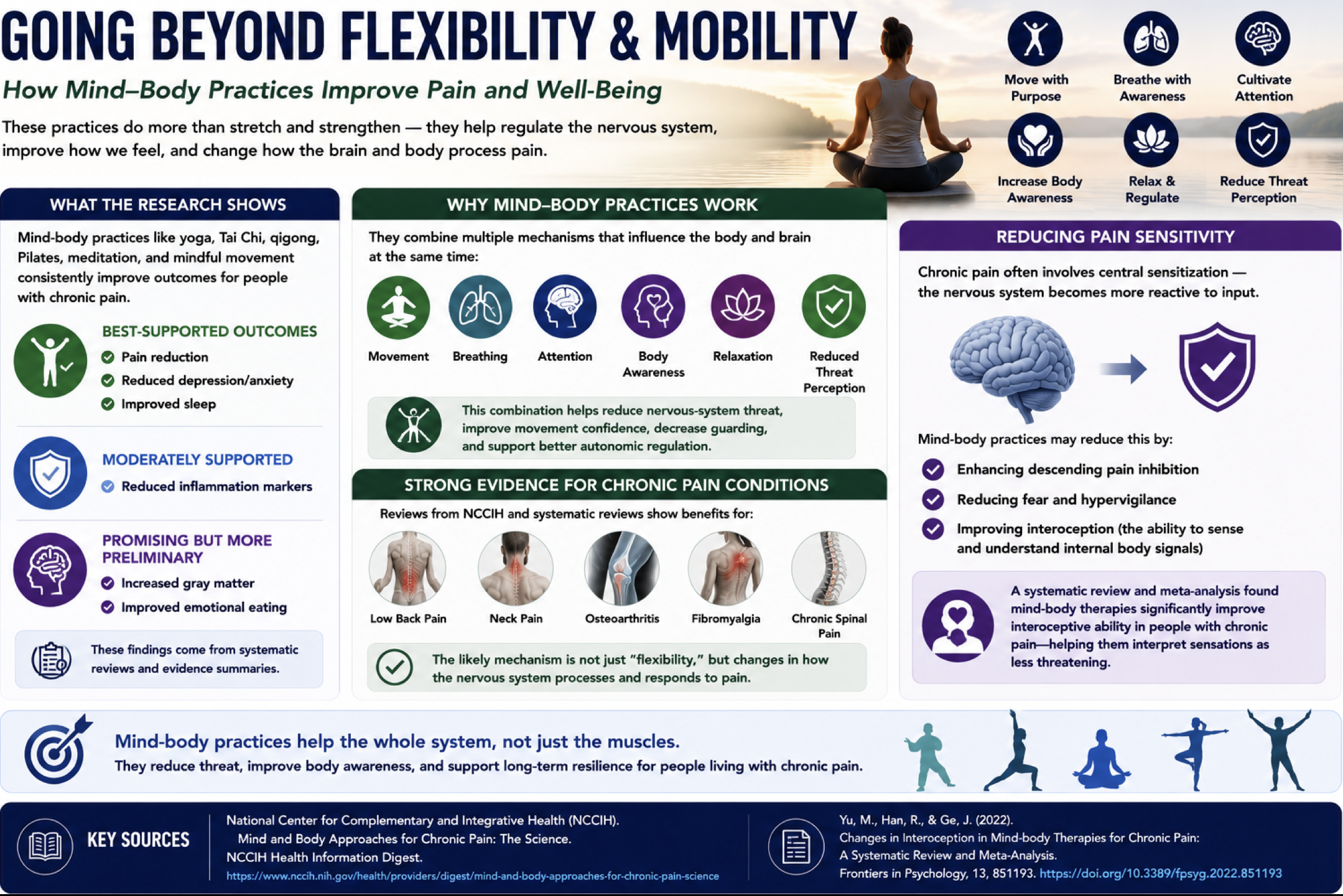
Research on mind-body exercise programs consistently demonstrates improvements in flexibility, balance, strength, coordination, postural control, and even pain reduction.
Tai Chi studies have shown improvements in balance and fall prevention while also enhancing lower-body strength, chronic pain, sleep, depression/anxiety, and movement confidence. Yoga research has demonstrated improvements in mobility, core endurance, breathing efficiency, and chronic low back pain. These benefits occur not because participants are isolating individual muscles or systems, but because they are training them together.
What makes these findings so interesting is that participants aren’t performing separate flexibility sessions, breathing sessions, and balance sessions. Instead, these qualities emerge from integrated movement experiences.
In other words, the body appears to improve many capacities simultaneously when movement is organized effectively.
The False Choice Between Stability and Mobility
For years, fitness professionals often treated mobility and stability as separate goals.
If someone lacked flexibility, they stretched, or did their joint mobility exercises.
If someone lacked stability, they performed core exercises.
However, research on motor control and movement quality suggests the relationship is much more complex.
The body doesn’t simply need more mobility or more stability. It needs the ability to transition between the two.
A healthy movement system can create stability when necessary and release it when appropriate. It can generate tension for force production and relax enough to allow efficient movement.
This adaptability may be one of the defining characteristics of resilient movement.
That helps explain why many people can spend years stretching tight muscles without lasting change. The issue is often not tissue length alone but how the nervous system organizes movement and manages tension throughout the body.
Breathing Is Not Separate From Movement
Breathing is another example.
Many people now understand that breathing influences posture, core function, stress regulation, and movement quality. Yet breathing exercises are frequently treated as a separate activity.
The diaphragm plays a critical role in trunk stability, pressure management, and movement coordination. Every breath influences rib cage position, spinal mechanics, and muscle recruitment.
Research increasingly shows that breathing is deeply connected to movement efficiency and postural control.
Rather than viewing breathing as a separate corrective strategy, it may be more beneficial to integrate breathing into meaningful movement patterns where the body learns how to coordinate respiration and motion together.
Core Stability Is More Than Bracing
The same concept applies to core training.
Research from Kibler and colleagues described the core as an integrated system responsible for stabilizing the trunk and transferring force throughout the body.
The purpose of the core isn’t simply to contract abdominal muscles. Its role is to coordinate the transfer of force between the upper and lower body while adapting to constantly changing demands.
This means true core training isn’t about isolating the abs. It’s about learning how to maintain appropriate stability while breathing, reaching, rotating, stepping, and changing positions.
When core training becomes integrated with movement, the lessons become more transferable to daily life and athletic performance.
Why Myofascial Integrated Movement Training Makes Sense
This is where Myofascial Integrated Movement (MIM) Training offers a unique solution.
Rather than treating mobility, breathing, stability, and movement as separate categories, MIM approaches them as interconnected components of one system.
A single movement sequence can simultaneously:
- Improve mobility
- Enhance breathing mechanics
- Develop core function
- Increase balance
- Improve coordination
- Build movement confidence
Instead of asking the body to learn these qualities in isolation and then hoping they transfer into movement later, MIM trains them together from the beginning.
This approach reflects how the nervous system naturally learns. The brain doesn’t organize movement by individual muscles. It organizes movement through patterns, relationships, and coordinated actions.
As participants move through integrated sequences, they learn how to manage tension, create stability, improve mobility, and coordinate breathing without separating these qualities into different training sessions.
More Than Corrective Exercise
One of the biggest misconceptions is that integrated movement systems are only useful for rehabilitation or mobility.
Research on mind-body fitness approaches consistently demonstrates improvements in strength, balance, coordination, and even power production.
When movement efficiency improves, force can be transferred more effectively through the body. Better coordination often leads to better strength expression. Improved mobility can reduce movement restrictions. Enhanced balance creates a stronger foundation for force production.
The result is not simply better movement quality, but often improved physical performance as well.
The question may no longer be whether stretching, breathing, core stability, and movement training are important.
The evidence clearly suggests they are.
The better question is whether they need to be trained separately at all.
Research on motor control, mind-body fitness, and integrated movement continues to point toward a simple conclusion: the body functions as a system, not as a collection of independent parts.
When we train the system as a whole, we often achieve many outcomes at once—greater mobility, improved stability, better balance, enhanced strength, more efficient breathing, and more resilient movement.
That is why integrated approaches such as Myofascial Integrated Movement Training may represent not just another exercise method, but a more complete reflection of how the human body was designed to move.
You can find more in our Online Masterclasses HERE and our Myofascial Integrated Movement programs HERE all can save 20% with code “save20”
Featured in





© 2026 Ultimate Sandbag Training. Site by Jennifer Web Design.