
Why Glute Training for Low Back Pain Is About More Than Strength
2026-06-4

When people hear that glute training can help low back pain, the assumption is often simple:
“Your glutes are weak. Make them stronger.”
While strength can certainly be part of the solution, emerging research suggests the real story is much more interesting. For many people with chronic low back pain, the issue isn’t simply how much force the glutes can produce. Instead, it’s how effectively the nervous system coordinates the glutes with the rest of the body during movement.
This distinction may explain why some people spend months doing bridges, clamshells, and hip thrusts yet continue to struggle with back pain.
The Research on Glute Training and Low Back Pain
Two recent studies provide valuable insights into this topic.
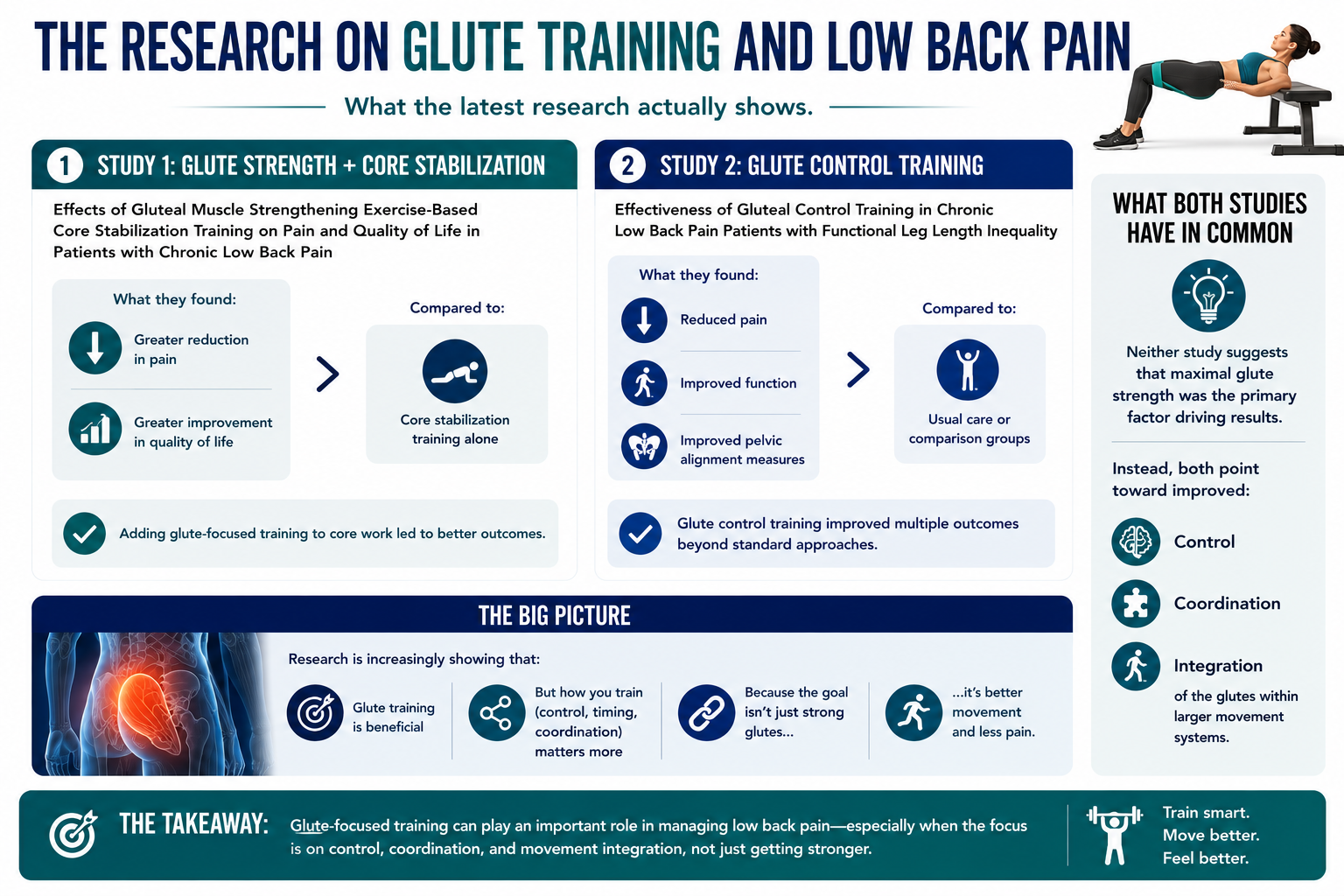
The study Effects of Gluteal Muscle Strengthening Exercise-Based Core Stabilization Training on Pain and Quality of Life in Patients with Chronic Low Back Pain found that incorporating glute-focused training into a core stabilization program produced greater improvements in pain and quality of life than core training alone.
Another study, Effectiveness of Gluteal Control Training in Chronic Low Back Pain Patients with Functional Leg Length Inequality, found that training focused on gluteal control improved pain, function, and pelvic alignment measures.
Notice something important.
Neither study suggests that maximal glute strength was the primary factor driving results.
Instead, both point toward improved control, coordination, and integration of the glutes within larger movement systems.
The Glutes Are Part of a Stability System
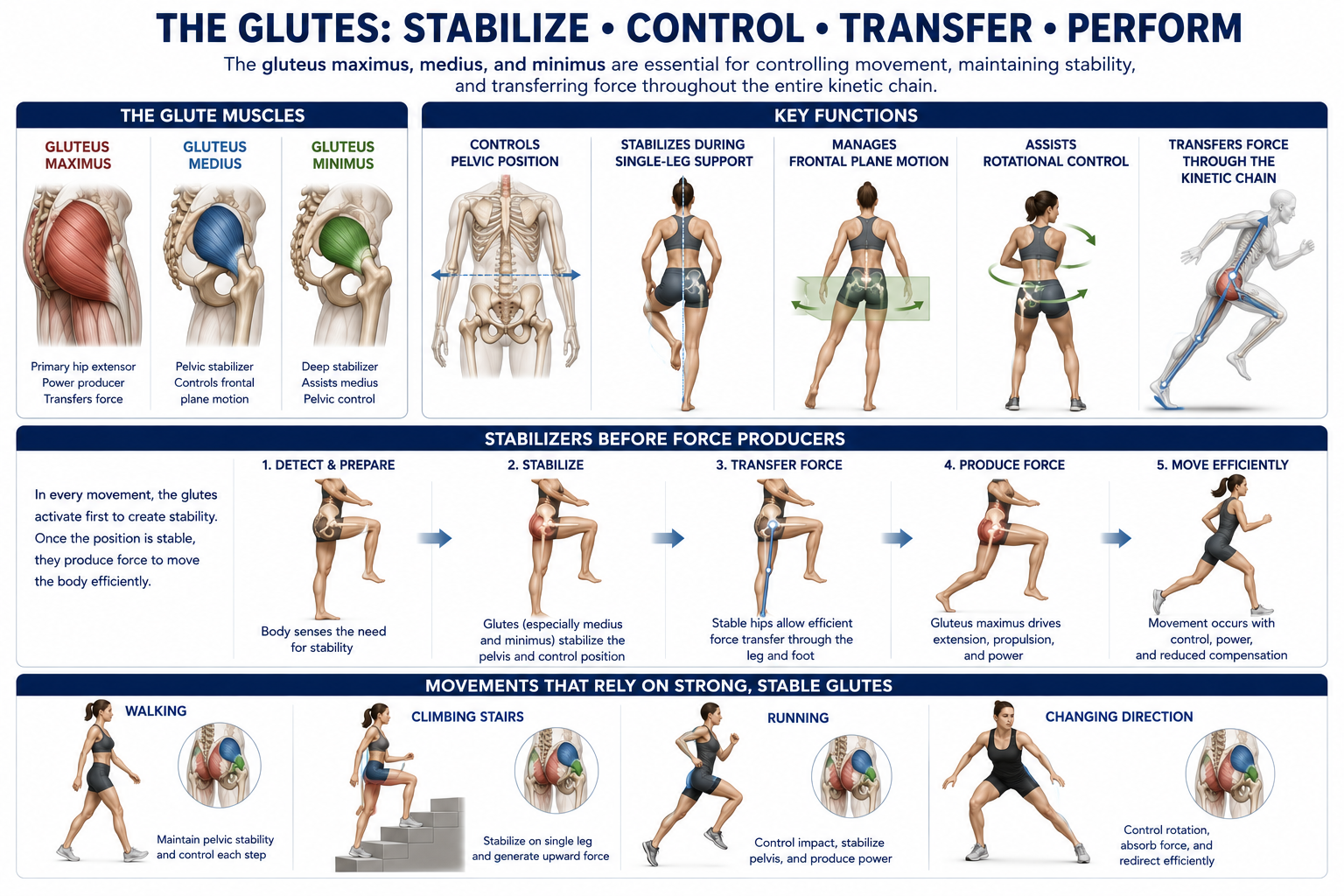
The glutes are often described as powerful hip extensors. While that is true, it only tells part of the story.
The gluteus maximus, medius, and minimus play critical roles in:
- Controlling pelvic position
- Stabilizing the body during single-leg support
- Managing frontal plane motion
- Assisting rotational control
- Transferring force through the kinetic chain
Walking, climbing stairs, running, and changing direction all require the glutes to work as stabilizers before they work as force producers.
This is why many people with chronic low back pain display altered movement patterns even when their measured strength appears relatively normal.
The nervous system may not be using the glutes effectively when stability is required.
Why Control Matters More Than Maximal Force
Imagine standing on one leg.
The goal isn’t to generate maximum glute force.
The goal is to continuously make tiny adjustments to maintain balance and alignment.
Your nervous system is constantly processing information from:
- Your feet
- Your hips
- Your visual system
- Your vestibular system
- Your trunk muscles
The glutes become part of a sophisticated stabilization network.
Research increasingly shows that chronic low back pain is associated with altered motor control strategies. People often develop protective movement patterns, excessive trunk stiffness, delayed muscle activation, or compensatory strategies that shift work away from the hips.
Over time, the lumbar spine may begin handling loads and motions that the hips should be managing.
This helps explain why improving glute control can have such a profound effect on back pain.
View this post on Instagram
The Missing Link: Single-Leg Stability
One of the most overlooked aspects of rehabilitation is that life happens primarily one leg at a time.
Every step we take requires the body to:
- Stabilize the pelvis
- Control side-to-side motion
- Transfer force efficiently
- Coordinate trunk and hip activity
This is where exercises emphasizing single-leg control often outperform isolated strengthening exercises.
When someone performs a step-up, single-leg deadlift, lateral step-down, or split-stance movement, the nervous system is challenged to organize stability across the entire kinetic chain.
The glutes must communicate with the core, feet, and trunk in real time.
This is fundamentally different from simply making a muscle contract harder.
View this post on Instagram
The Role of the Nervous System
Chronic low back pain is increasingly viewed through a biopsychosocial lens.
Research shows that pain can influence:
- Movement confidence
- Motor control
- Muscle recruitment patterns
- Threat perception
- Protective tension
In many cases, the nervous system becomes more protective and less adaptable.
This is one reason why slower, controlled movement patterns can be so effective.
Exercises that combine:
- Balance
- Breathing
- Single-leg stability
- Rotational control
- Movement awareness
help the nervous system learn that movement can be safe again.
Rather than simply building stronger glutes, these approaches improve the quality of communication between the brain and the body.
A Better Goal Than “Stronger Glutes”
The takeaway from these studies is not that strength doesn’t matter.
Strength is important.
But strength alone is often insufficient.
The most successful rehabilitation programs help people develop glutes that are not only stronger, but also more responsive, coordinated, and integrated into whole-body movement.
Instead of asking:
“How strong are the glutes?”
A better question may be:
“How effectively are the glutes helping the body create stability, transfer force, and coordinate movement?”
For people dealing with chronic low back pain, that shift in perspective can make all the difference.
The goal isn’t simply bigger or stronger glutes.
The goal is a smarter movement system.
And when the hips, core, and nervous system learn to work together again, the low back often no longer has to do the job alone.
Learn better low back solutions at our upcoming NEW Low Back Pain Masterclass. Only 3 days left to save 20% with code “back20” HERE
View this post on Instagram
Featured in





© 2026 Ultimate Sandbag Training. Site by Jennifer Web Design.