
Medicine Ball Slam Deserves Better Than “Just Get Tired”
2026-07-28

Walk into almost any gym and you’ll see the same thing happen with medicine ball slams: someone picks up the ball, hoists it overhead, and hurls it down as hard as possible, over and over, mostly as a way to get their heart rate up and feel like they did something intense.
That’s not wrong, exactly. It will absolutely make you breathe hard. But it also misses almost everything valuable this exercise is capable of teaching and in the process, it quietly increases the risk of hurting yourself doing it.
What Most People Are Actually Missing
The medicine ball slam, done with real intention, is one of the most complete teaching tools available for triple extension, full-body stability, posterior chain strength, and the ability to decelerate force and convert it into elastic power. Done carelessly, as a pure conditioning tool with no attention to mechanics, it’s just repetitive, unregulated force through a body that hasn’t been taught how to organize itself around that force. That gap is exactly where injuries happen.

Triple Extension: The Skill Most Slams Never Actually Teach
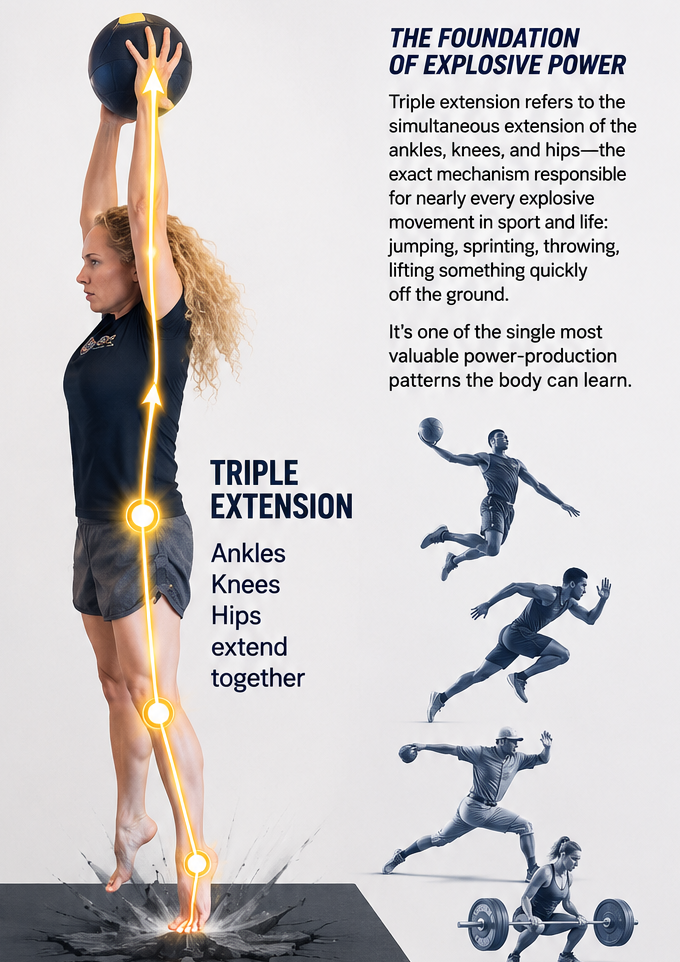
Triple extension refers to the simultaneous extension of the ankles, knees, and hips the exact mechanism responsible for nearly every explosive movement in sport and life: jumping, sprinting, throwing, lifting something quickly off the ground. It’s one of the single most valuable power-production patterns the body can learn.
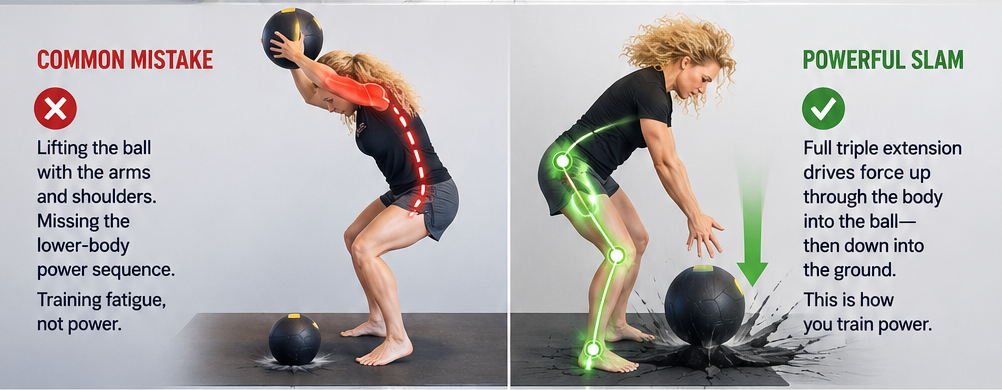
A properly executed med ball slam should train this directly. As you rise up and extend upward before the downward slam, your ankles, knees, and hips should extend together, in sequence, driving force up through the body into the ball. Most people skip this entirely they simply lift the ball with their arms and shoulders, missing the entire lower-body power sequence that makes this exercise so valuable in the first place. When you’re not training triple extension, you’re not really training power. You’re just training fatigue.
The Top Position Is a Powerful Plank Not a Pause
The moment at the top of the slam, ball overhead, body extended, is often treated as a throwaway transition point. It shouldn’t be. That position is genuinely a powerful, standing plank your core, lats, and shoulders have to stabilize your entire structure while your body is fully extended and about to generate significant force downward.
Rushing through this position means skipping a genuine stability training opportunity. Owning it, even briefly, teaches your core and shoulders to organize and brace before force production, which is exactly the sequence your body needs for safe, powerful movement anywhere else.
Your Feet Are Doing More Than You Think
The ankles and feet are working hard throughout a well-executed slam, both in the initial extension and in absorbing and redirecting force as you transition into the downward, decelerating phase. A foot and ankle that can’t stabilize under this demand sends instability up through the knees and hips, undermining both power output and injury resilience. This is foot training in a genuinely functional, load-bearing context not an isolated balance drill.
Posterior Chain Strength and the Deceleration Most People Skip Entirely
Here’s the piece almost everyone misses completely: the slam isn’t only about the explosive part. It’s equally about decelerating your body and the ball’s downward momentum with control, using your glutes, hamstrings, and lats to absorb that force rather than simply letting gravity and momentum do the work while your joints take the brunt of it.
This eccentric, decelerating phase is where real posterior chain strength gets built, and it’s also where that absorbed energy gets converted into elastic energy for the next rep a genuine stretch-shortening cycle, not just repetitive impact. Skipping this control is exactly how people end up straining their backs or shoulders doing an exercise that should be building resilience, not risking it.
Building the Foundation Before You Slam
This is exactly why progressions matter before jumping straight into unregulated slams. Ultimate Sandbag snatches teach the body triple extension and full-body force transfer in a more controlled, gripped context, building the coordination the slam later demands. Mobility Ball Snapbacks a progression popularized by Coach Dos teach the deceleration and elastic energy component directly, training the body to absorb and redirect force before ever adding the ballistic, uncontrolled nature of a full slam.
View this post on Instagram
Progressing through these drills first means that by the time you actually get to the med ball slam, your body already understands triple extension, stability, deceleration, and elastic energy and the slam becomes what it was always meant to be: a genuinely powerful, purposeful expression of full-body strength and control, not just a way to get tired.
That’s the difference between doing an exercise and actually training with it.
Find out more and save 20% on ALL our DVRT courses and functional training tools with code “save20” HERE
Featured in





© 2026 Ultimate Sandbag Training. Site by Jennifer Web Design.