
Hamstring Tightness Isn’t a Flexibility Problem
2026-09-6

Tight hamstrings are something that I think I have been dealing with since I was a teenager. When I hurt my back at 14, therapists had me stretching and stretching my hamstrings. Looking back, I don’t think that tight hamstrings caused my back injury, but I definitely did not have great flexibility.
Having good flexibility is always a good thing, but current research doesn’t necessarily point us to things like tight hamstrings being the cause of injuries/pain as much as it can correlate (don’t forget correlation/causation fallacies). The way I like to explain why we should care about issues like hamstring flexibility is because it could be a sign of other things not working as well they should. THIS could impact our ability to perform, move well, and be more resilient.
A person may experience limited straight-leg raise because of:
- muscle extensibility
- stretch tolerance
- neural mechanosensitivity
- hip anatomy
- previous injury
- pain/protective responses
- movement strategy
- nervous-system sensitivity
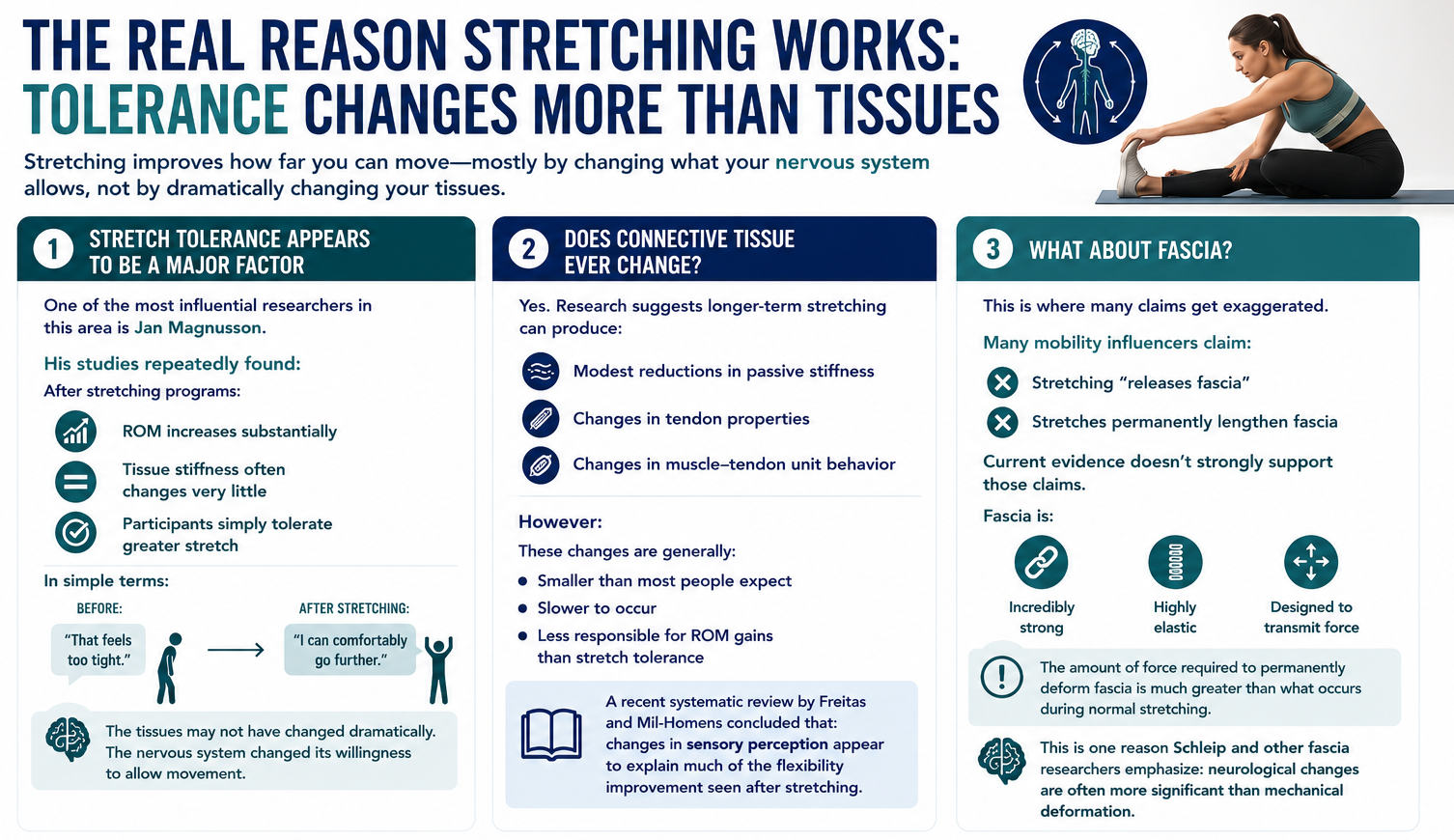
The “Sensory Theory” of Flexibility
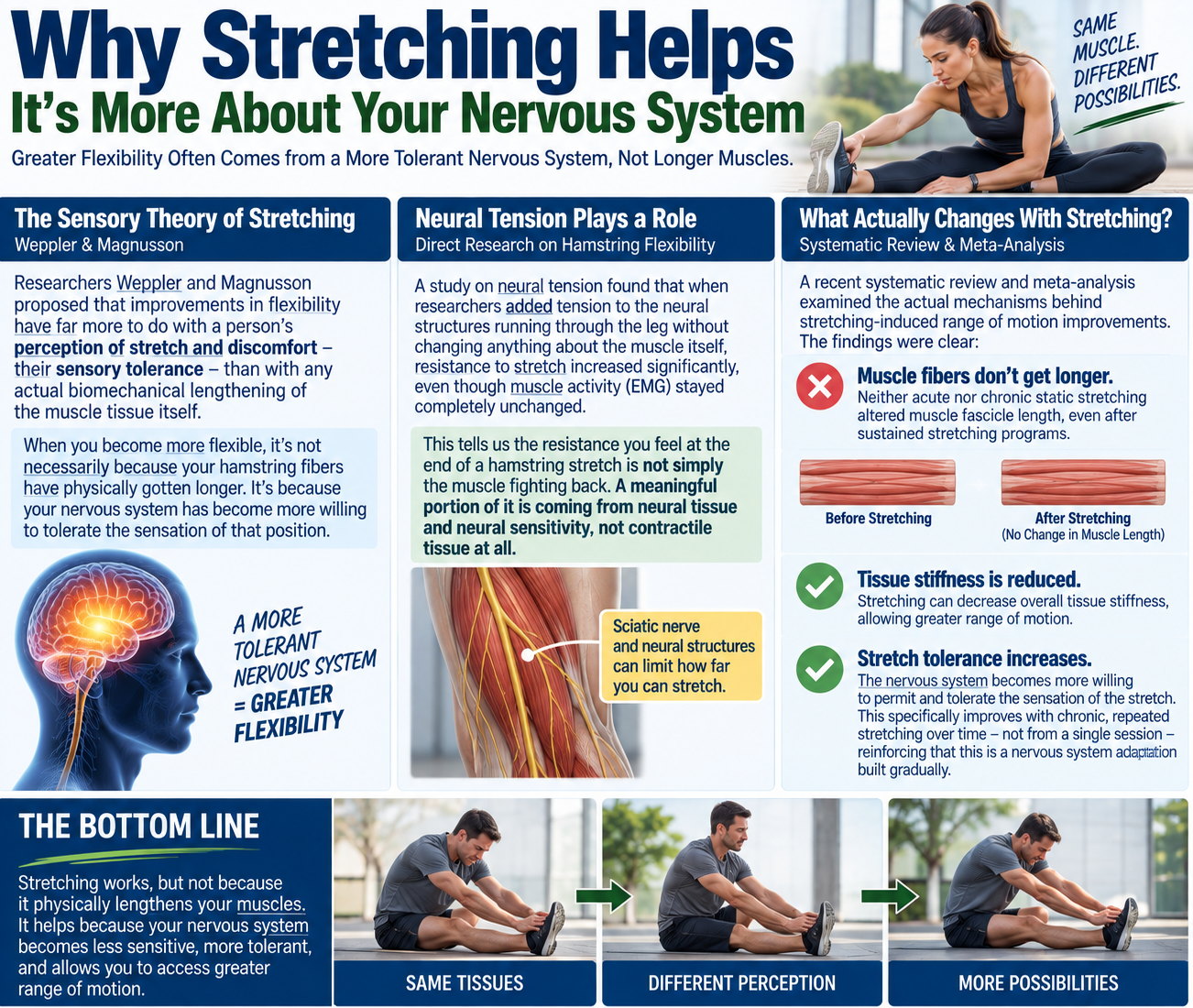
Researchers Weppler and Magnusson proposed what’s become known as the sensory theory of stretching: that improvements in flexibility have far more to do with a person’s perception of stretch and discomfort their sensory tolerance, than with any actual biomechanical lengthening of the muscle tissue itself. In other words, when you become more flexible over time, it’s not necessarily because your hamstring fibers have physically gotten longer. It’s because your nervous system has become more willing to tolerate the sensation of that position.
Direct research supports this. A study on neural tension in hamstring flexibility found that when researchers added tension to the neural structures running through the leg without changing anything about the muscle itself, resistance to stretch increased significantly, even though muscle activity, measured through EMG, stayed completely unchanged. This tells us the resistance you feel at the end of a hamstring stretch is not simply the muscle fighting back. A meaningful portion of it is coming from neural tissue and neural sensitivity, not contractile tissue at all.
A recent systematic review and meta-analysis examining the actual mechanisms behind stretching-induced range of motion improvements reached a striking conclusion: neither acute nor chronic static stretching altered muscle fascicle length, meaning the muscle fibers themselves didn’t get longer, even after sustained stretching programs. Instead, improved range of motion was driven by two other factors: reduced overall tissue stiffness, and increased stretch tolerance, the nervous system’s willingness to permit and tolerate the sensation of the stretch. Stretch tolerance specifically only improved with chronic, repeated stretching over time, not from a single session, reinforcing that this is a nervous system adaptation being built gradually, not a tissue being reshaped.
Why This Matters More Than It Sounds
This isn’t just an academic distinction. It directly explains a pattern many people have experienced firsthand: hamstring tightness that doesn’t respond to stretching no matter how consistently it’s performed, tightness that seems to fluctuate with stress or fatigue rather than training volume, or tightness that returns almost immediately after a stretch that felt effective in the moment. This seemed to be my life as stretching and stretching didn’t seem to get me too far.
If tightness were purely a tissue-length problem, none of these patterns would make much sense. But if tightness is substantially a protective, nervous-system-driven response, the brain limiting range of motion because it doesn’t yet perceive that range as safe or well-supported, these patterns make complete sense. A nervous system under stress, lacking confidence in the stability of a joint, or generally in a guarded state is going to restrict range of motion regardless of how many times the muscle itself has been stretched.
Why Core Stability Changes the Equation
This is exactly where core stability enters the picture, and it’s a more direct connection than it might first appear. If a major driver of hamstring guarding is the nervous system’s uncertainty about whether a given range of motion is safe and well-supported, then building genuine core and pelvic stability addresses that uncertainty directly. A stable, well-controlled pelvis and spine give the nervous system a secure foundation to release tension from, rather than asking the hamstrings to compensate for instability elsewhere in the chain by staying guarded and short. This reframes hamstring flexibility work: instead of only lengthening the tissue, build the proximal stability that gives the nervous system permission to actually let go.
View this post on Instagram
Why Mind-Body Practice Is a Genuinely Better Tool Here
Because the primary lever being pulled here is nervous system tolerance, not tissue mechanics, mind-body practices are particularly well-suited to this problem. Breathwork directly shifts the nervous system toward parasympathetic, less-guarded states. Mindful, non-striving attention to a stretch — noticing the sensation without bracing against it or forcing past it, works with the sensory tolerance mechanism directly, rather than fighting it through aggressive, forced stretching that can reinforce guarding instead of resolving it. Slow, controlled, breath-integrated movement builds active range of motion the nervous system has actually organized and approved of, rather than range achieved through passive force that the nervous system may continue to resist.
Tight hamstrings are rarely just a tissue problem waiting for the right stretch. The research points toward a nervous system that hasn’t yet been convinced a given range of motion is safe, stable, and well-supported. Addressing that directly, through core stability work that gives the body a secure foundation, and mind-body practices that work with the nervous system’s tolerance rather than against it, is very often a more effective, more lasting solution than another few weeks of the same stretch that never quite seems to stick.
Learn more solutions in our DVRT educational programs like our Low Back Masterclass and Myofasical Integrated Movement programs, ALL 30% off along with our Ultimate Sandbags with code “laborday” HERE
View this post on Instagram
Featured in





© 2026 Ultimate Sandbag Training. Site by Jennifer Web Design.