Top 5 Go-To Exercises for Low Back Pain
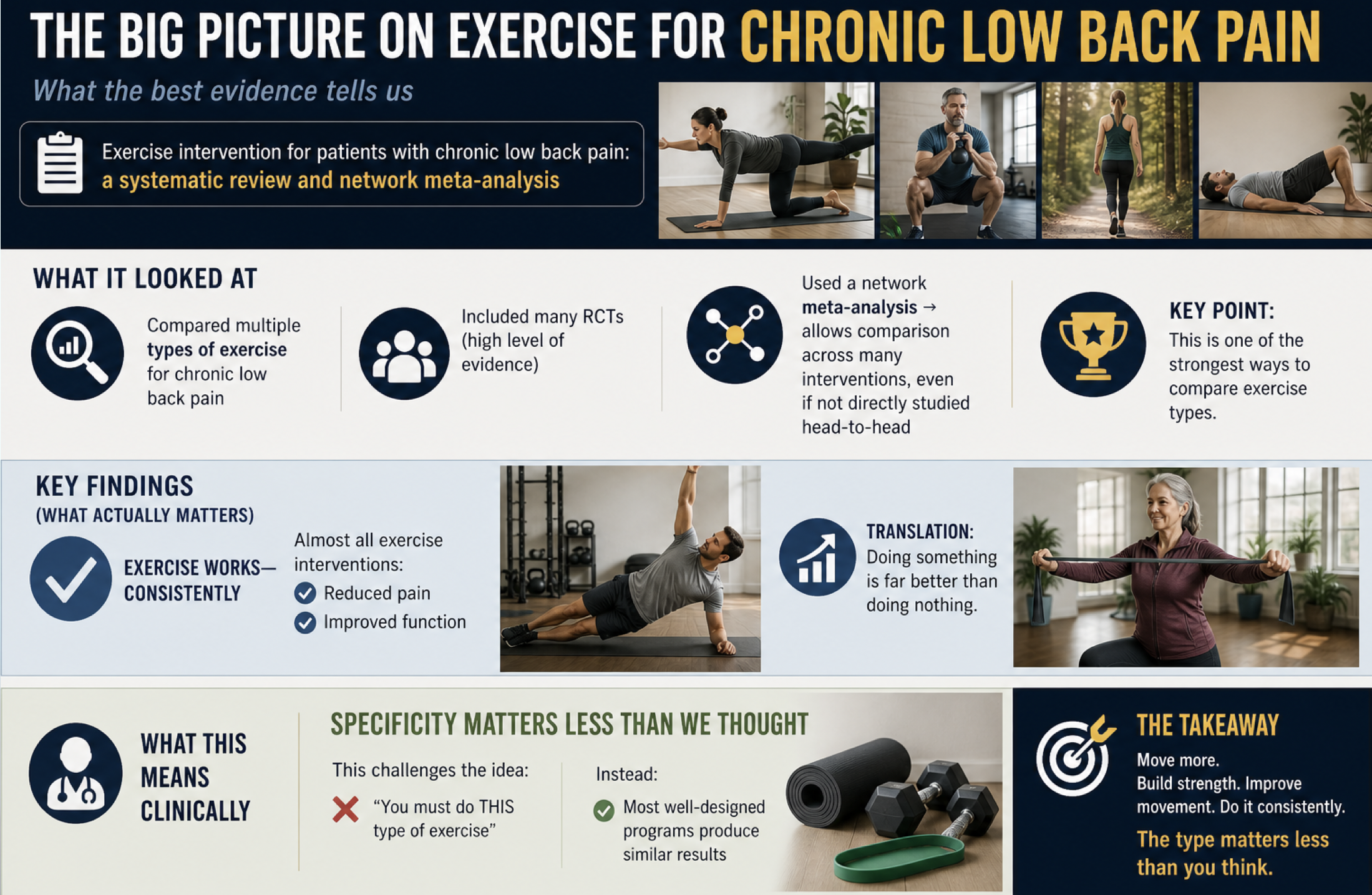
One of the biggest misconceptions about low back pain is that you need a collection of highly specialized “back exercises” to feel better. While specific low back exercises certainly have their place, the research increasingly points us in a different direction. Studies have found that functional exercise programs can be just as effective, and in some cases more effective, than highly specific low back pain interventions for improving pain and function. The common denominator isn’t a magical exercise, it’s helping people move better, become stronger, build confidence, and improve their ability to tolerate daily activities.
This is why our approach isn’t focused on finding exercises that simply target the low back. Instead, we look for movements that help people feel safe, can be easily progressed and regressed, teach the body to work as an integrated system, and cover fundamental movement patterns such as squatting, lunging, hinging, pushing, pulling, rotation, and locomotion.
These five exercises consistently check all of those boxes.
1. Body Rows
Many people experiencing low back pain become apprehensive about bending forward. Traditional rowing exercises often require a hip hinge position that can create anxiety or discomfort before someone is ready.
The Body Row provides all the benefits of a pulling exercise while minimizing those concerns. It teaches core stability through a natural plank position while developing upper back strength, postural muscles, and shoulder stability. Most importantly, it helps people learn how to connect their arms to their trunk and lower body. Rather than thinking of pulling as an upper-body exercise, the Body Row teaches pulling as a whole-body skill.
2. Bow Stance Medicine Ball Pushes
The lunge pattern is essential for real-world movement, but jumping immediately into more advanced single-leg exercises can overwhelm someone’s stability and confidence.
Bow Stance Medicine Ball Circles create a perfect bridge. The staggered stance provides a stable foundation while teaching the hips, trunk, and shoulders to work together. The circular motion encourages controlled rotation and anti-rotation, helping develop core stability without rigid bracing. At the same time, the exercise improves hip mobility and coordination.
Instead of separating mobility and stability, this exercise teaches both simultaneously.
3. Standing Cable or Superband Horizontal Press
Many people think pressing is purely an upper-body exercise. In reality, effective pressing requires force to travel from the ground through the legs, trunk, and finally into the arms.
The Standing Horizontal Press allows people to learn this concept naturally. The resistance challenges the body to stabilize while producing force. The legs create a foundation, the core transfers force, and the upper body expresses it. This teaches real-world strength while improving trunk control and coordination.
Rather than isolating the chest and shoulders, the movement teaches integration.
4. Ultimate Sandbag Front Loaded Reduced Range of Motion Squat
Squats are one of the most beneficial movements for building strength and function, but they can also create fear for someone dealing with low back pain.
That’s why we often begin with a reduced range of motion squat while holding the Ultimate Sandbag in the Front Loaded position. The front load naturally increases core engagement, helping people maintain posture and trunk control. The reduced depth allows individuals to build confidence and movement quality without feeling overwhelmed.
Over time, range of motion, load, and complexity can all be progressed. The goal isn’t simply performing a squat, it’s helping someone feel capable and successful while learning how to coordinate the entire body.
5. Ultimate Sandbag Press Out Hip Bridge
Few movement patterns create more anxiety for people with low back pain than the hip hinge. Many immediately associate hinging with bending over and hurting their back.
The Press Out Hip Bridge provides an excellent alternative. By performing the movement from the floor, we reduce the fear often associated with standing hinges while still teaching the fundamental components of hip extension.
The Ultimate Sandbag Press Out creates active engagement of the lats and core while the bridge teaches how to drive through the feet and activate the glutes. The result is a powerful lesson in force transfer between the lower body, trunk, and upper body.
Instead of simply strengthening the glutes, the exercise teaches how the glutes, core, and lats work together as a system.
Building Better Movement, Not Just a Better Back
What makes these exercises so effective isn’t that they directly target the low back. It’s that they help people develop the qualities that research consistently associates with better outcomes: strength, movement confidence, coordination, load tolerance, and function.
Perhaps most importantly, they help people experience successful movement. Every positive movement experience teaches the nervous system that movement can be safe. Over time, these experiences build confidence, reduce fear, and improve resilience.
That’s why these remain our go-to exercises. They don’t just train muscles. They teach people how to move better, feel stronger, and trust their bodies again.
Find out many more solutions at our upcoming Low Back Pain Online Masterclass. We start June 12th and only a few days left to save 20% with code “back20” HERE