
Why Rotational Training Might Be the Missing Piece in Your Program
2026-08-1

Most training programs are built almost entirely around moving forward and backward; squats, presses, rows, lunges. Useful, foundational movements, but they leave out something your body relies on constantly: rotation.
You rotate to swing a golf club, throw a ball, or catch yourself when you stumble sideways. You rotate every single time you walk, as your trunk counter-rotates against your swinging arms and legs. And yet rotational training is treated, in most programs, as an afterthought a few Russian twists tacked onto the end of a workout, which is a sad way to think about great rotational training.
View this post on Instagram
Coach Cory Cripe shows much SMARTER & better ways of training rotations and obliques.
That gap matters more than most people realize.
Rotation Builds Real Functional Fitness
Functional fitness means training the body as it is designed to function to build as much efficiency and usable strength as possible not just moving weight through a single plane in a controlled gym environment. Nearly every powerful, coordinated human movement involves rotation: throwing, swinging, changing direction, and even simple daily actions like turning to grab something behind you.
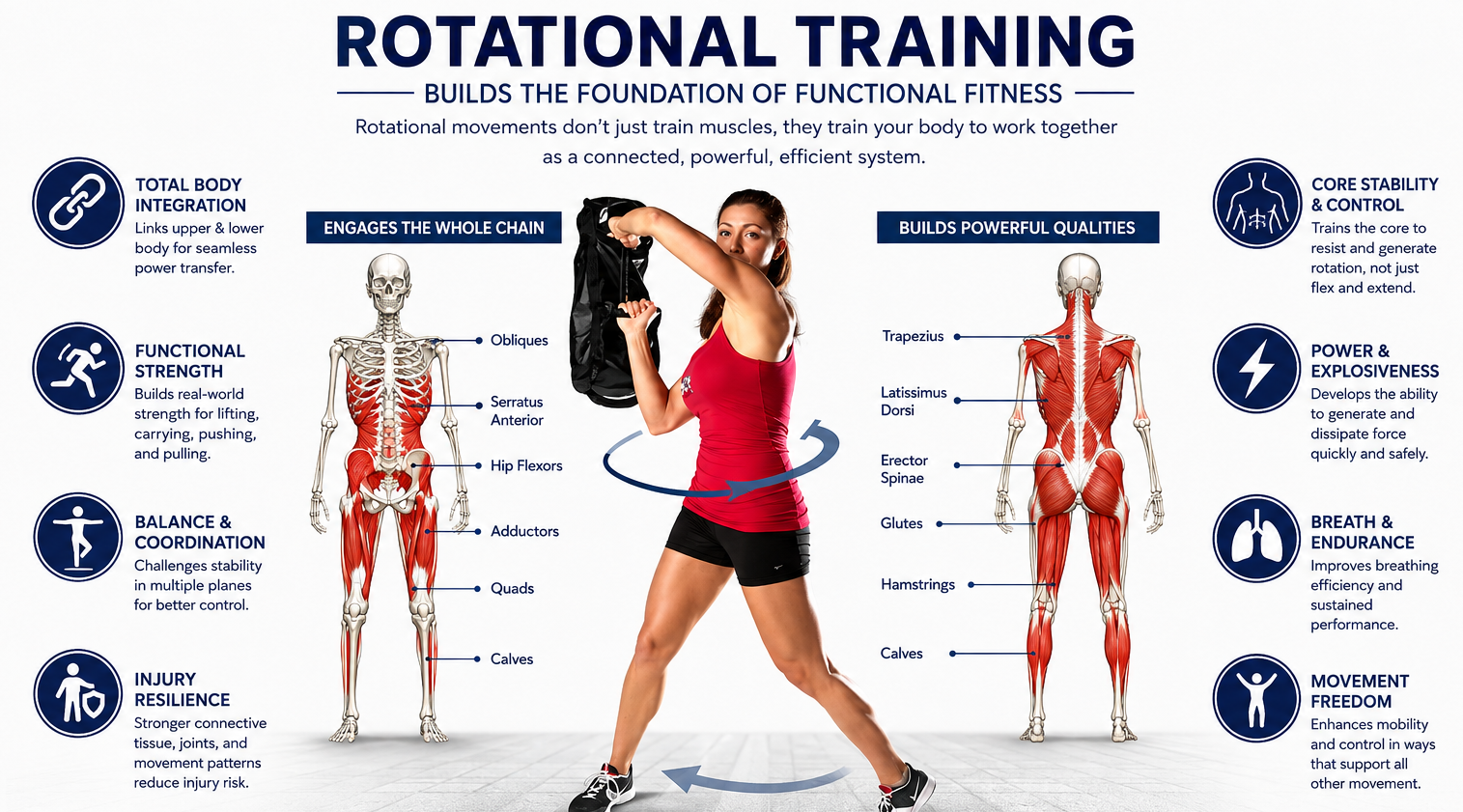
If your training never challenges rotation, you’re building strength and stability that doesn’t fully transfer to the movements your body actually performs most. Rotational training closes that gap directly, preparing your body for the diagonal, multi-planar demands of real life rather than just the sagittal-plane demands of a gym floor.
Rotation and Core Stability: A Different Kind of Core Work
Here’s something that surprises a lot of people: real core stability isn’t primarily about how much you can crunch or how long you can hold a plank. Research on core function in athletic performance defines core stability as the ability to control the position and motion of the trunk over the pelvis, allowing for optimal transfer of force through the body. Control is the key word and rotational training is one of the most direct ways to build it.
When you train rotation, your deep core muscles aren’t just bracing statically. They’re working dynamically, controlling how much rotation happens, resisting excess or unwanted movement, and managing the transfer of force between your hips and shoulders. This is a fundamentally different and far more functional kind of core training than static holds alone can provide.
View this post on Instagram
Rotation and Hip Mobility
Rotational training also has a direct relationship with hip mobility, and the connection runs in both directions. Controlled rotational movement takes the hips through ranges of motion internal and external rotation especially that most linear training never touches. Over time, this builds genuine, usable rotational hip mobility, not through passive stretching, but through active, loaded movement your hips actually have to control.
At the same time, hip mobility supports better rotational movement at the trunk. When the hips can rotate freely, the lower back doesn’t have to compensate by over-rotating to make up for what the hips can’t provide. This is a two-way relationship worth understanding: training rotation improves hip mobility, and improved hip mobility makes rotational training safer and more effective.
View this post on Instagram
Coach Greg Perlaki shows hip mobility exercises that can help our ability to produce rotation
Why Rotational Training Can Help Reduce Low Back Pain
This is where rotational training becomes especially important, not just for performance, but for long-term back health. A significant amount of low back pain is linked to poor motor control and inefficient force transfer through the trunk, not simply “weak” muscles, but a system that isn’t coordinating well under rotational demand.
When the hips can’t adequately rotate or generate force, the lumbar spine frequently absorbs that rotational demand instead exactly the kind of compensation pattern associated with chronic low back strain. Training rotation deliberately, with control, teaches the hips, core, and thoracic spine to share rotational demand appropriately, reducing the load that would otherwise concentrate at the low back.
Why Resisted Rotational Training Matters Specifically
Not all rotational training is equal, and this is a distinction worth understanding. Simply moving through rotation , twisting side to side with no resistance, challenges mobility, but it doesn’t build much genuine core control. Resisted rotational training changes that entirely.
When you add resistance to rotation it’s being forced to control that range against an external load, which is a far greater demand on the deep stabilizing muscles responsible for managing trunk position and force transfer. This resisted control is exactly what carries over into real-world rotational power: the ability to generate force through rotation while still maintaining control, rather than simply rotating freely with nothing managing that motion.
. The core control built under resistance directly improves the quality and safety of every other rotational movement you do in training, in sport, and in daily life creating a genuine feedback loop between resisted practice and better, safer, more powerful rotation everywhere else.
Learning how to control resisted rotation leads us to better core stability while also enhancing our hip mobility that leads to better rotational training exercises.
Rotational training isn’t a specialty add-on for athletes. It’s a foundational piece of functional fitness, real core stability, usable hip mobility, and long-term back health and training it with resistance, not just range of motion, is what actually builds the control your body needs to rotate safely and powerfully everywhere else in life.
Coach Cory Cripe shows how to combine essential aspects of rotation, stability, resisted rotational work and smarter training!
Save 20% on our DVRT education that explores rotation deeper like our L.I.F.T. modules HERE with code “save20”
View this post on Instagram
Featured in





© 2026 Ultimate Sandbag Training. Site by Jennifer Web Design.